Author: Sandra Gilch

  • Guitar player João Cuña passionately presents instrumental Fado in Faro

    Guitar player João Cuña passionately presents instrumental Fado in Faro

    Chapter 3: A marine biologist between ocean and stage

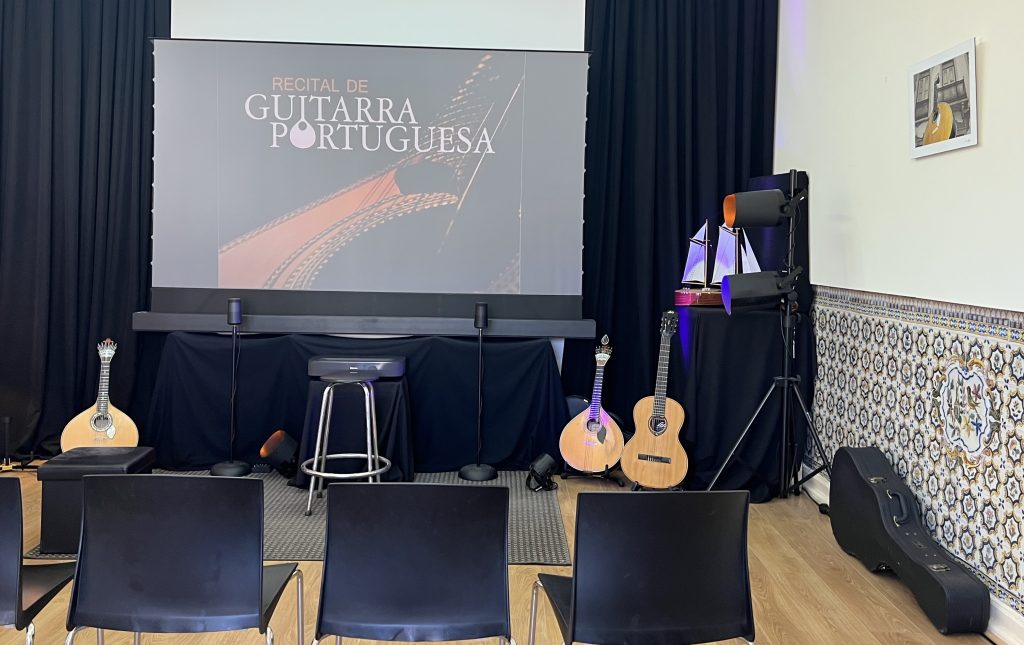
    Visitors are already sitting on the chairs in Faro’s old chapel of the pregnant virgin when João Cuña enters the room with his guitar (Well, with one of his guitars… he has 40 in total.). The musician closes the doors to his Recital de Guitarra Portuguesa, and dims the lights saying: “Please turn off the sound of your phones. No photos, no videos, in general.”

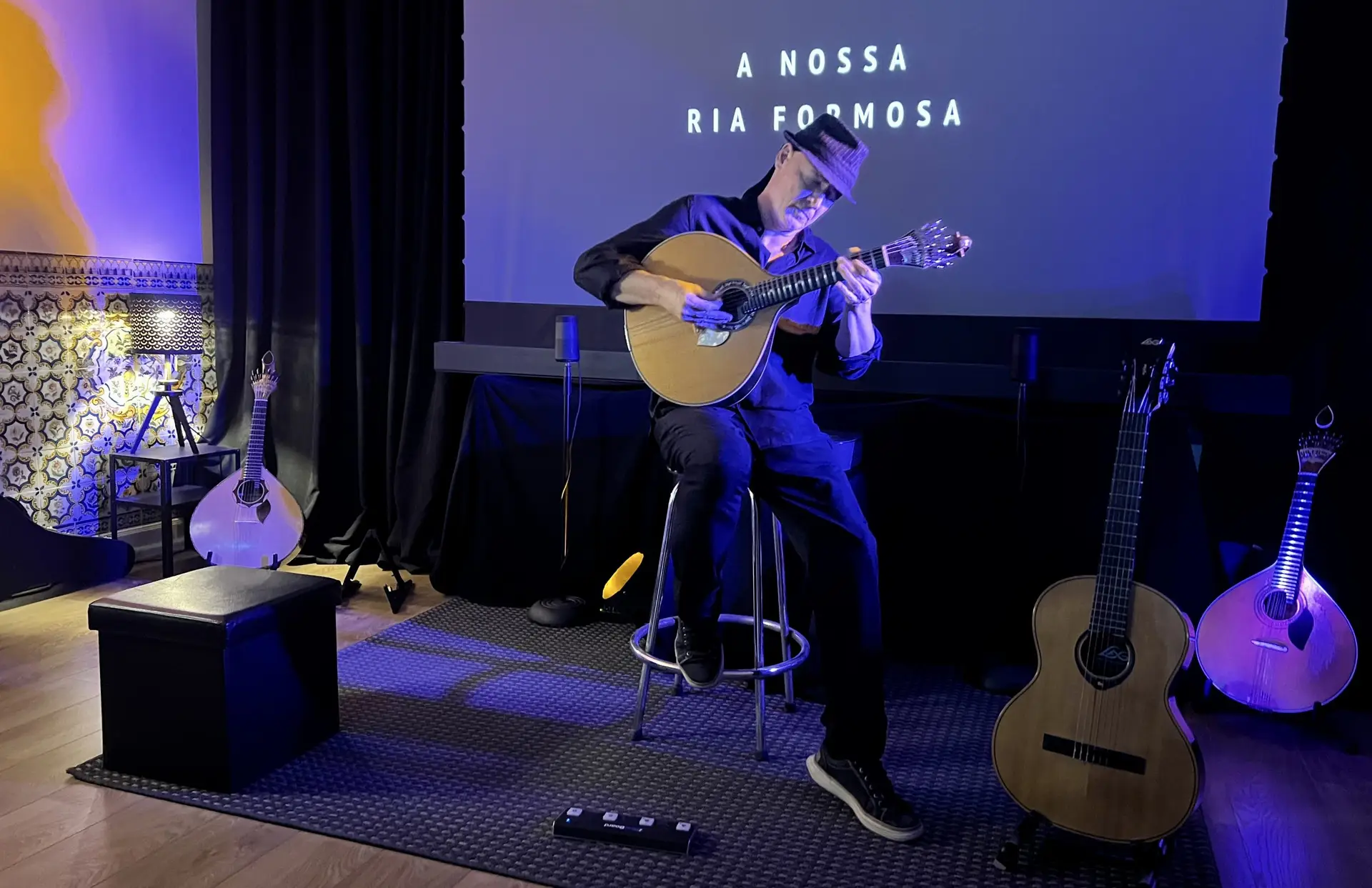
    The recital, located in the building of the tourist office of Faro, is not just like any other Fado place. The shows are created from the bottom of João Cuña’s heart, which you will feel during the shows. When he plays the guitar, all eyes in the room are on him. Only his own are shut. The rhythms and melodies seem to be found within himself, flowing through his blood. His words and his guitar sounds will guide you through a unique emotional journey. The room is small, allowing an intimate atmosphere with around five to ten people sitting in two rows of chairs.

    “Here in this small room you capture many things. You start to understand that it’s a lot of psychology. It’s not only music, it’s psychology. (…) All cultures can understand, but still it depends on the individual if one enjoys it. (…) I feel a lot if you are enjoying or not. And sometimes I react. Yes it’s the ego. Somehow I want you to be with me. I’m giving everything so at least people should listen.”1

    João Cuña

    João Cuña has friends from all around the world

    He describes his show as a mix of music, cultural knowledge and emotion. Some jokes and surprises bring the laughs out of the visitors. And laughing is something very important in music, he thinks. After each song, he talks with the audience, telling them anecdotes as for example that in Coimbra Fado, people traditionally don’t clap but instead show their appreciation through clearing their throats. João explains this usually before he plays a Coimbra Fado. The outcome is what one would expect: no clapping among the audience. Something else, that no one in the room expects, is the moment when he gives his guitar to the visitors. His shows have been experienced by over 40.000 people, his guitars travelled through 80.000 hands.
    “That’s unique. No guitar player gives his guitar to someone else. But I thought, why not? The people don’t expect it, it’s always a good surprise.”

    João Cuña

    The visitors come from different places in the world, but here, they are united for a little while of their lives.

    “I had a guy from Finland who came 10 times. I told him, why, you know everything, the jokes. He says, ‘I want to feel the emotion, I want to feel the emotion again’”

    João Cuña

    When João plays the guitar, he plays with the guitar. Moving through the room and moving his instrument is “part of the performance”, as he puts it, and also a way to convey emotions.

    “If I move with the guitar, listeners will see and also hear the guitar moving. It’s the way I play, the way I feel the music.”

    João Cuña

    Where is the fado, when there is no voice?

    João remembers a Spanish guy who came to his show who disrespectfully threw in the room that ‘Music without voice is no music!‘. He thinks that for him as a guitar player it is more difficult to touch the people emotionally, yet it is possible. “That’s the reason I play.” And with this way of playing, he even made the Spanish guy admit that instrumental music indeed is music.

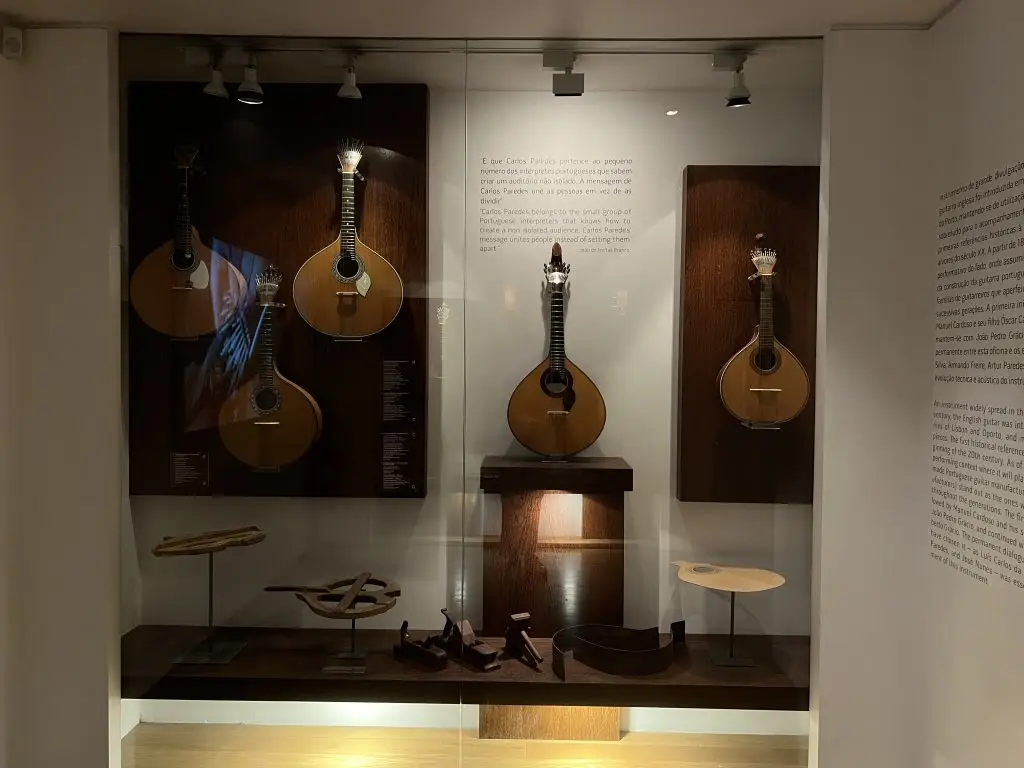
    The Portuguese guitar has existed before the fado. Thanks to its use in Lisbon Fado and Coimbra Fado it survived over the years. The instrument has become so popular that musicians use it even outside the fado genre. As there are two styles of fado, there are also two types of Portuguese guitars. Both models have 6 double strings, other than a classic guitar which only comes with 6 single strings. The Lisbon tuning is B A E B A D when listed from the highest-pitched course to the lowest.

    “The three lowest-pitched courses (D, A, B in low-to-high notation) are tuned with one string an octave apart from the other in the pair, while the three highest-pitched courses (E, A, B in low-to-high notation) are tuned in unison, meaning both strings in the pair are the same note and the same octave.”

    João Cuña

    As the expert explains, the practice of playing the pair of strings creates a full, rich sound with a “chorus effect” due to the micro differences in tension and tuning.

    “These guitars are high-tension instruments with a wide dynamic range, which enhances artistic expression. This, in conjunction with the pairs of strings being played together, allows for beautiful, soulful vibrato making the guitar almost ‘cry’ and provides a vast range of volume intensities while playing.”

    João Cuña

    The characteristic sound of the Portuguese guitar is determined by higher tonalities than other string instruments. This makes it a solist instrument, suitable for playing melodies. 

    “Of course you can play it to accompany singers, but it’s the classical guitar that plays the rhythms. It has more lower notes. The Portuguese guitar on the other hand is the solist instrument, playing the answer for the singer, the introductions, the solos. Its sound is very important and characteristic for the fado. It’s like the Spanish guitar in the flamenco, the bandonion in the tango.”

    João Cuña

    Also, the way of playing the Portuguese guitar is special: only two fingers are active.

    “The index finger plays in both directions, and the tumb plays only down strokes. All the songs being played on the Portuguese guitar are played with only two fingers in the right hand. It’s a funny thing.”

    João Cuña

    João Cuña describes differences between fado guitars

    The sound of every guitar is determined by its shape and – of course by the tuning of the strings. Only for the classical guitar, there exist over 100 tuning systems. Portuguese guitars have another tuning which can be adjusted according to the preferences of the musician. Coimbra fado guitars are equipped with thicker strings that are tuned one tone below to be more suitable for the male voice. In Coimbra fado, only Coimbra guitars are accepted. A Lisbon guitar might have some problems after many years when you tune it lower than usual. For Lisbon fado, both guitars work equally well.

    “I played many years also Lisbon Fado with Coimbra guitars tuned one tone above, so they had Lisbon guitar sounds.”

    João Cuña

    Apart from the Portuguese guitar, João has also a collection of classical acoustic guitars. He shows me his magical one that can record and repeat his playings. That makes it suitable for composing: João invents the rhythm and lets the acoustic guitar do its magic. Thus, he is able to play the melody on the Portuguese guitar simultanously.

    The musician treats his guitars like family

    As he appreciates each of them, the musician baptized them: The Portuguese guitar he currently plays on in the recital is named after his daughter ‘Rita’. But there is more to it. His “beautiful babe” is named after his wife ‘Tânia’. Then there is Mammy ‘Nanda’, which is the diminutive of his mother’s name Fernanda. And the guitar grandmammy is ‘Graciosa’, because the name of the luthier was Grácio and also because it means ‘graceful’.

    The Recital da Guitarra Portuguesa is João Cuña’s own room for Fado that he opened in 2012, guaranteeing a stable work and income. Before, he played in many different places, also in the capital Lisbon where he is originally from. Nowadays, he continues to perform on stage with Pedro Mendes and Francis Matas, just as he has since 1994, when he founded the world music trio AMAR GUITARRA.

    Combining passions: the marine biology and the music

    Already as a young boy, at the age of 12, João Cuña started learning to play the guitar. Later he has also developed a passion for the ocean and the environment, which he intensely explored with his studies in marine biology at the Universidad de Algarve. Throughout many years, he has followed these two passions, working both as a marine biologist and a musician. When he was 37, he decided to fully focus on the music. “And then I began starving”, he jokes with a wink, referring to the difficulties of financial surviving in the cultural industry. Today he is 55.

    When Covid came he had to close the recital. After a few days he thought that this would be the perfect moment to put an idea into action that he has always thought of but never really had “the time and muse to do it”. He created a proposal which was recognized and financially supported by the Portuguese government. S. A. V. E. Ria Formosa is the title of his immersive live music and video experience.

    “It’s my life musical project. I thought I have to do it before I die.” João presents 8 original compositions in 3 parts. Throughout the narrative in the video he combines ecological with personal inspirations. S. A. V. E. is a unique experience, which melts live performance with cinematic recordings of landscape and music. João Cuña would perform live the melodic response to the rhythms played in the video. Usually, in the live performance he wears black. And in the film – wandering along the beaches of the nature reserve at Ria Formosa with his guitar – he wears white. Like Yin and Yang, the Portuguese guitar and the acoustic guitar complement each other to form a harmonious whole.


    1. Quotes from my interview with João Cuña on September 23rd 2025 in Faro ↩︎
  • The Fado Museum: A mediator between tourists and musicians

    The Fado Museum: A mediator between tourists and musicians

    Chapter 2: Sara Pereira about honouring a living cultural heritage

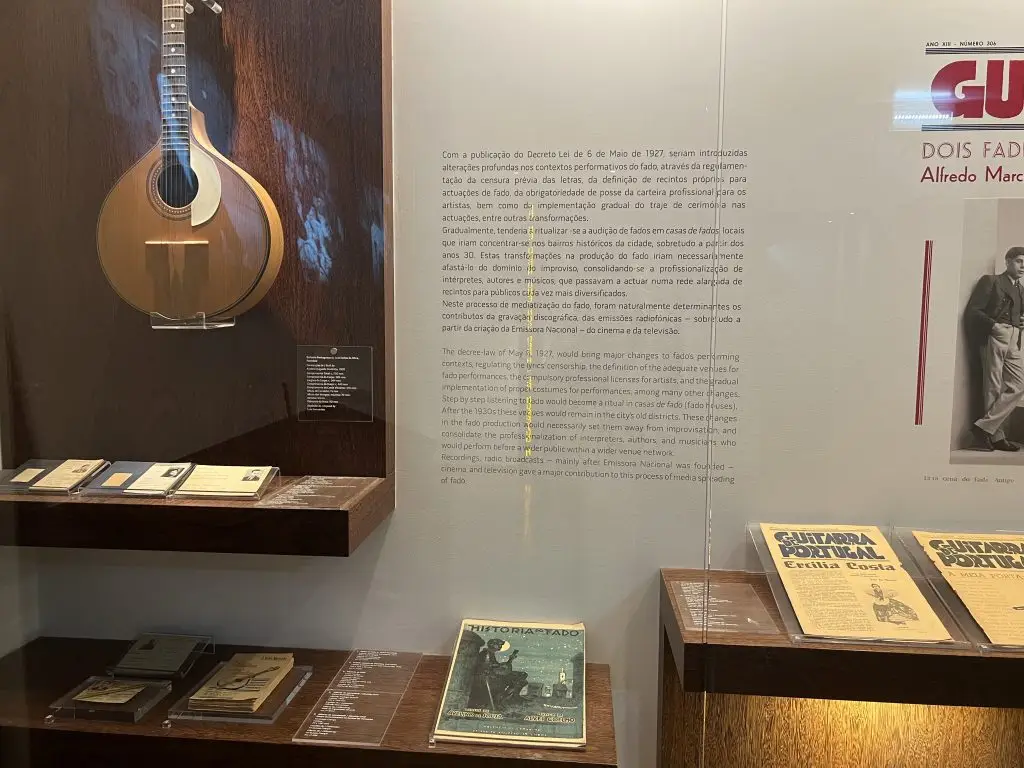
    “I would like for the Portuguese to be more aware of the past role of African culture in their own culture”, says the Portuguese music scientist Rui Vieira Nery. His research on Fado’s origins is widely used as a reference for explaining the history of Fado. Also, the exhibition in the Fado museum is taking Nery’s writings as a fundamental source of information. He links his theories about the development of Portuguese culture very closely to the nation’s colonial history. Thus, Portugal has always been forced to interact with other cultures, especially African ones. Through the connections between the colonies and African slavery in Brazil, popular dances with African roots were later brought to Portugal.

    “Afro-Brazilian dances were developed throughout the 18th century in Brazil and then were carried to Portugal, they are not ‘pure’ African music; they are already the result of a combination between African rhythms and expression with European forms and harmonies, so they are already a negotiation, and when Portuguese composers take that and try to compose in that vein, of course, there’s new negotiations.”

    Rui Vieira Nery, 20191

    It is due to its Afro-Brazilian roots that Fado was not only sung but also danced to all the way until the end of the 19th century. Throughout the last centuries, Fado has lost its choreographic character and rather focuses on the depth of lyrics, emotions and the singing.

    Museums are not just about the dead

    Considering this complex und multilayered history of Fado, it was necessary to gather all knowledge on this cultural phenomenon and make it visible for the public.

    “Lisbon City Council with the major Jean Soares in 1998 decided to open a Fado Museum to preserve, to safeguard all this heritage that was distributed. It was in the hands of the families, the artists; it was not gathered in one place and preserved and studied.”2

    Sara Pereira

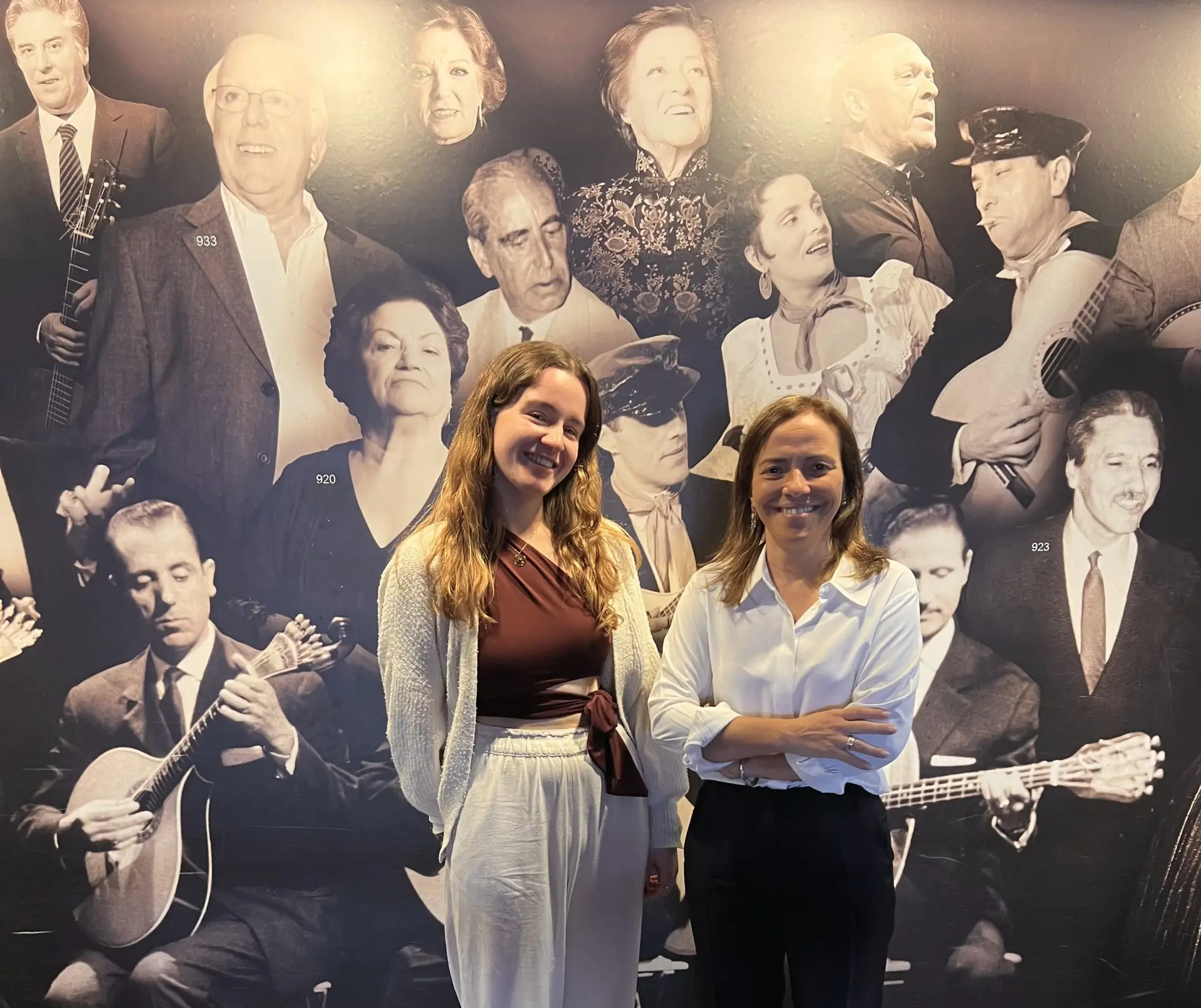
    Sara Pereira, the director of the Fado Museum has been part of it since its founding. “Unfortunately, this wasn’t my idea”, she laughs when I ask her about the museum’s beginnings. Building up a museum from zero comes with a lot of challenges.

    “The biggest challenge at the beginning was to deal with some suspicion of the artistic community because they were thinking that the museum was synonym of dead patrimony. We had to conquer their trust. And I think we did it. ”

    Sara Pereira

    To gain the artists’ trust and their support, Sara Pereira and her small team had to build a connection with them. Therefore, for one year, they went to all Fado houses across Lisbon spreading the plan of the Lisbon city council to open a Fado Museum. Through that, they “started to know people and to go deeper and deeper in this field”.

    The Fado Museum preserves a living Cultural Heritage

    After some years of existence, the Fado museum’s team started to build a plan for taking part in the nomination of Fado as a UNESCO cultural heritage.

    “We presented to UNESCO in 2010 and then UNESCO deliberated in 2011. What we presented in 2010 were all the measures that the museum was developing since 2005. All the programs, documentaries with the national television. All the inventory of the museum, all the workshops of our school, guitar lessons, all the work with the community. We had to have declarations of the community, attesting their participation in this program and their willingness to achieve this goal.”

    Sara Pereira

    The UNESCO nomination was a long process – with a happy ending, which has actually been the beginning of something even bigger. Today, all humanity carries a responsibility to preserve Fado on a national and international level. The Fado Museum is the leading operator in this preservation.

    “We have to develop all the safeguarding measures proposed. We have to guarantee that we are promoting the transmission of this tradition to younger generations; that we are keeping the community, artistic community working together with us.”

    Sara Pereira

    Fado is not just music. It’s a mutli-layered cultural phenomenon that’s fading lines between disciplinaries of arts. It unites elements of theatre, dance, poetry and philosophy.

    “One of the ideas in the safeguarding plan was precisely to explore this ability of Fado to dialogue with multiple arts and domains: with visual arts, with the cinema, with the theater, with graphic, everything. It’s much more complex than we could suppose.“

    Sara Pereira

    Putting together the diversity of Fado

    Putting this complexity into exhibitions is what the Fado Museum is continously working on for the alternating temporary exhibitions.

    Question & Answer
    How do you curate an exhibition, Sara Pereira?

    “I’m bringing together all the information available about that subject and publishing the catalogue as exhaustive as we could at that time. So, our idea was to start building knowledge about Fado, about this patrimony and about its importance throughout our history. And to also put it in relation with all the different artistical domains. Sometimes we also have celebrations of anniversarys. In partnership with the cultural government, we made an exhibition for the 100 years of work by Carlos Paredes.”

    To explain everything to the visitors, there is are well-educated experts at the museum. They give guided tours through the exhibition and are available for any questions the visitors might have.

     “The mediation team has the role of making that bridge between the contents of the exhibition and the public. Because it’s very difficult for one exhibition to reach all kinds of public. We have young people, we have older people, we have people who know deeply everything about Amália. And we have another visitor who knows nothing.”

    Sara Pereira

    Question & Answer
    As the museum’s director, how do you find the balance between the people passionate about Fado and the tourists that don’t have any background knowledge?

    “It’s a big challenge for all of us, for everyone who works in a museum and specifically in this one. Because for instance Amália, well… every Portuguese knows Amália and for us it’s a bit obvious. And then we invite curators, who know a lot about one subject. And they can write a lot and are excited to explain and to transmit everything. And that can also be a challenge because our visitors – they are not willing to read a lot.”

    The planning of the exhibitions takes much time. Therefore, Sara Pereira and her team have to work with one or two years of anticipation. This is also important in terms of collaborating with other cultural institutions that plan their schedule years ahead. For instance, when it comes to organizing Fado concerts, the museum works together with the big venue Centro Cultural de Belém, as Sara Pereira explains. “All that program has to be defined one year in advance.”

    Question & Answer
    Sara Pereira, is it right that with the exhibitions you give voice to artists of the past and with the concerts to artists of the present?

    “Yes. And we have even curated exhibitions with the participation of artists, of living artists. (…) I think this work of giving voice to them is one of the main objectives of the museum. To work together with the community, helping them.”

    The museum enriches the heritage of Fado

    In 2025, the Fado museum started organizing and recording videos under the theme Gesto do Fado (“Fado Gesture”) – a project presented by the association Access Lab. The museum already collaborated with Access Lab before, as they sometimes included a translation to Portuguese gesture language in the concerts. The new project should bring fado even closer to the deaf community.

    “It’s a beautiful project. And for all of us it was also a learning process because – I also had that misperception that deaf people can’t listen to music. It’s totally wrong. They can feel it, and they deeply appreciate it. So, all the work in process until we reach the final videos is wonderful. All the elements, they come here, they choose the lyrics first, they work on the choreography.”

    Sara Pereira

    In the first phase of the project, they recorded videos with well-known fadistas, like Ricardo Ribeiro and Camané. Right next to the singers there are artists presenting the same lyrics in gesture language. Sara Pereira points out the great and empowering impact of this project. Together with the fadista, “at the same stage there is a deaf interpreter with the exact same importance – it’s very beautiful to give them that empowerment.”

    Fado gains value, and so the museum gets bigger

    The perception and experience of Fado is evolving and so is the Fado museum. The current rooms have gotten too small to present all information and artworks that deserve to be seen by the public.

    In 2026, there will be construction works to make the exhibition space bigger: The offices of the museum’s staff, the museum shop and services will be relocated to another building. The new museum will honor the UNESCO world heritage of Fado to an even greater extent.

    “We want to incorporate more information about Amália, more information about Carlos do Carmo, more objects, more collections. More works of art, if possible.”

    Sara Pereira

    A new permanent exhibition will be created – and this shows once again that everything is changing. In all the past centuries Fado has travelled across continents and has undergone cultural and social influences. Let’s see it this way: With time, with all the changes that happened in the past and those about to happen in the future, this living cultural heritage gets richer and richer. Day by day. Song by song.


    1. Hoyt, S. (2019). Rui Vieira Nery interviewed by Satch Hoyt, Lisbon, 2019. In Afro-Sonic Mapping. Retrieved from https://afrosonicmapping.com/rui-vieira-nery-interview/ ↩︎
    2. Quotes from my Interview with Sara Pereira on 23rd October 2025 in Lisbon ↩︎
  • Fado in Portugal: How and why it attracts so many tourists

    Fado in Portugal: How and why it attracts so many tourists

    Chapter 1: Tourism beyond the beach waves

    What does it take to be Europe’s Leading Tourist Destination? It may be stunning landscapes, endless beaches with Atlantic waves or cultural and historical richness – Portugal has it all. In 2025 the country has been voted Europe’s top destination. On top of that the World Travel Awards 2025 honor Lisbon as Europe’s Leading City Break Destination and the magical Porto receives the title of Europe’s Leading City Destination.1 What’s the secret behind this success? To be one as a culture, it is important to have something to be proud of. Something that makes everyone smile when they hear the word – without any doubt, in Portugal, this thing is the unique FADO.

    Does Fado unite all touristic places across Portugal?

    Not every tourist knows about it before they go there, though during their stay in Lisbon it will almost be impossible to not get to know the melancholic, sometimes dramatic Fado sounds.

    It is normal that there are tourists visiting a foreign country without any expectation or knowledge about its culture. At the same time there are travellers who inform themselves beforehand about the places they go, thus setting some kind of expectation or objectives for their stay.

    Tourists searching Fado, Fado searching tourists

    People travelling to Algarve in the South of Portugal usually don’t go there with the intention to experience Fado, but rather to enjoy beaches and waves. However, there are places in the region that may give you a glimpse of the Fado universe. As I started my travels in Faro at Algarve, I experienced my first Fado night outside the capital Lisbon. And still, I could feel the city’s magic illuminating the restaurant.

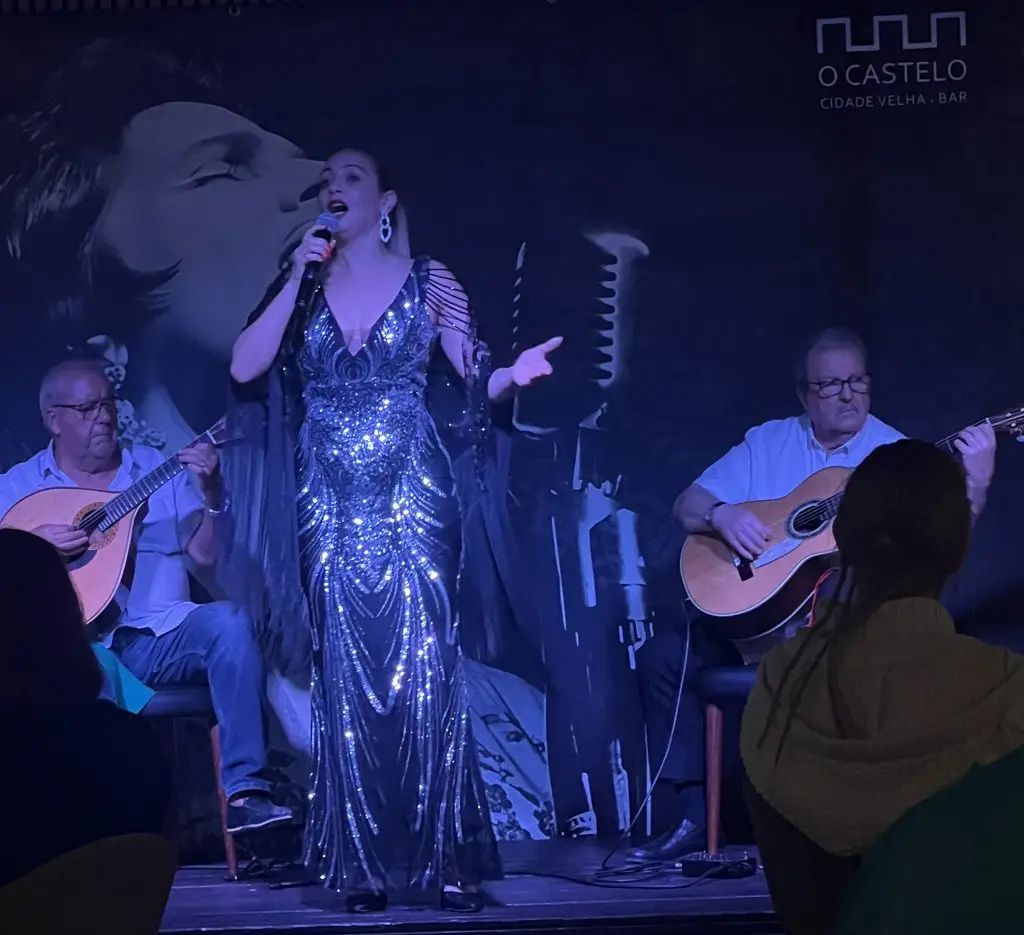
    Every night, O Castelo presents excellent music to their guests. From Mondays to Thursdays the Fado nights transform the restaurant into a hall for soulful traditional music. I go there on a Monday, assuming that there won’t be a lot of people. Well… When I ask for a place for me without having made a reservation before, the waiter looks sceptically at me. “Do you want dinner?” he asks. I said, “I would be fine with a drink”. I thought that would make it easier to get a table. He retorts that “fado is only possible with dinner”. Luckily he seems to like me, as he looks for a place to get me seated. Leading me to a table on the terrace, he notes that we will find one inside as soon as someone leaves.

    Fado restaurants are full, even on Mondays

    I started to like my view from outside. I saw the musicians coming to stage, starting to tune their guitars. One of them with a Portuguese, the other with an acoustic guitar. The speaker outside transferred the music from inside to the terrace. While I was looking, the man comes again to my table. “Hello, follow me please”, he says, grabbing my wine glass in an elegant way. I follow him.

    From a table in the middle of the room I will watch this fado night – and I have a pretty good view to the artists’ table. The female fadista is clearly recognizable by her festive dress. I feel somehow an emotional distance toward her, which dissolves as soon as she starts talking on stage: Helena Candeias opens the night and welcomes all guests in different languages. From Portuguese to Spanish, English and French. With her black glittering dress and the cloth around her shoulders she is a great appearance. And she seems to get even greater when she opens her voice to singing.

    Fado makes souls dance

    She animates us to sing with her, in the “international language” that everyone knows and understands. It is the lyrics lalala.

    She comes down and walks elegantly through the rows. I look at her very consciously until she reaches my table. She stays a moment, looks into my eyes while she is singing. Alternatingly she animates everyone to either clap or sing lalala – with success: the guests in the O Castelo are happily interacting with her. After a few fado classics, she leaves the stage. Later Helena goes through the tables to talk with the remaining guests. The restaurant has slowly gotten empty.

    Lisbon: The center of Fado in Portugal

    Fado is very closely bond to Portugal, especially to its capital Lisbon. At that Fado night in Faro, the artists carried with them a kind of a longing towards Lisbon. The deep connection exists as it has been played there since its beginnings. Also, many songs refer with their lyrics to places in and around the Portuguese capital city. All the people in the restaurant knew that they were far from Lisbon, which adds even more emotion, more saudade to the Fado night.

    Nevertheless, to fully experience the Fado universe in Portugal, one needs to go to Lisbon. And so, I did.

    Walking through the oldtown of Lisbon, the bairro of Alfama, one will see and hear Fado in every corner. During the day, you will already see the tables announcing “the most authentic Fado night” everywhere. At night, it will feel different. Every now and then you see a guitarist in front of a restaurant, Fado singers disguised as normal humans. In Alfama, almost every restaurant plays fado. You don’t have to look for it.

    Fado in Portugal as a national symbol

    Being associated with a specific music genre is very often turned into a key instrument in promoting that place as a tourist destination: apart from Fado’s Lisbon we have cities like the Tango’s Buenos Aires, Samba’s Rio de Janeiro, Folk-music’s Dublin. Characteristic sounds define those places – and thereby create their very own “soundscape”.2 Even when we know that fado is unconditionally linked to Lisbon, you will need to look for it to find good fado. At the same time, Fado will be looking for you.

    With all the offers, some very touristically and others more authentic, it is almost a challenge to find oneself the best place for a magic Fado night. You won’t find fado houses all over the city, but you will find them all over Fado hotspots Alfama and Bairro Alto. When I walk through the circled alleys of Alfama, I can hear fado sung from different directions. Sometimes, it makes me stop for a moment and think about where the sounds come from.

    Fado as a living cultural heritage in Portugal

    The value of the Portuguese music genre (which is much more than just music) can be felt in the streets, in the Fado houses, between a singer and a listener. To officially recognize this emotionally and cultural significant value the UNESCO International Commitee incorporated Fado in the 2011 Representative list of the Intangible Cultural Heritage of Humanity. This decision has been reasoned with the following three criteria.3

    1: Fado strengthens the feeling of belonging and identity within the community of Lisbon.

    2: (Fado’s inclusion in) the Representative List could contribute to further interaction with other musical genres, (…) encouraging intercultural dialogue.

    3: Safeguarding measures reflect the combined efforts and commitment of the bearers, local communities, the Fado Museum, (and) the Ministry of Culture, as well as other local and national authorities, and aim at long-term safeguarding through educational programmes, research, publications, performances, seminars and workshops.

    Appearing on the list of Intangible Cultural Heritage defines Fado as a cultural phenomenon that is of value to all humanity, and that responsibility for its management goes beyond its nation of origin. The Fado museum has launched a protection plan. It includes the involvement of civil society, fostering education, promoting research, energizing traditional venues and taking actions to promote Fado at an international level.


    1. Tourism of Portugal (2025, October 23). Portugal voted Europe’s Best Destination in 2025 at the World Travel Awards. Turismo de Portugal. https://www.turismodeportugal.pt/en/Noticias/Pages/portugal-melhor-destino-europa-2025-wta.aspx ↩︎
    2. Zarrilli, L. (2022). LISBON’S FADO SOUNDSCAPE: BETWEEN IDENTITY AND TOURISM. GeoJournal of Tourism and Geosites, 41(2), 517–522. https://doi.org/10.30892/gtg.41224-858 ↩︎
    3. Henriques, C. H. N. (2016). Lisbon Fado as Heritage of Humanity: Interconnections with Tourism. In C. Henriques, M. C. Moreira & P. A. B. César (Eds.), Tourism and History – World Heritage: Case Studies of Ibero-American Space (pp. 383–406). CICS-NOVA. ↩︎