Author: Sandra Gilch

  • Sandra Correia carries the soul of Alfama to ‘Fado Português’ in Porto

    Sandra Correia carries the soul of Alfama to ‘Fado Português’ in Porto

    Chapter 13: Home is a feeling and so is Fado

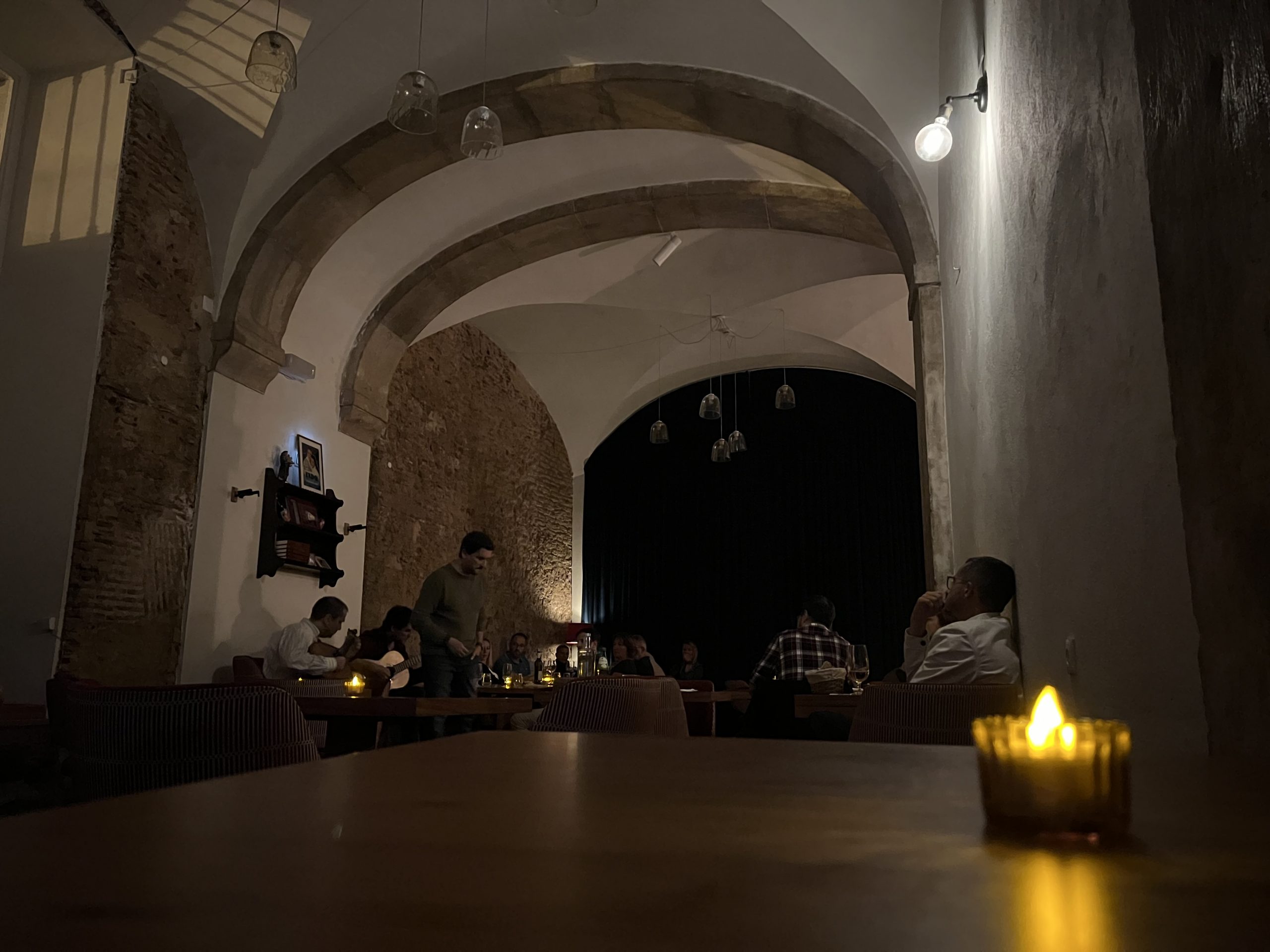
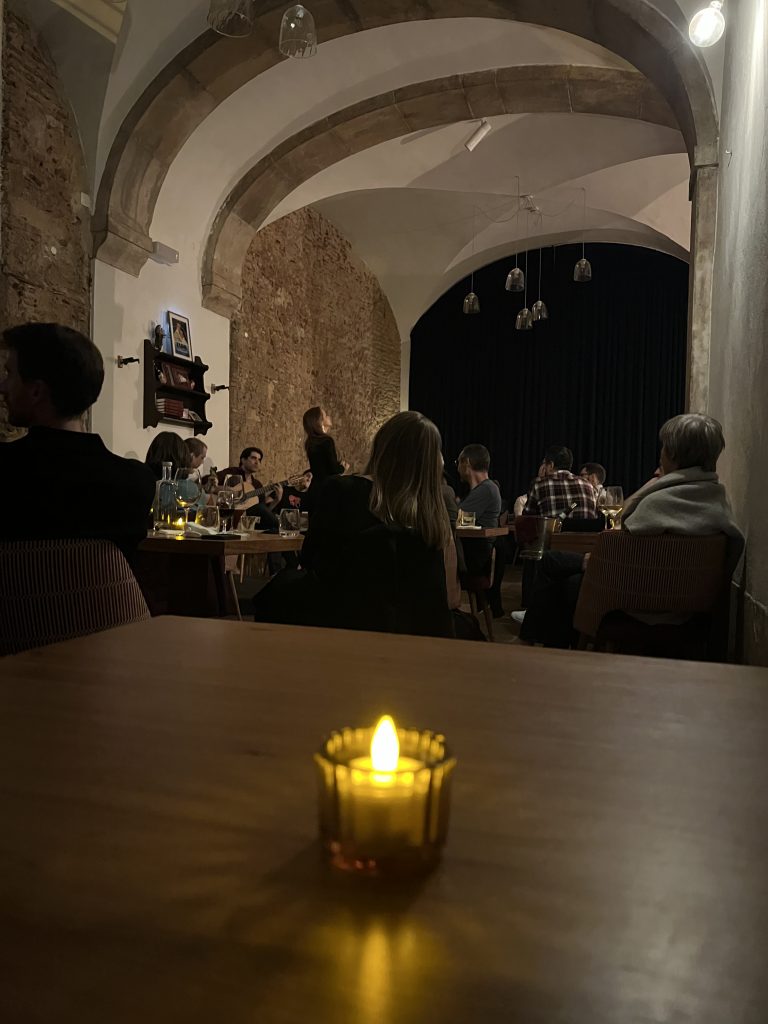
    It’s a windy Thursday night in October when I walk through the streets of Porto with a clear destination: the restaurant Fado PortuguêsThere are some Fado houses in the center of Porto, but I choose this one and only Fado house at the other side of the river, in Vila Nova de Gaia. The restaurant was founded in 2021 by Sandra Correia, a renowned Fado singer. She started singing professionally at the age of 16 – since then, she has amazed audiences with her voice in many countries and of course in the Fado houses of the capital Lisbon.

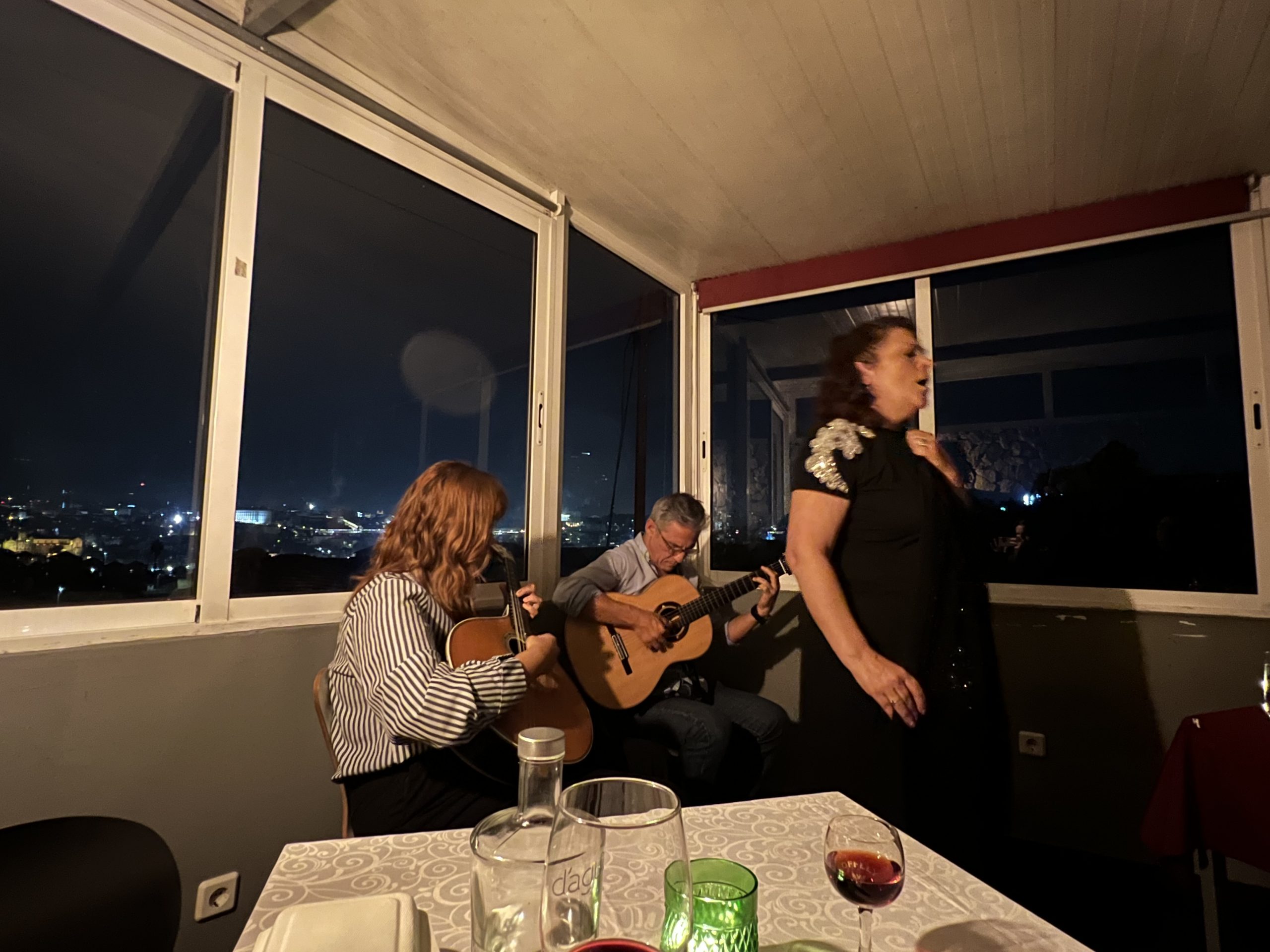
    Going into the restaurant warms me not only physically but also emotionally. Sandra Correia welcomes me kindly and points me to the second room of the restaurant, where tonight’s dinner show will be presented. Today, there are less guests than usual, so the front area of the restaurant is left free, and everyone can enjoy their evening with a magnificent view over Porto. The room is fully framed with floor-to-ceiling windows, the bridge lights glitter on the seemingly far horizon. They are reflected in the Douro River, that gently bends to the right and finally disappears in the dark. 

    “You won’t be able to explain it, but you will want to hear it again.” 

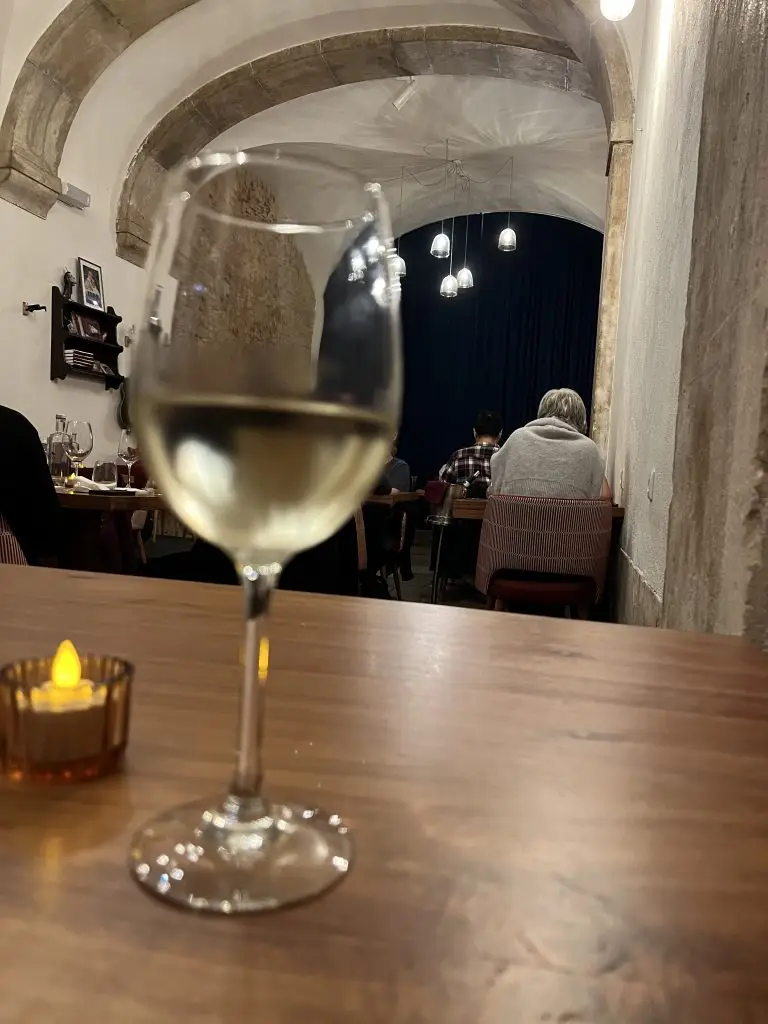
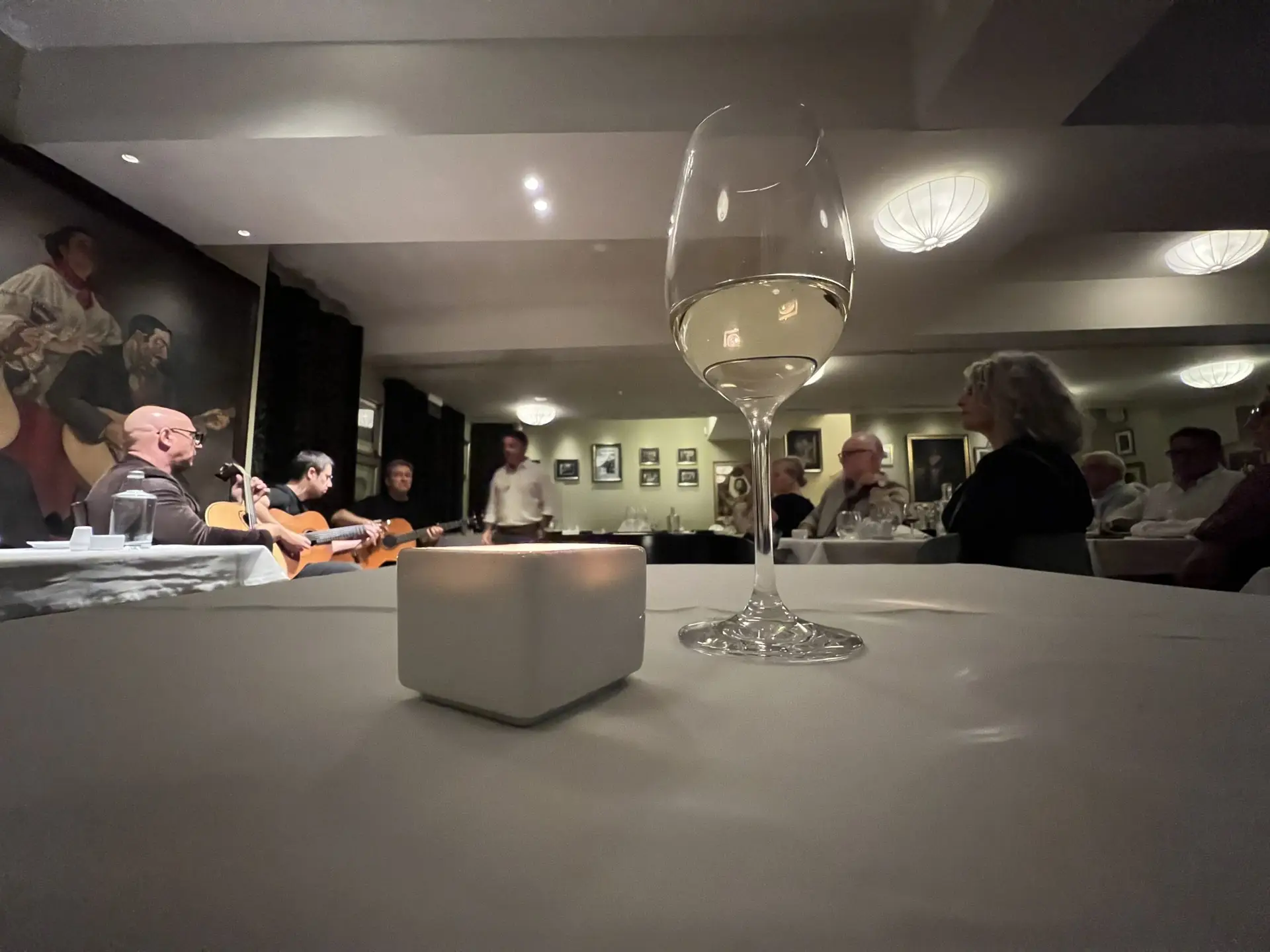
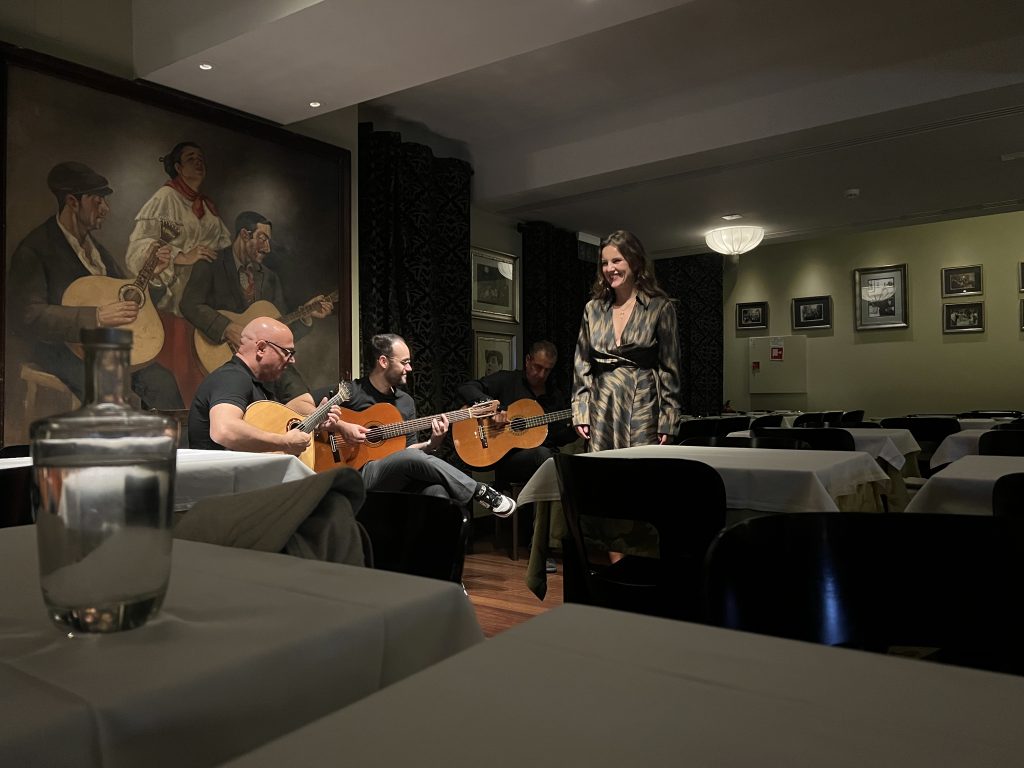
    The atmosphere in the room is intimate and it seems more silent than in Lisbon Fado houses. I sit down and get a glass of red wine. A man walks from table to table. It’s João Costa Menezes, who has worked as a producer for many years. He gets to know the guests and introduces them some facts about the restaurant. If I hear it right, I am part of an audience with a Portuguese couple, another two Portuguese friends and an US-American group, who have never listened to Fado before.

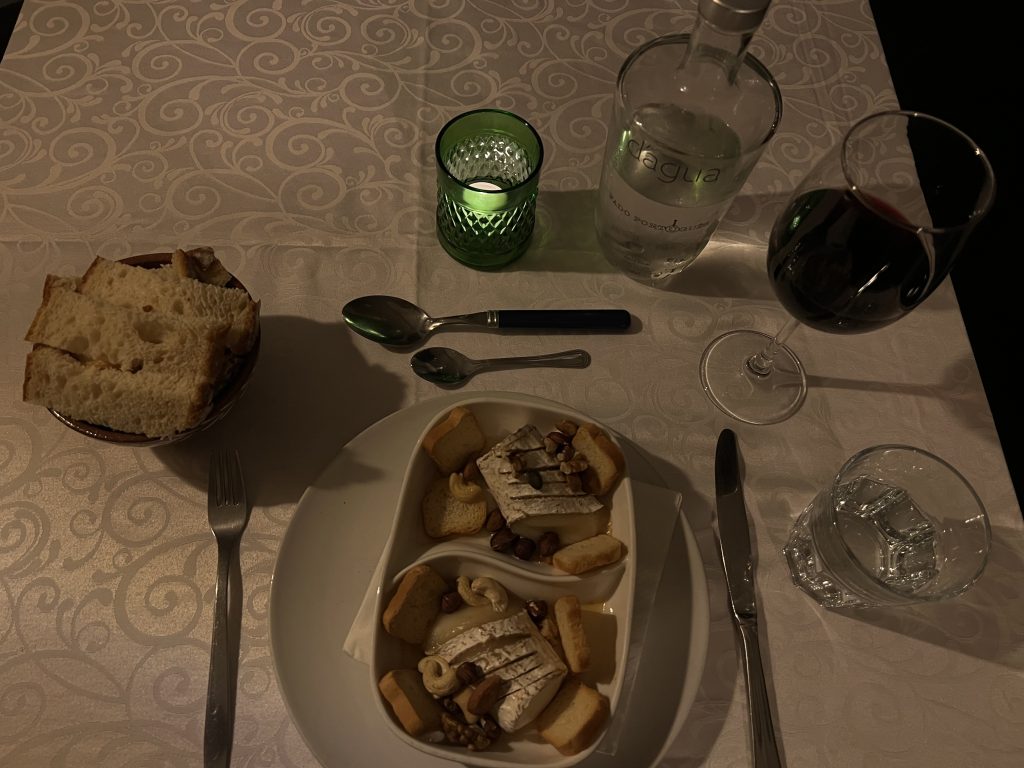
    At 21.05h João lights the candles, “they are getting ready” he whispers to me, referring do the musicians. Do I look impatient?, I think to myself, because yes, I am. Before the first live set is played, starters are being served. The delicious goat cheese with honey and walnuts prepares me well for the exquisite Fado presentation. 

    Three courses, three sets of Fado

    After some minutes, João steps to the front to present some introductory information about Fado. He describes how Fado spread through the streets and taverns, where people started singing spontaneously – today known as fado vadio. “The base for Fado are poems, singers interpret these poems and the Portuguese guitar answers to the singer’s melody.” Then, he makes the space free for the musicians. 
    Surprisingly, today’s Portuguese guitar player is female, which is very unusual. Sandra Cristina is the first singer – with her blond hair and knee-long pink dress her appearance kind of falls out of the typical fadista image I had until then. She sings a quick and expressive Fado. I look to the table next to mine, where one of the two Portuguese men looks towards the singer with tears in his eyes. For me, it takes some minutes to connect with her voice and way of singing. The longer she sings, the more I like it. 

    As I sit there, surrounded by warm people and soulful music, looking at the night views over Porto, drinking an excellent sip of red wine, having another taste of the warm goat cheese – it feels like the best place I could be in that moment.

    Before the next set, main dishes are served – I get some couscous with roasted vegetables. 

    Eyes bring us closer to each other

    With the next singer I connect right from the first moment I see her. Mia Morgado holds intense eye contact with the guests in the room. When she looks at me, it feels like she looks into my soul and I into hers. I tell her after the set how much I liked that, and she explains to me that she does it intentionally.

    “Many Fado singers close their eyes, which makes them seem very deep inside the song, inside themselves, inside their souls”

    Mia Morgado

    However, for Mia, a part of carrying these emotions to the audience, is looking right into their eyes.

    “Now it’s getting epic, she’s one of the best Fado singers of the country.” Mia says about the restaurant owner, who will be the third and last singer of the night. Dessert is now served on the tables. I find the way back to my seat. 
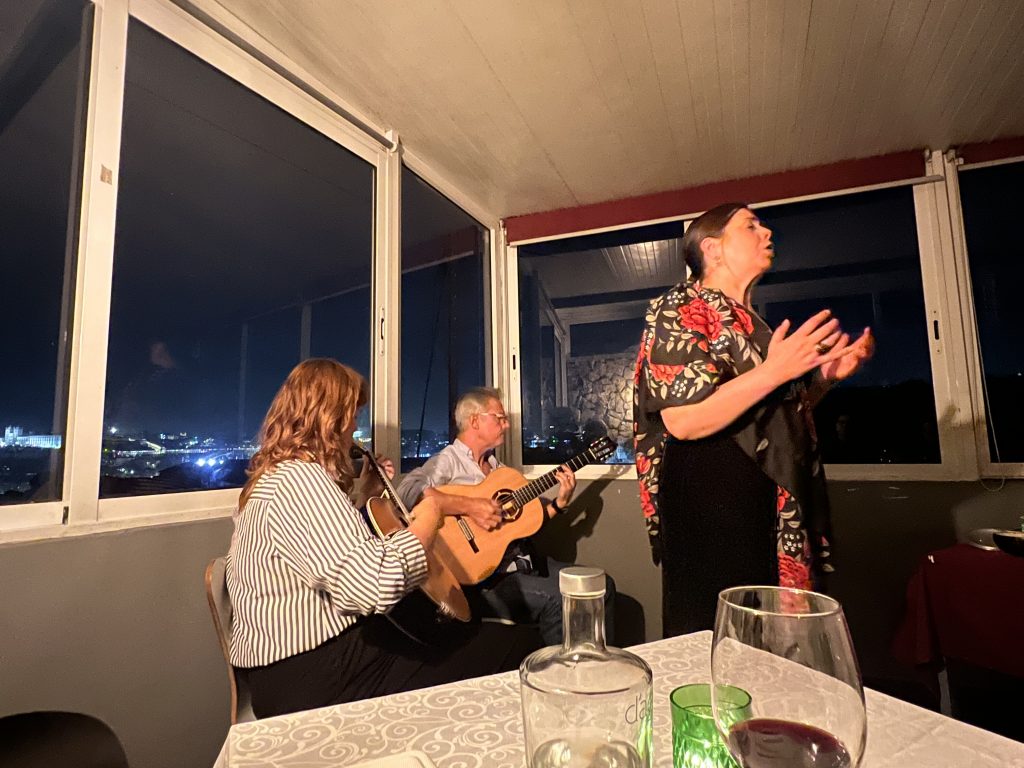
    Sandra Correia starts singing expressively while she slowly walks to the front of the room. She has the unique power of captivating the audience; even in the moments she doesn’t sing. When she stands in the front and closes her eyes, I am with her. She feeds my soul with so much emotion, from sadness to joy and love. I feel an enormous gratitude for experiencing this with her. Suddenly, a voice from the back joins her, it’s Sandra Cristina, the first singer of the evening. And then Mia Morgado follows them both. Together they create a powerful voice trio that echoes across all corners of the restaurant.

    “Fado cannot be explained, it must be felt” is the spirit of this restaurant. And once you have been there to experience it, you will realize how much truth lies in that phrase. It starts from the perspective of the singers who intuitively decide on their song choice. As Sandra Correia puts it: 

    “I have a lot of experience. I feel the people in the room, my feeling in the moment and then I know what I would sing.” 

    Sandra Correia

    Fado singers feel the energy in the room they sing

    An interplay of feelings of the present moment determines the music that is played. Sandra Correia played for many years in the fado houses of Lisbon, for example at Club de Fado. She gets nostalgic when she thinks of that time. “Alfama is my home” she says with a smile, and “here in this fado house I also carry with me all the places I sang in”. She is proud of having created this space for herself and for everyone else. When I ask her whether it feels different to sing in Porto than in Alfama, where she used to be surrounded by many other fado houses, she looks around in her restaurant and realizes:

    “This place brings the soul of Alfama to Porto.” 

    Sandra Correia

    Lisbon is magical and so is this incredible view over Porto. Now, she is not anymore singing in her ‘home’ Alfama. Instead, she is in her home region, close to her parents. “I visit them every day, and I’m very thankful that it’s possible”.

    Fado, a feeling of home

    Together with João Costa Menezes as the manager, Sandra Correia is at her restaurant every evening. Sometimes, she plays concerts in other places. But mostly, she amazes the guests in her own space at Fado Português. João is there to build the connection with the each of the visitors; he answers their questions and talks with them about where they are from and whether they experienced Fado before. He tells me that every night he adapts to what he feels among the audience – sometimes he explains more and sometimes less backgrounds about Fado. 
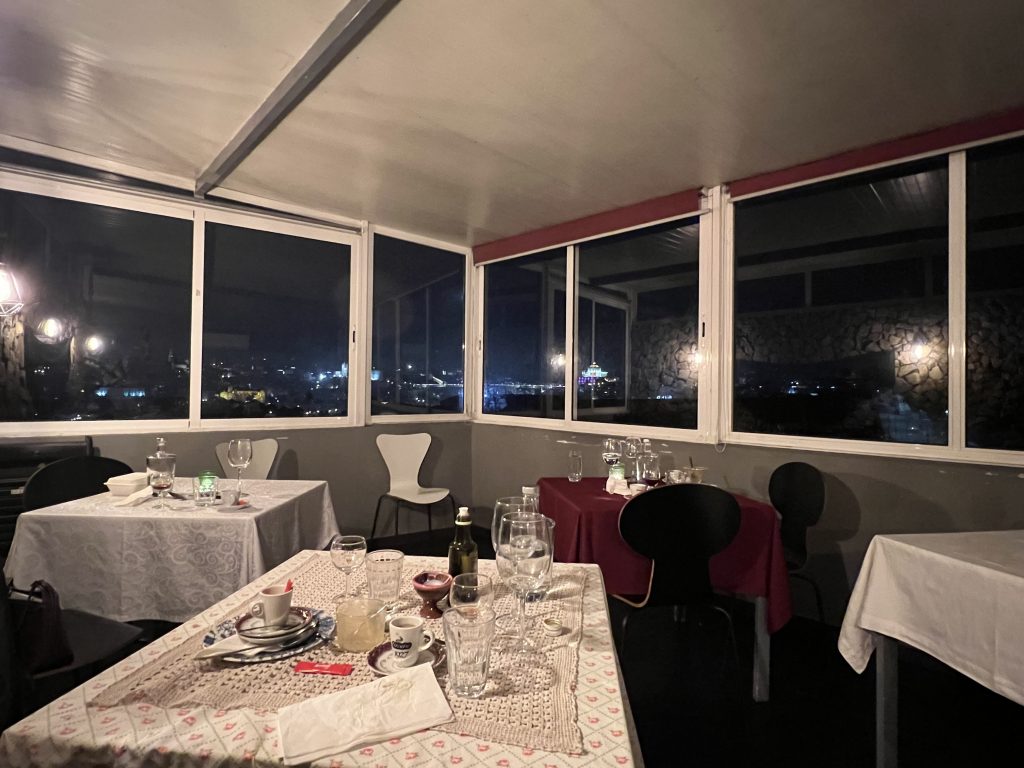
    When I mention my impression of the Fado offer in Porto, João agrees with my observation that there are many more “touristic Fado shows” than traditional Fado houses. He states that “the daily fado shows kill the Fado houses. It happens in Porto and will probably happen in Lisbon.” Whatever happened or will happen, Fado is alive. And at Fado Português in Porto, it awakens at night.
  • All across Portugal: Live Fado for tourists in historic venues

    All across Portugal: Live Fado for tourists in historic venues

    Chapter 12: Fado shows outside the restaurants

    Apart from traditional Fado houses there is another, more modern version of Fado experiences. From Algarve over Lisbon to Porto – the touristic Fado shows in historic venues have spreaded all across Portugal. Though shows are sung by authentic fadistas, the Fado experience is different from a dinner night at a restaurant.

    In Alfama, close to the Fado houses, Fado e Fado offers daily shows in a historic venue. The venue is hidden in the basement of a building with symmetrically impressing bows on the ceilings. I get to sit in the first row chairs; next to me I hear Germans speculating about the two chairs on stage. “Will the singers sit down?“ – the other one retorts “but I thought it’s only one singer?” 

    Fado lessons for tourists

    I explained them that the chairs are for the guitar players, one will play the Portuguese and the other the acoustic guitar. They are fascinated by my knowledge, asking more and more questions. Lucky them – before the show starts, a woman explains all basics of the Fado music to the tourists in the room. The ‘lesson’ begins with some bits of the origins of Fado. It moves on to the characteristics of traditional Fados and the different kinds of guitars.

    An elderly male fadista opens the concert. Then he announces “the beautiful Nadine” to stage. In the end, they even sing a duet together and are honored with a huge applause from the audience. The atmosphere in the room is different in comparison to Fado restaurants. People sit in rows, as you would expect it from a small concert venue. The show is fully booked on this Saturday night of October. 

    At the Fado e Fado experience singers will explain the gist of a song to the visitors. When I talk to the singer Nadine after the show, she tells me that this is especially important for her. “It makes it easier for listeners to connect with the feelings in the song”, she states. Nadine also thinks that the setting makes it easier for guests to focus on the music. In restaurants they may sometimes be distracted by the food, which distracts her when she sings. 

    Fado shows beneath the ground

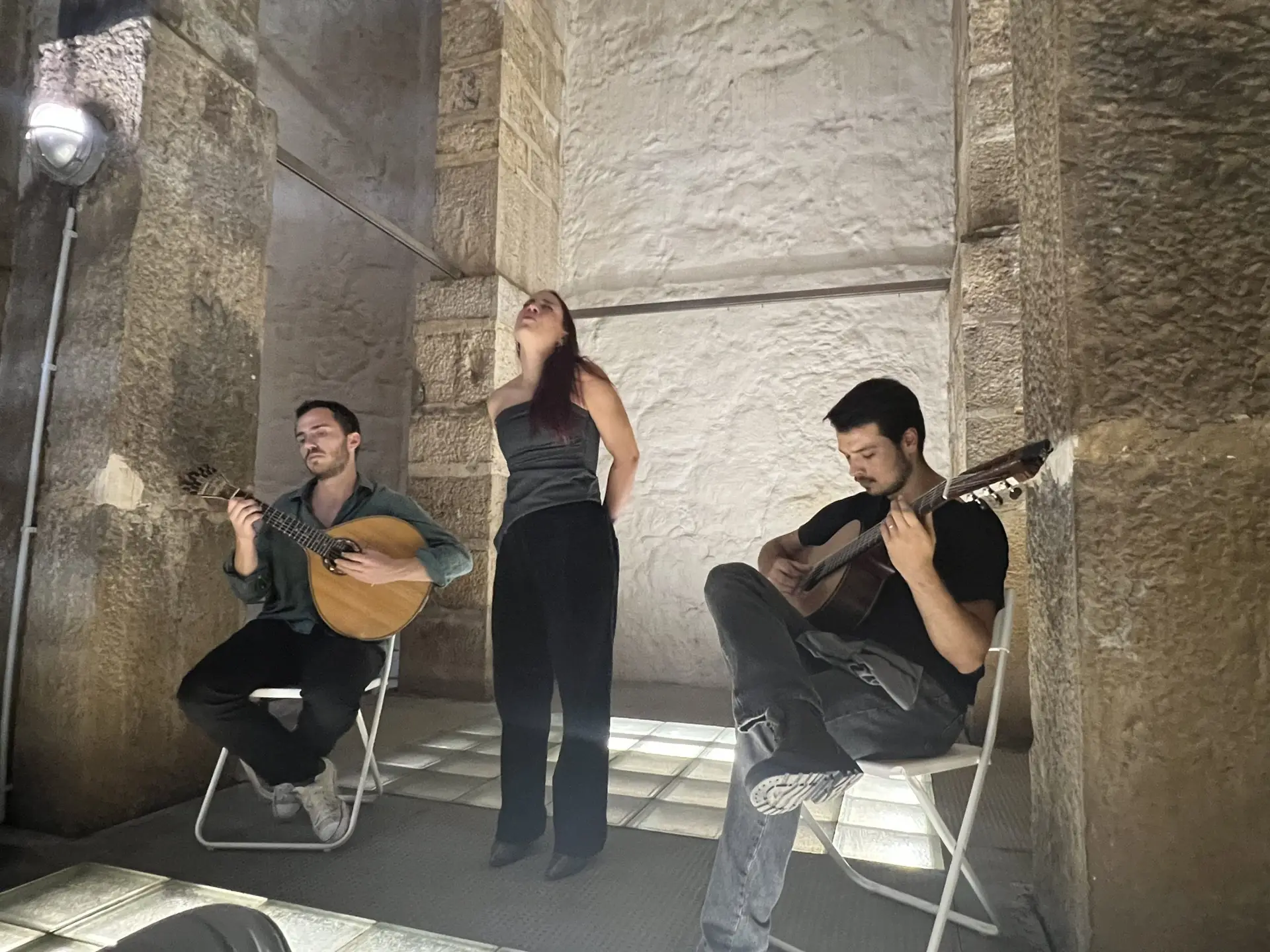
    We move on to the next modern Fado place, located in the middle of Jardim do Príncipe Real in Lisbon. Real Fado Concerts has turned a 19th century underground water reservoir into a Fado concert room. The Reservatório da Patriarchal has no windows, and is hidden from the surrounding world. Next to the playground of the park, organizers of the show will lead you downstairs. Stepping into the natural venue of stones and bows feels like entering a secret space of the city.

    A few minutes after 19h the musicians come to the front – two young men. They start with an instrumental, then, kind of surprisingly, a soft voice joins them on their song. Filipa Biscia opens the show with Fadista Loca and then continues with Saudade de lo bem. She enchants everyone in the room with her fine and precise voice. My gaze goes from her to the acoustic guitar, to her, to the Portuguese guitar and all the way back. The trio fits well together. 

    Filipa explains the importance of the feeling saudade in Fado. She also makes clear, that in traditional Fados the singers can choose the poems they would sing. The poem she would sing now is: “I love your eyes. But I love mine even more. Because if it weren’t my eyes. I couldn’t see yours”. 

    The show continues with famous classics: “Strange way of life”, which, as Filipa presents, was written by Amália Rodrigues and originally sung by Alfredo Marceinero – two names in the history of Fado that everybody must know. Another traditional Portuguese song “Lisboa a Noite” that is usually played at the parade around St. Anthony in June. 

    Tourists show their enthusiasm about Fado

    When the musicians take a short break, I listen to the conversation of excitement between a man and a woman next to me. I can only get some bits of it.

    she has such a quiet voice it’s beautiful‘ – ‘the end of a line always drops, do you notice?‘ – ‘I love that guitar‘ – ‘I saw he only plays with two fingers‘ – ‘It looks like he two strings in one‘ – ‘They are singing to someone who is gone

    The show continues with a beautifully played instrumental. Both guitar players seem excellent for their age. I wonder that with the experience they will gain in the future they will get even better from day to day or if at some point, they will reach the top of their talent-mountain. Filipa finishes the show with the beautiful gesture of shaking hands with everyone – singing “Ola, muito obrigada!”.

    Where architectural and vocal miracles meet

    Tavira is a little town in the South of Portugal. I take a train from Faro to get there. From the train station I walk towards the location of Fado com História, close to the river. The beautiful concert venue Igreja de Misericórdia is somewhat hidden in a side street. On the right side of the church there is the auditorium, where usually one of the two daily concerts by Fado com História takes place. The auditorium is a small and intimate hall, with a living room kind of feeling. Pictures on the walls and chairs in rows, Fado music on playback echoes onto the small alleys outside.

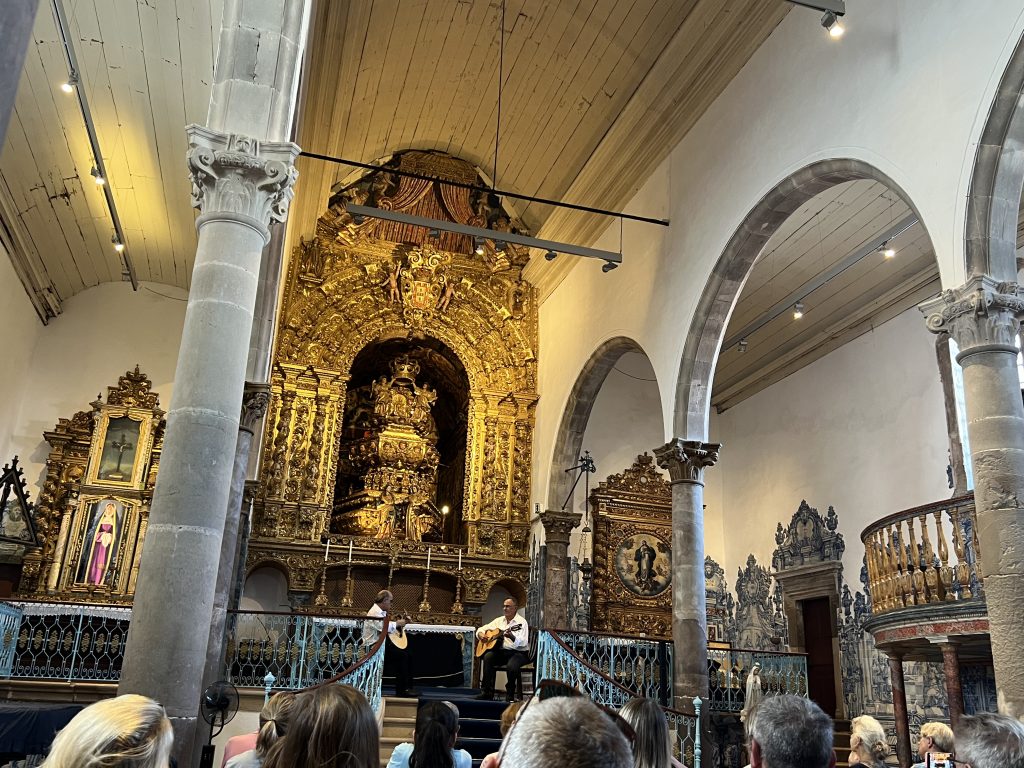
    “Today both presentations are in the church, because we have a big group coming”, Vírgílio Lança, host of the shows and acoustic guitar player tells me. I am happy about that, because I was even more excited to see the interior of the church and to hear the singer’s voices echoing in the big hall. And I don’t get disappointed: Benches are filled with people from front to back, from left to right. The high ceiling of the Renaissance building is supported by eight columns – a set of blue and white tiles from the 18th century decorate the walls. 

    Surrounded by tourists, tourists, and tourists

    The two guitar players come towards the front of the church, they take the stairs up to the altar and sit down on the prepared chairs – Giuseppe on the Portuguese guitar and Vírgílio, the host, on the acoustic guitar. After fixing some issues with the microphone, Vírgílio Lança welcomes everyone. “Temos Portuguesa?”– silence. “No Portuguese people”, he detects. So, he continues his introduction about the importance of Fado for Portuguese culture in English, and then also in French. 

    They start playing an instrumental, the pace of the song lets their fingers move quickly. Some delayed visitors sneak themselves into the church. After giving the audience a great first impression of the magic Fado guitar sounds, the host introduces today’s singer: “She is beautiful and has a powerful voice, but above all, she sings with her heart – Helena Candeias!” I remember Helena’s uniquely energetic and emotional powerful voice from my first Fado night at O Castelo; when she sings, I cannot take my eyes of her. Because she doesn’t just sing with her voice, but with her whole body. 

    Operatic voice, traditional Fado

    She starts with a traditional Fado, which are “the most important ones”, as Vírgílio explains. “The musicality of a traditional Fado is always the same”, he goes on, “the singer chooses the lyrics without the musicians knowing about it”. Within the evolution of Fado, the musical foundation of the Fados hasn’t changed a lot. However, the lyrics are composed in a new way to fit to the old traditional melodies.

    With Maria Lisboa Helena sings her soul out, holds tones until the infinite that echo into the upper corners of the church. She continues her show with April in Portugal, one of the most famous Portuguese songs: the first original release has been followed by 1000 official recorded versions.

    At the end of the show, I talk to Helena and share my fascination about her powerful voice echoing into every corner of the church, even without a microphone. Helena tells me that in the church, they normally sing with microphone. But on that day, Vírgílio Lança had the idea to sing without microphone and eventually he got to persuade her. Lucky audience.

  • Amália Rodrigues’ house museum tells the stories of an iconic lifetime

    Amália Rodrigues’ house museum tells the stories of an iconic lifetime

    Chapter 11: Welcome to the Fado Queen’s home!

    “I came into life singing” – in one of her first written poems Amália Rodrigues describes the crying of her birth as the first song she sang.

    I came into life singing 
    The first lament I sung
    Though it was sung while crying
    With feeling that it rang

    Amália Rodrigues

    From 1920 to 1999 she was flourishing and spreading her music throughout the world. Visiting her house will proof you that she wasn’t just a talented singer, but also a woman with sense and style. For many reasons she is celebrated as the greatest Fado legend of all time. Amália Rodrigues defines Fado as:

    “a very mysterious thing, you have to feel it and you have to be born with the anguished side of the people, to feel like someone who has neither ambitions nor desires, a person…as if one did not exist. That person is me and that’s why I was born to sing fado.”1

    Amália Rodrigues

    A century filled with Amália Rodrigues’ grace

    She knew that she would want to open her house for the public, so before her death she founded her own foundation, that is today in charge of managing the house museum. Everyone who’s interested can visit her house and take a guided visit through its rooms. The museum’s tour will bring you insights into her life and personality. 

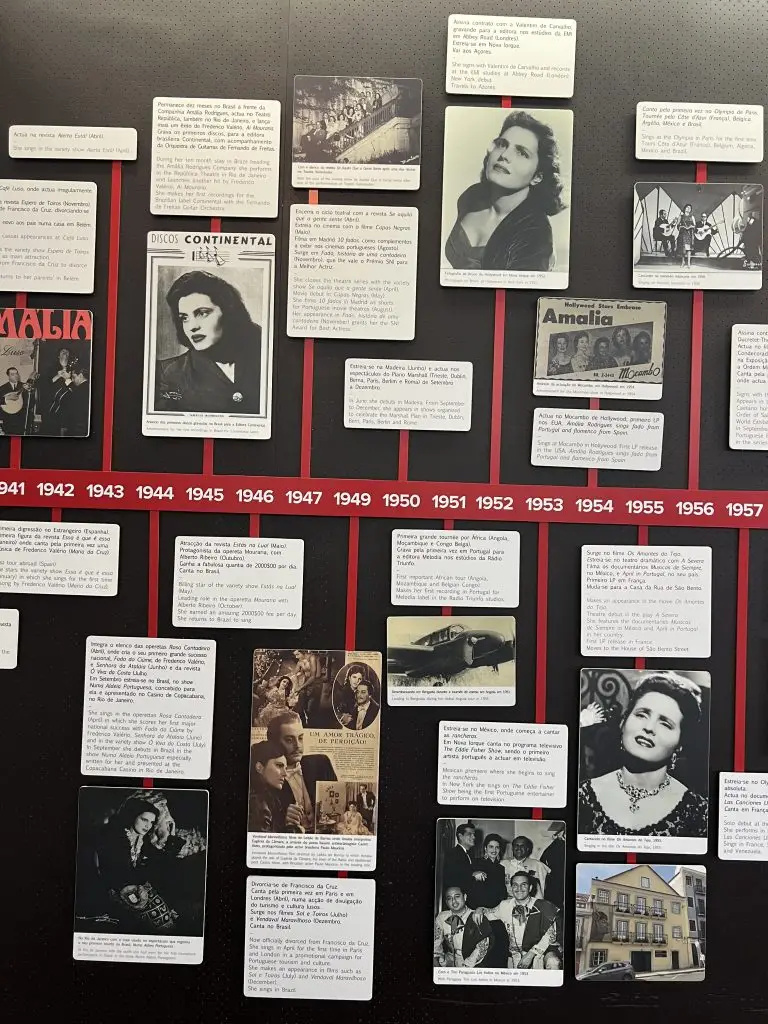
    The first room of the museum showcases Amália’s biography on a timeline full of marks and information. Born to a poor family in Lisbon, she discovered her love and talent for singing at a very young age. Her parents wanted her to marry before she would sing in the Fado clubs, as the guide in the museum tells me. So, in 1940 Amália married the Portuguese guitar player Francisco da Cruz. The marriage only lasted a few years. Amália was one of the first women in Portugal to make a divorce.

    And soon, on one of her trips to Brazil she met her future husband César Henrique de Seabra Rangel, who would stay by her side until his death in 1997. Two years later, on 6th of October 1999 Amália returned to the heavenly angels. An era came to an end.

    Globally known and loved

    Nowadays, the internet allows us to watch and listen to concerts in other countries, which makes it also easier for artists to become internationally recognized. Amália lived in an era where there were no such streaming platforms as Spotify or YouTube to distribute music through.

    Thus, she contributed her music through singing in the real world. She travelled to various countries on different continents. Her international orientation is reflected in her language skills: She spoke and sang in Portuguese, French, Italian, Spanish and English. 

    Amália Rodrigues embodies an emblematic character

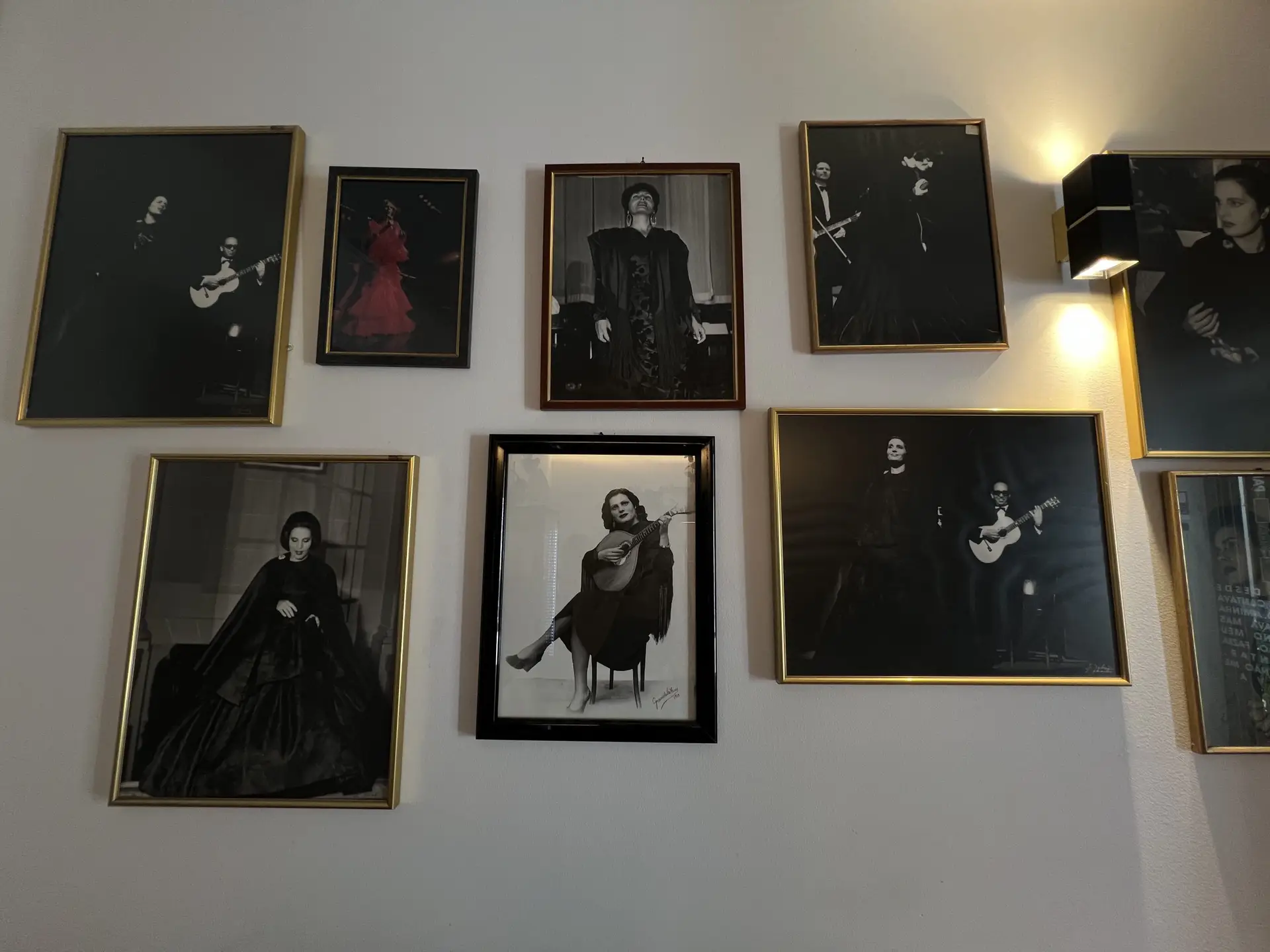
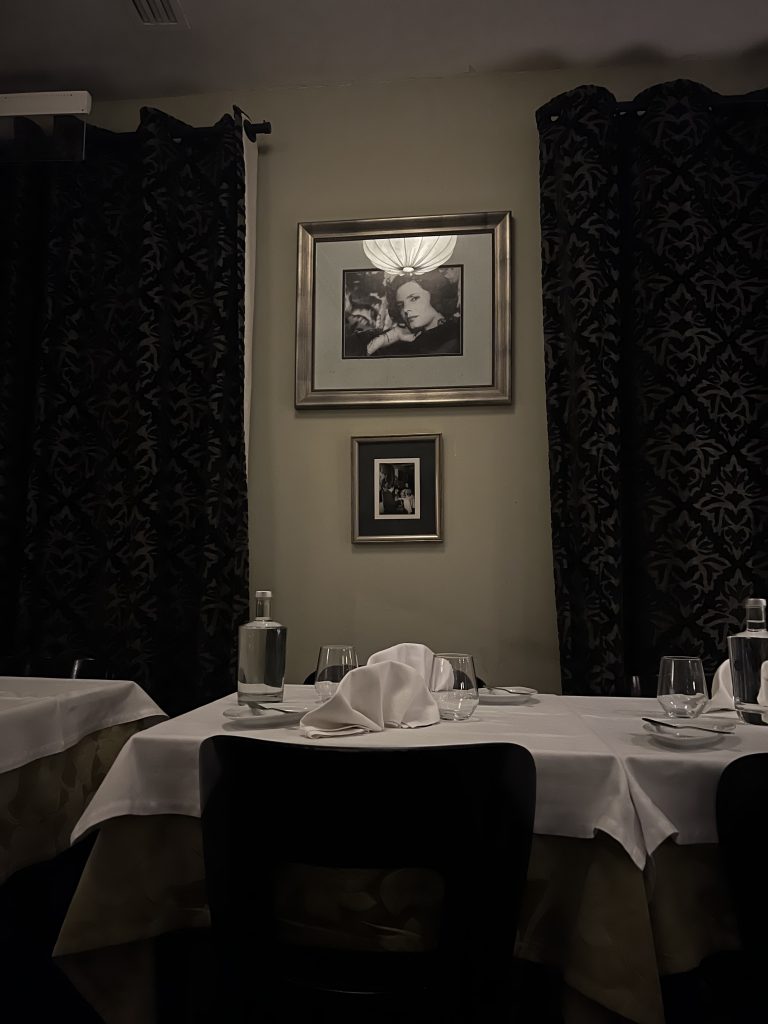
    Several paintings and portraits of Amália decorate the house – they show her at the age of 20 to 26 and 70. She was a beautiful and charismatic woman in all these stages of her life. She was a woman that turned to be almost kind of an icon. You will barely find a Fado house in Lisbon that has not hung up portrays of Amália on its walls. And there is more behind those portraits than (just) a reminder to her great Fado singing. In a way, she embodies freedom and a unity of nations.

    Somehow, she managed to keep the balance between a world star and a sensitive, charismatic woman. All her elegance and grace, the diversity in one personality, can be explored in Amália’s house museum in Lisbon.

    The clock room shows her love for fashion. She even designed many pieces by herself. When she sang Fado, her dresses on stage were black. She also showed her love for colourful outfits in international shows singing folklore: from Samba in Rio to Flamenco in Spain. 2000 accessories and 200 shoes are still to be seen in her home and proof how much Amália took care of her appearance. The amount of high heels shows that she wasn’t a tall person at all. In her bedroom one will find many divine statues and pictures that show her deep connection with religion. 

    Notes from the Fado Queen’s heart

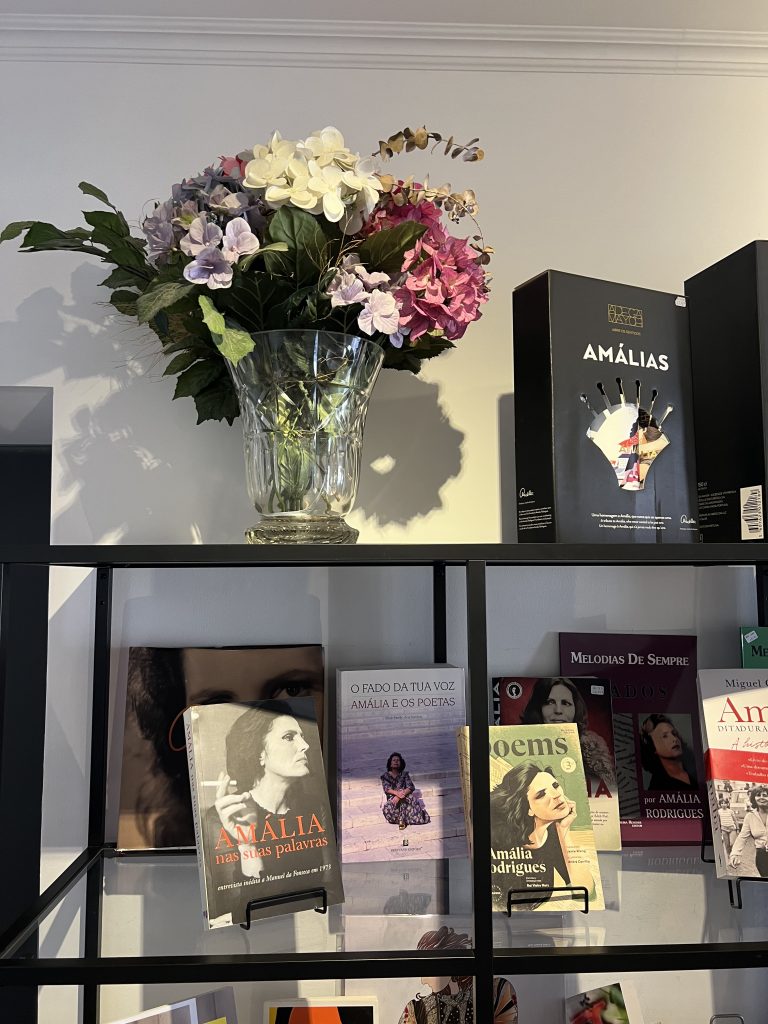
    After I walked through Amália’s house, I felt like I got to know her in the most intimate way possible. Until I found a book with collected poems written by her. And when I read it, even though I cannot talk to her anymore face to face, it feels like her soul is talking to mine through her poems. Her passion for flowers cannot only be seen in her house and garden but also in her poems, as for example in Rosa vermelhaGostava de ser quem era, and Flor de Lua

    Gostava de ser quem era
    Pois quando eu era menina
    Tinha toda a primavera
    Só numa flor pequenina
    I’d like to be who I once was
    After all when I was young
    In a single tiny flower
    I had a whole springtime sprung

    Amália Rodrigues

    She herself describes her trajectory as a poetic creator in an interview with Vitor Pavao dos Santos: “I always liked writing poetry, I had a knack of ceremony, to avoid giving a speech, I’d make acknowledgements with verse, with quatrains.”

    However, she was also critical with her writings: “I know I’m not a poet, but I’m able to come up with lyrics to sing, as good as the ones that are out there.” Rui Vieira Nery notes that in Amália’s poems there are hardly found any references to Lisbon. She sang other poet’s works, too: from the marches of Raul Ferrão to the elegies of David Mourão-Ferreira or Alexandre O’Neill.2

    The way Amália has combined her talents as an actress, poet, stylist, fadista and multilingual singer is unique… Her life fills a century with grace. She brought her music to countries all around the world, while staying close to the roots and at the same time opening up for other cultures. being travelled around the world. 


    1. Possible Gender Differences in Classical Music, Flamenco and Fado (Alicia Garcia-Falgueras, 2023) ↩︎
    2. Poems and Biographical info from the book Poems by Amália Rodrigues, edited by Rui Vieira Nery ↩︎
  • Tradition meets modernity: the secret behind Fado ao Carmo

    Tradition meets modernity: the secret behind Fado ao Carmo

    Chapter 10: A non-touristic place for tourists

    When guitar player Luís Guerreiro and Fado singer & producer Rodrigo Costa Félix found out that they both had the same dream, they worked together on fulfilling it. After the pandemic they started their first Fado restaurant “Fado ao Carmo”, located in Chiado. After singing himself at established Fado houses like Club de fado for over 20 years, Rodrigo has already learned a lot about the life in Fado houses before he opened his own. 

    “I knew what I want to do and what I don’t want to do”

    They had started some new ideas such as offering a fixed menu, instead of creating a separate “tourist menu” as restaurants used to do it before. Having been aware and proud of the success their restaurant had, they soon decided to open a second venue with the same name. They found a beautiful place for it, located in Travessa do Almargem in Alfama.

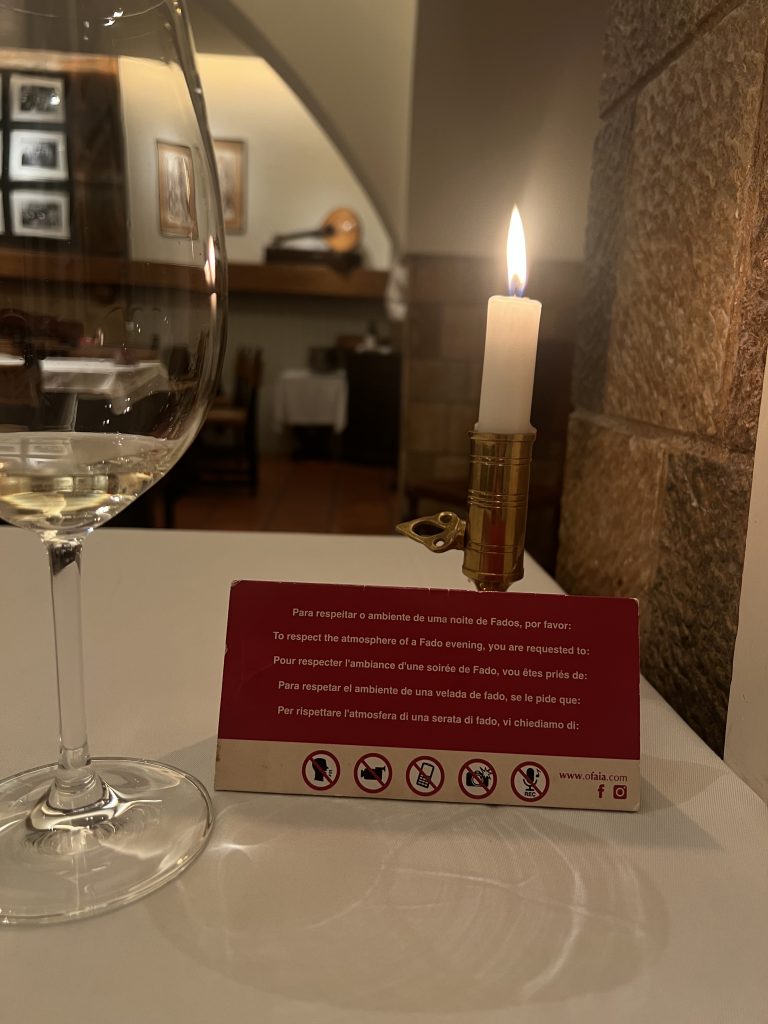
    Rodrigo seems to be a real perfectionist, which doesn’t make it easier for himself to manage a restaurant. “Most guests are tourists, but we don’t want to make them feel that they are in a touristic place”. Thus, being attentive towards the guest in every little detail is one of the main principles in his restaurant. At the beginning of the evening the waiters would explain to each table how the restaurant works: food is served in between the sets, there is no service during the fado presentation, and taking photos and videos of the musicians is allowed, but without flash.

    A late night at Fado ao Carmo

    I arrive at the restaurant in Alfama shortly after 10pm. It’s the time when the first guests finish dinner, and tables get available for the late birds like me, who want to listen to good fado accompanied with a glass of white wine. Musicians are having a break right now, desserts are being served.

    I have some minutes until the next set starts. I have a taste of my white wine will be the perfect companion for listening to excellent guitar and voice interplays. There two red chairs placed on a little plateau in the middle of the room. Slowly, when the lights are dimmed, the musicians come from outside and walk towards them. The guitar players sit down and the singer, Ana Margarida Prado, stands between them. The guitars are tuned, last dishes are served before the show starts. Silence. Cutlery is clinking on the plates. Guitar strings are gently plucked. Some whispers, some laughs until the singer decides on the song. Her voice is more voluminous and powerful than I could have imagined. 

    As with the applause, a loud “beautiful“ echoes from the audience towards the musicians. Before the next Fado is sung, absolute silence enters the room and stays with us for around half a minute. I notice that silence in a big venue like this is a bigger silence than the silence in a small room. It’s so powerful, because it is silence itself that keeps people truly silent. Someone on the other side of the restaurant puts his wine glass back on the table. I can’t see but hear it. She chooses a song, the melody starts on the Portuguese guitar. She now uses the performance space and draws circles singing and expressing herself. 

    Tourists come here from around the world

    The set is finished, and I realize that the singer didn’t talk at all, but maybe she did that in the opening set. Rodrigo switches the lights back on, opens the shutters at the entry door and starts again the background playback music. The main part of the fado night seems to have come to an end. The last guests finish their desserts, ask for the bill, leave the restaurant.

    After the Fado set Rodrigo comes again to sit next to me. While we talk, he cannot take his eyes from the entrance area. And it seems to hurt his eyes when no one opens the door for the guests on their way out. He tells me that those acts of service – opening the door, saying goodbye and thanking them – are the most important way to show appreciation for the guests’ visit. 

    Do you feel that guests are sometimes distracted by the food?
    “Yes, sometimes that happens. Some also stop eating during the Fado presentation and continue in the break. The problem is then that the food may get cold.”

    Do you choose the singers every night?
    “Yes, we choose all the singers. Very wisely. We usually have two musicians and two singers, one woman. one man. We try to keep the cast young, as we also want to attract a young audience.

    What happens if guests don’t follow the restaurant rules?
    “We go again to them, explain them. It’s all a matter of respect.”

    Rodrigo Costa Félix

    I lose Rodrigo from my conversation when he gets up impatiently to open the door for an American couple. For the next and final set of the night, Rodrigo himself will be the singer. Ana Margarida Prado is now having dinner on a table close to the musicians. After diving into the Rodrigos calming way of singing, the most beautiful surprise enlightens the room. Ana stands up from her table and her voice joins Rodrigo’s on the song Hortelã Mourisca. Together they create beautiful harmonies from one to the other side of the room. This moment will be held in my memories forever.

  • A Baiuca, the real-world definition of an authentic Fado house

    A Baiuca, the real-world definition of an authentic Fado house

    Chapter 9: Close to the Fado roots

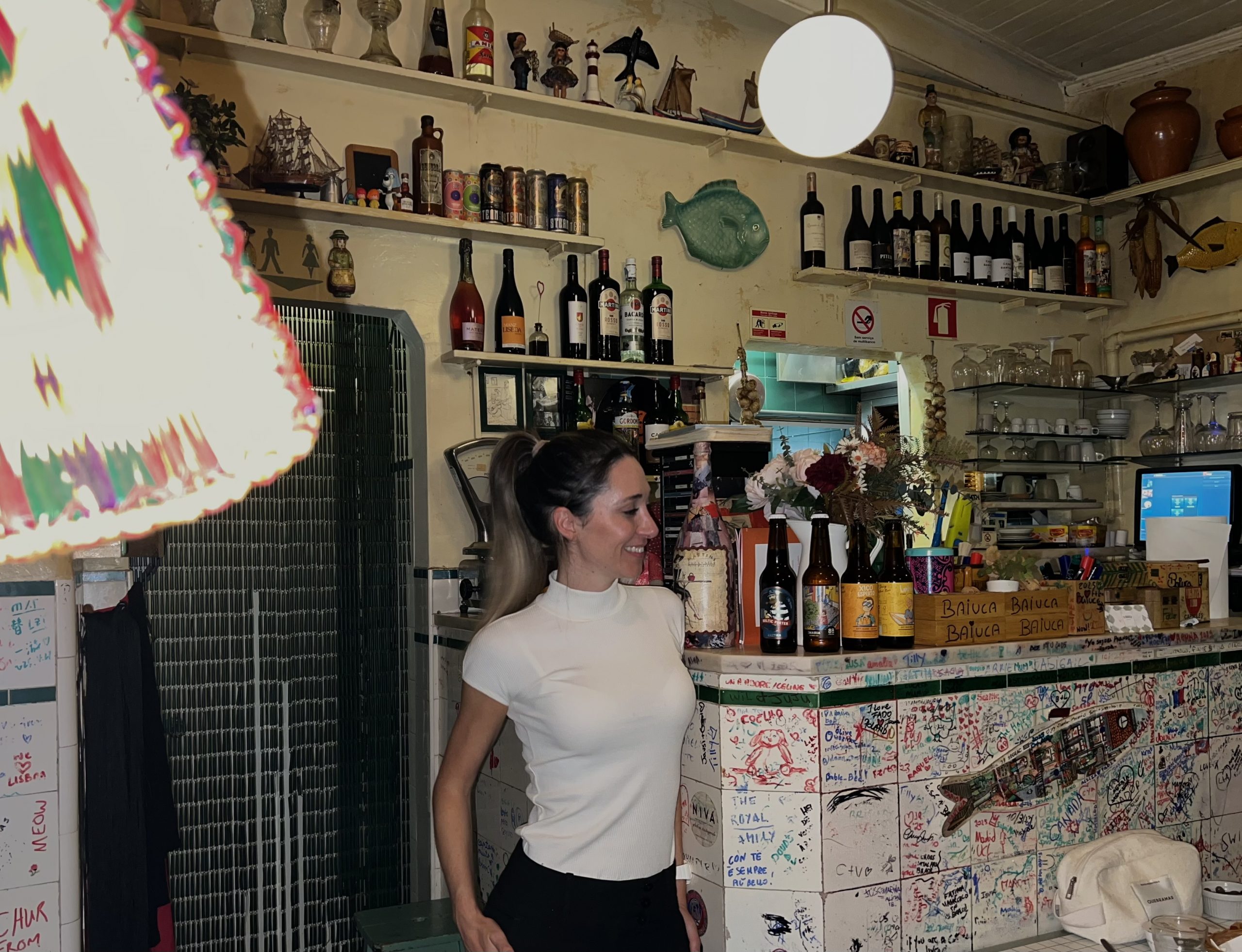
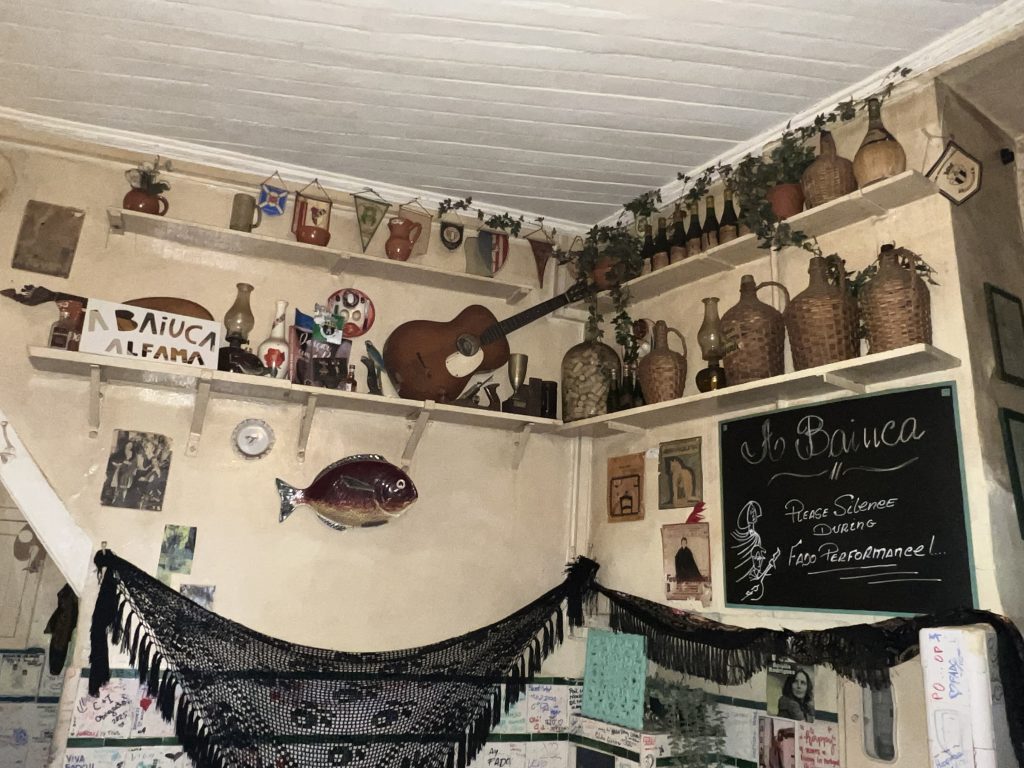
    On the first step into A Baiuca, the restaurant gives the vibe of an authentic and relaxed gathering space. Restaurant owner Clara Sevivas shares her warm energy with the people in the room, making it a place to feel comfortable and appreciated. She believes that “the place is very special for itself, even without me”. The musicians and the people that come there make every Fado night at A Baiuca a memory for the hearts.

    A Baiuca seems not so touristy like other Fado houses – there are also a lot of Portuguese people coming, as Clara explains to me. She also has regulars from all over the world. And this is just one of many aspects that proofs.

    “They show a lot of interest in the Fado, some even started learning Portuguese to understand the lyrics.” 

    Clara Sevivas

    Authentic reviews decorate the walls at A Baiuca

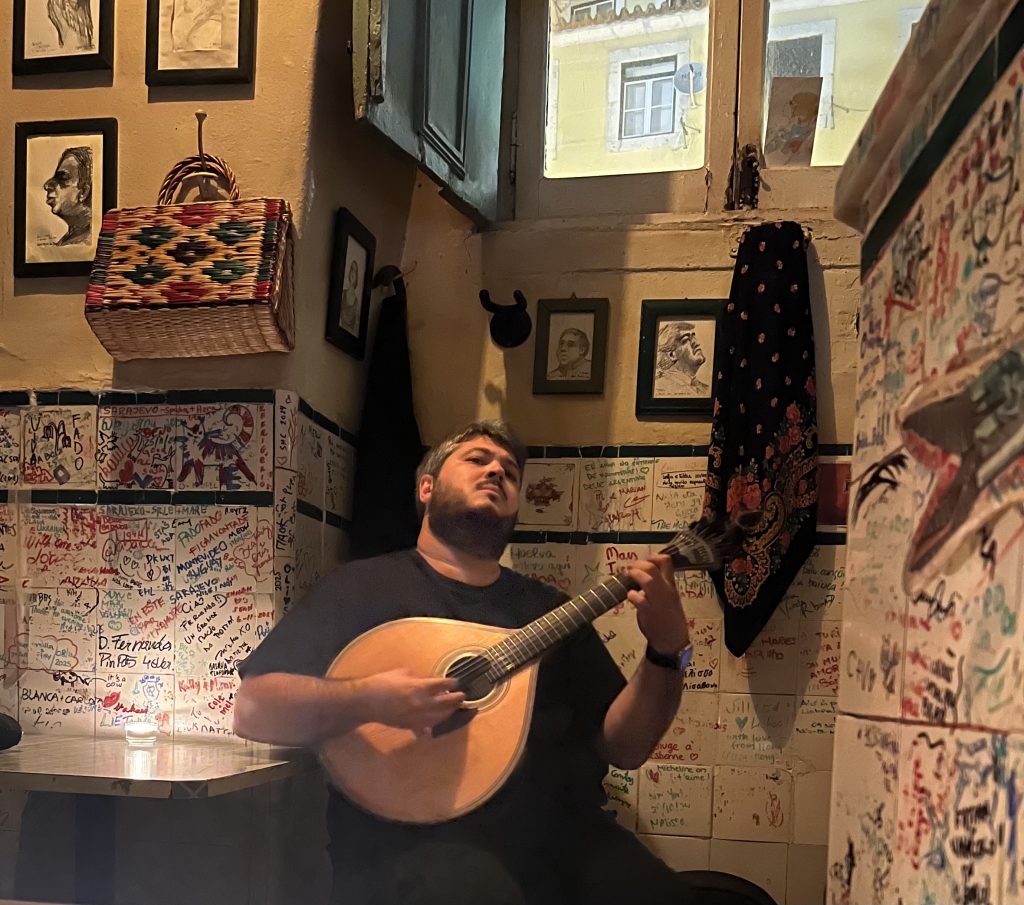
    The walls of the restaurant room are full of scratches and comments in different colors. Clara explains the origins of this “idea”. After she bought the place, they started to draw grids on the walls, noting down the results of their card plays. “One day we forgot to erase it. And then someone else wrote something.” And these doodles animated guests to write more and more notes on the walls. Today one can read hundreds of messages on the walls, capturing people’s emotions and thoughts during the Fado nights at A Baiuca in the past years. A place that unites souls.

    On Tuesdays and Wednesdays, guests come here to listen to one of the top Portuguese guitar players Ângelo Freire. Growing up in Graça, the area right next to Alfama, Ângelo has always been in touch with fado. As a child he went to the Fado houses in Alfama. At the age of 7, he started learning to play the guitar by himself. He played Fados, and he also found the potential in his voice. In his youth he took vocal coach lessons, and for 8 years he studied guitar. In the past years he accompanied great Fado singers on stage such as Mariza or Ana Moura.

    Life at the Fado house as an authentic foundation

    Currently, Ângelo plays the Portuguese guitar on stage with singer Sara Correia. And still, it’s important for him to keep playing in the Fado houses, where Fado is born and kept alive in the most authentic way. Ângelo is closely connected with the people in the neighbourhood around A Baiuca, the Fado house where he plays on Tuesday and Wednesday nights. It’s like his emotional foundation for everything else he does. He would never want to stop playing at the Fado houses. 

    Sometimes it’s difficult to find subs for the days when he has other shows to attend. Because on the big stages they need the best musicians, such as Angelo. He is planning a guitar project with Jose Manuel Neto and Luis Guerreiro, touring together through Europe. “They are my inspiration”, says Ângelo about musicians older than him. He looks up to them. I can feel that during his performance at A Baiuca, where he plays together with a female elderly woman and an acoustic guitar player from the older generation. 

    “The audience will usually notice how I feel on that day from my choice of songs. On some days I’m in a positive mindset and on others in a darker mood.” 

    Ângelo Freire

    When he enters the restaurant, I feel that he is rather in a stressed mood and that his head was circling in many directions. Later he confirms my first impression as right. That doesn’t stop him from performing great as he used to do.

    In the first set, Ângelo “only” plays the Portuguese guitar, accompanying his “Fado grandmother”, as he says, Fernanda. She has a powerful voice. Restaurant owner Clara stands behind the bar, surveilling the room. When someone starts to make noise, she points with her finger on her mouth: “shhhh”. I like that. She seems to have an authentic connection with the traditional way Fado is performed.

    And suddenly, Clara starts singing herself, creating a wonderfully harmonious duet with Fernanda. It’s incredibly beautiful how her young voice interacts with Fernanda’s voluminous one. 


    Is it a problem for you when guests in Fado houses film you?
    “It’s okay if they want to have it as a memory. But I’m sure that most of them don’t look at the videos again after that evening.”

    What do you think about early evening Fado shows?
    “The fadistas that sing there don’t grow from their performance.”

    Do you also play your own songs in the Fado houses?
    “Sometimes, but usually not. To be honest I don’t remember all lyrics of my own songs.” (*laughs*)

    Ângelo Freire

    The traditional Fado lyrics are in his mind – the melodies on the Portuguese guitar and the chords on the acoustic guitar. But the lyrics of the own songs not… a musicians’s mystery.

    In the Fado houses one will see, that Fado is about more than just singing or playing some guitar strings. There is the vivid energy in the restaurant, the connection between the listeners’ souls.

  • Welcome Home – Welcome to the Fado house O Faia!

    Welcome Home – Welcome to the Fado house O Faia!

    Chapter 8: Where Fado flows through the veins

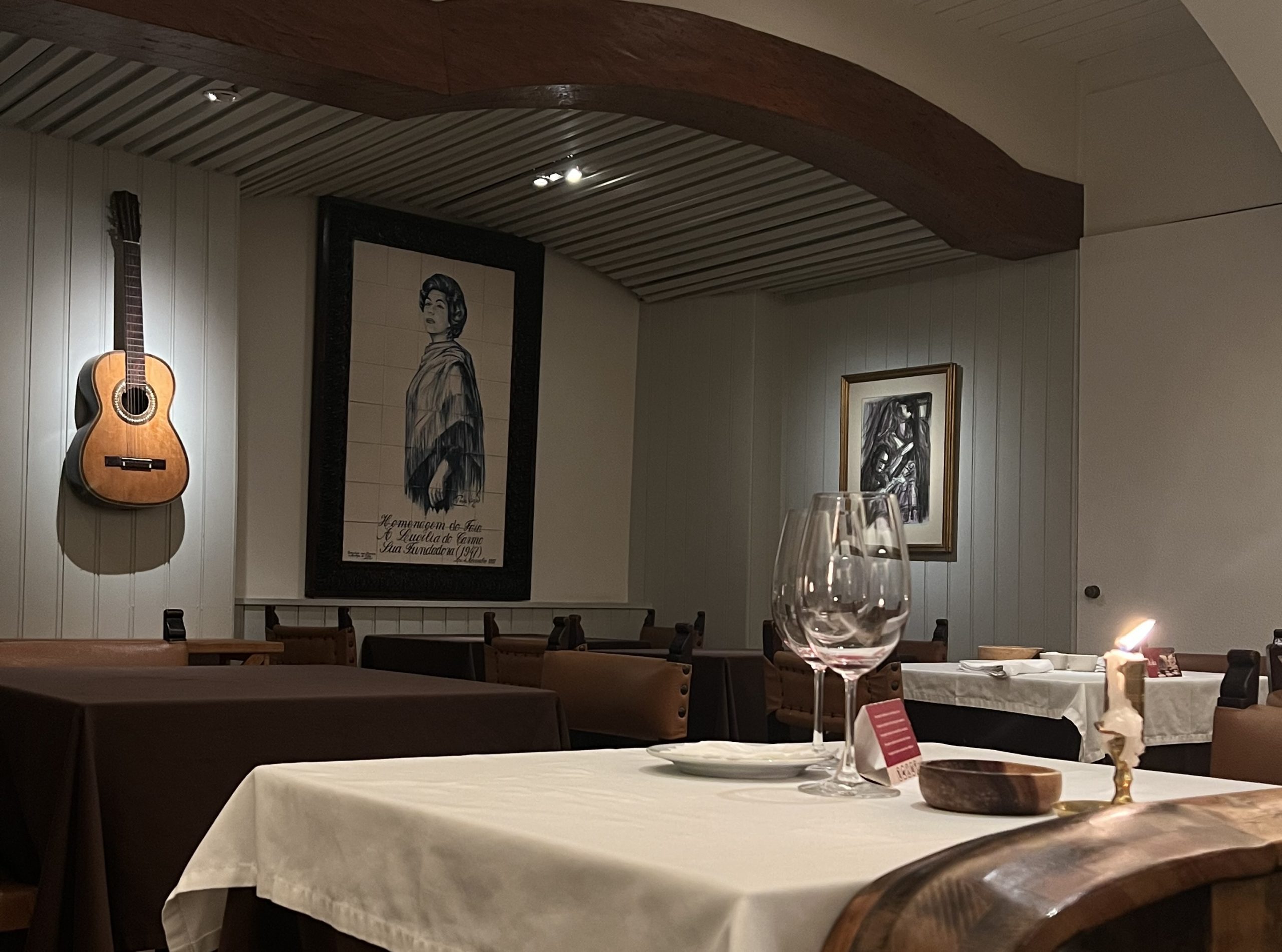
    The first day of the year 2021 marks a day of national mourning in Portugal. The country had to let go of the greatest male Fado singer. Of a man whose nickname was “Lisbon’s voice”. He was the first Portuguese to be awarded with the Latin Grammy. I’m talking about Carlos Alberto do Carmo Almeida, known as Carlos do Carmo. Thanks to his mother Lucília do Carmo who was a great fadista herself, Carlos felt Fado in his veins even before he was born. In 1947, when little Carlos was 8 years old, his parents bought a Fado venue which the family named “O Faia”.

    When his father Alfredo Almeida died in 1962, Carlos started to manage the restaurant and would sing there every night together with his mother. In his over 50 years of career, he toured around the world. His concerts at London Royal Albert Hall, the Alte Oper in Frankfurt and the Olympic Stage in Paris are some of the many highlights. Carlos do Carmo has been an idol for many contemporary fadistas; some of them, as for example Camané or Mariza, even sang together with him on stage. 

    To enable embracing his artistic international career, Carlos do Carmo decided to sell the Fado house in 1979. Since then, O Faia lies in the hands of another family who have taken more than good care of it. On its website the history of the restaurant is described in detail…

    “António Ramos was, at that time, hired to work as a bartender, a few years later, he was invited to be part of the society. In the mid-90s, with the two sons, Pedro and Paulo, he assumed the management of O Faia, which once again fulfilled his Fado (fate): being a family home, that of the Ramos family. The father and sons are there every night, paying attention to every detail, doing what they like the most with the passion they always have: welcoming at their place.”

    At O Faia, we learn how to show appreciation

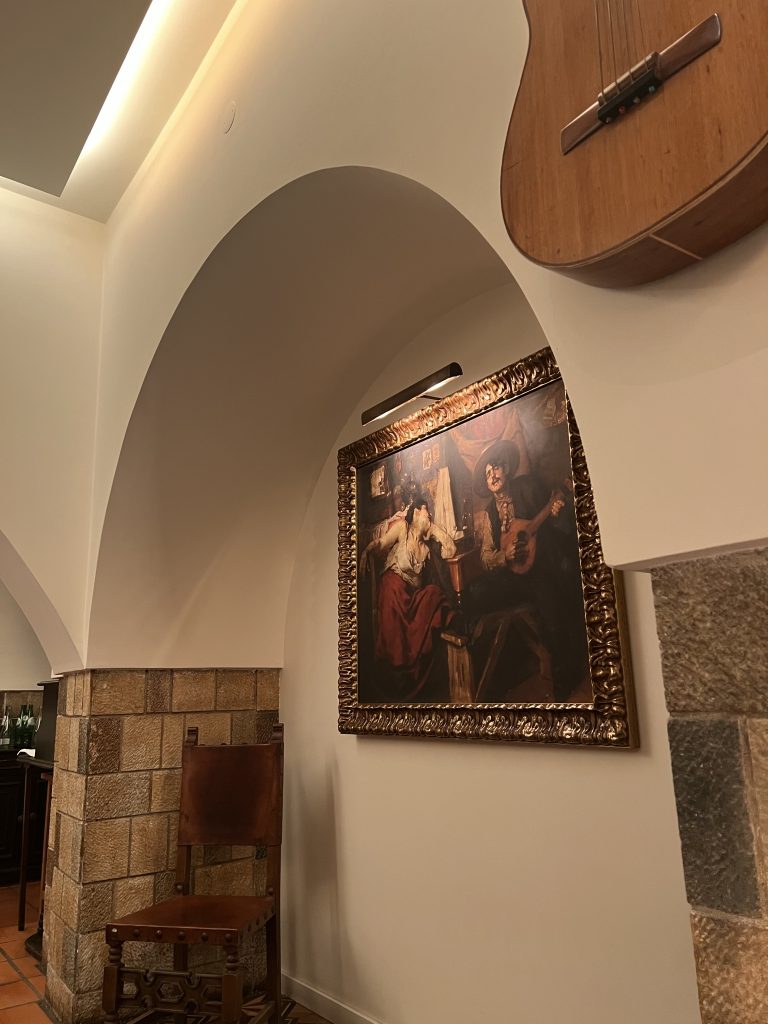
    It’s true. When I go there on a Thursday night, the Ramos’ brothers welcome me. I arrive after dinner time, when the 2ndround of fado is about to start. The dinner round was fully booked, now it’s getting calmer. Entering the main room of O Faia  in the Bairro Alto of Lisbon feels like walking into your parents’ living room. Seeing the brothers working together and breathing in the soulful interior of the restaurant create this comfortable feeling of home. Big bows form the ceilings, pictures of Fado legends and guitars decorate the walls. On my right there is an acoustic guitar, at the wall in front of me (some meters away) a Portuguese Fado guitar. Even three guitars are on the wall on my left. It’s like an exhibition of well-shaped guitar-bodies. The guests create a harmonious atmosphere. Most of them are young to middle-aged English-speaking couples. 

    Shortly after I arrive at my table, the waiter brings the wine menu. I look it through. Another waiter puts a candle on my table and lights it. As I’m alone I won’t take a bottle of wine. But still, it’s fun to see what they offer. In the end, I simply tell the waiter that I would like a glass of white wine. He asks “dry or something simple?”. “Dry” I say decisively, without any doubt. A few moments later, the waiter comes up to me with the wine bottle, pours a little sip to let me try it. It has exactly the taste I look for in wines. Accentuated but light. I watch some of the other guests tasting wines. Most of the glasses shimmer red.

    An unforgettable Fado night at O Faia

    Now, before the show begins, it’s the most stressful time for the waiters. During the Fado presentation there won’t be any service, it’s a matter of respecting the silence. Pedro Ramos, one of the owners of O Faia, tells me about the history of the restaurant and the changes happened over time in consuming Fado.

    “It started with fadistas singing in taverns, mostly for free. It was until the early morning hours that people wouldn’t leave the Fado places. Today Fado is still rooted in the fundamental tradition of being connected with gastronomy.”

    Pedro Ramos

    A big change happened from the point when smoking was forbidden in restaurants, as Pedro Ramos notes. Thus, nowadays the fadista’s talent is appreciated and respected more by the guests in a restaurant. There is an official beginning and an ending of a show or a Fado set, and people pay a corresponding price for the experience. 

    At 23:30h lights are slowly dimmed in the dining room of O Faia. Now, as the electronic lights are off, candle lights determine our views. Chatters transform into whispers, whispers into silence. It gets so quiet that I don’t even dare to eat my sweet potatoes chips. We hear a female voice singing, muffled by the walls dividing us from her. I wonder, is she doing a voice-warmup? The seemingly young voice fades, now we solely hear plucking guitar strings. And – the sound of a phone dropping to the floor. I guess, that wasn’t part of the show. 

    Listeners without phones, singers without microphones

    The guitar players enter the room. They sit down, start chatting, tuning their instruments. “Ainda no” (=Not yet), they continue tuning, then slowly start playing a melody. The first fadista of the night comes into the middle of the guitar players: Maura Airez, a beautiful young woman dressed in black. She whispers to the musicians. They seem indecisive about the song choice. “Ela!” (=That one!), Maura says with a laugh. As she starts singing, my heart slowly contracts. The Portuguese guitar, the acoustic guitar and the singer’s voice seem like gears mashing perfectly into each other.

    The acoustic guitar player, who is one of the Ramos’ brothers is placed right in front of my table. He plays in a uniquely passionate way. His head is close to the guitar neck, he almost hugs the instrument. I can hear his breaths in the rhythm of his playings. When I dare to take my eyes away off him, to let them wave through the restaurant, I see that each and every one looks towards the front. The best thing is that there are no phones allowed, thus everyone sees the magic through their own eyes – not through a camera lense. 

    At O Faia, one emotional highlight chases the next

    After a few songs, Maura leaves the stage. I hear the echoe of an applause and see redwine sparkling in the candlelight. Strings are retuned. Happily delighted of the energy in the room, the guitar player continues to breathe in the rhythm of his playing. The next renowned fadista is on his way: Ricardo Ribeiro.

    He takes a step back to place himself a little behind the musicians. His eyes are closed when he begins to sing. I can’t believe how much power his voice carries. I heard his name before, but never have I heard his voice in a live performance. The volume reaches into every corner of the room; and it seems that each sound he produces glides back to him, filling him with even more power. The guitars get louder and so does his voice. He sings himself from the fado classic “Mas fadistas que fados” to “A minha janela”. Ricardo thanks the audience for the applause, moving his lips to “obrigado”. I can’t hear a tone, maybe his voice is in singing mode only right now. 

    Another tuning break, another change of singers. Three women use the little break to get up from their tables and head towards the door to leave the room. A waiter accompanies them on their way out, then sneaks himself through the curtain back into the main restaurant room. Meanwhile, I observe the shadows of the guitar bodies, which rise all the way up to the ceiling. The guitars are playing an instrumental now which seems to turn out longer than planned. We all wait for the next singer to appear.

    Impressive appearance meets breathtaking voice

    The Portuguese guitar player Bernardo Romão looks behind him over his right shoulder to check if someone comes. The instrumental continues. A waiter, who seems to feel responsible for resolving the waiting situation, walks back to look for – Lenita Gentil, there she comes. “Boa noite” – she is the first artist of the three to talk before and in between the fados she presents. “Canto un fado tradicional. Me passo con ela mi rua”. 

    From my little Portuguese knowledge I understand that she will sing a traditional fado that has accompanied her on her path. Her voice moves my body; my heart jumps in circles and my skin is bathed in goosebumps. It’s the most intense Fado experience I have had until then. Lenita Gentil claps with the rhythm – her energy is unique. She still stands on the side, giving me the impression that she doesn’t like to be in the centre. “Laleuilauleiiii” – together with the audience she starts a beautiful choir, that marks the end of a magic Fado night at O Faia.

    Lights are turned back on. Glasses are getting empty. The waiters empty the last open wine bottles. Some candles are already burnt down, others not. Tablecloths are removed. The air in the room smells different now than it will tomorrow. 

  • A Fado tour through Lisbon’s oldtown with Pedro Moutinho

    A Fado tour through Lisbon’s oldtown with Pedro Moutinho

    Chapter 7: In the footsteps of Fado

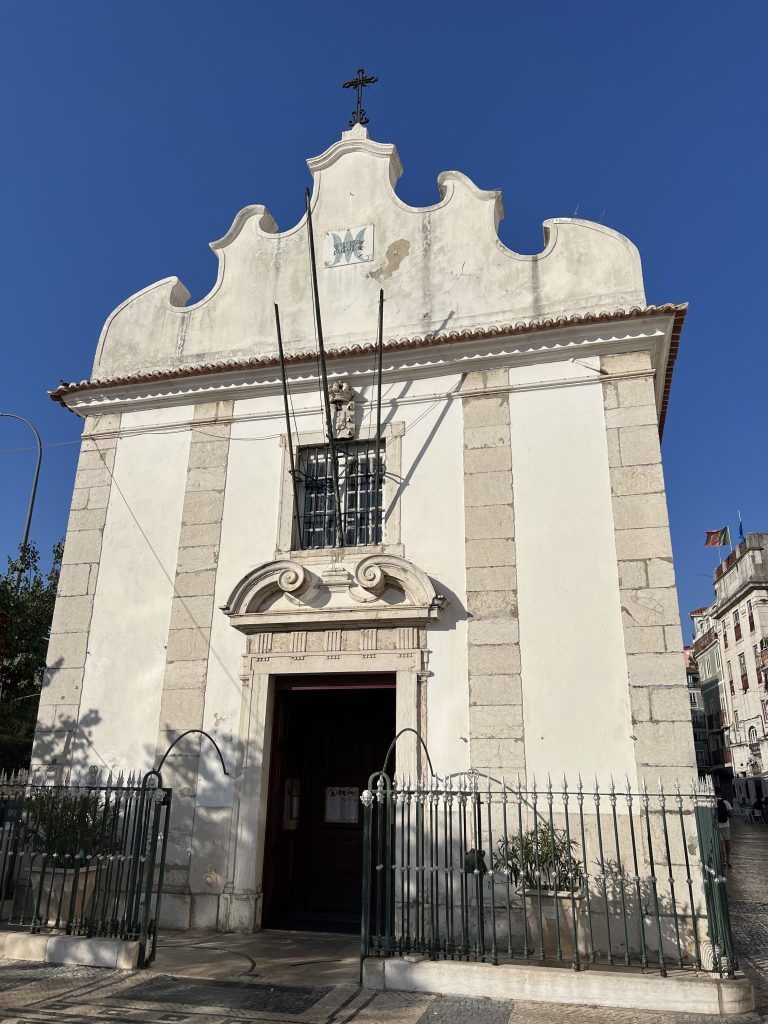
    Walking through the streets of Mouraria with a fadista is like being guided by a Hollywood actor to the Hollywood sign. We start from Rossio Metro station, from there, Pedro Moutinho leads me right to the edge of the Mouraria bairro. There he draws my attention to the Capela de Saúde. The small chapel is, as Pedro tells me, a reoccurring theme in many Fados.

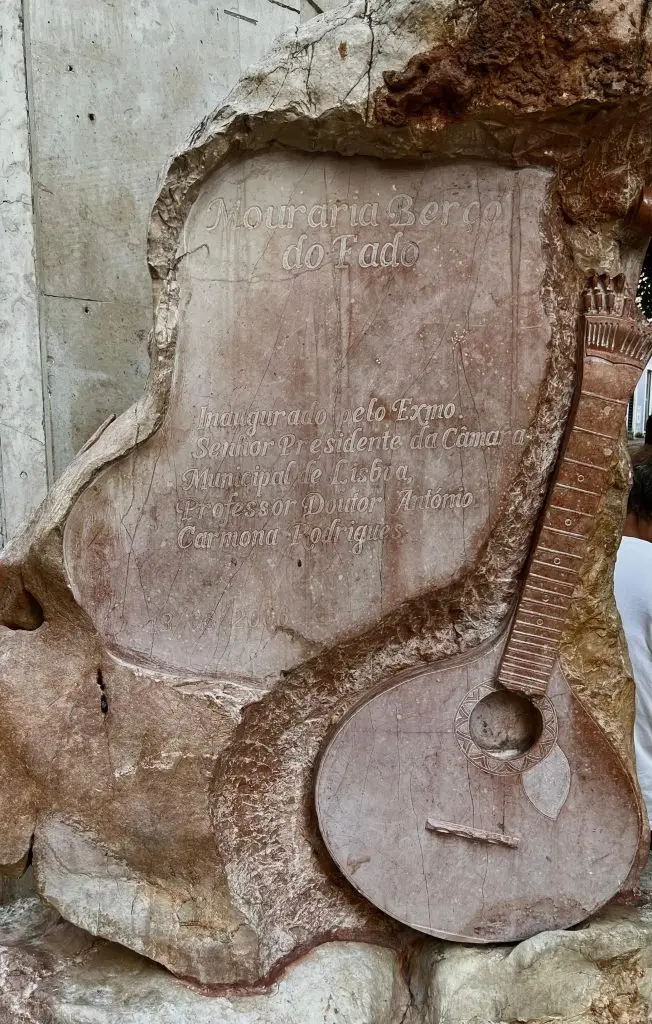
    Going a little further we reach the beginning of the Rua do Capelão, which is marked by a monument. Its inscription frames Mouraria as “the cradle” of Fado. It’s the place where the music was born and grew up. Later, Fado houses were opened throughout Alfama and the Bairro Alto which nowadays attract the tourist crowds.

    We walk up the streets, pass by the photographs of Camilla Watson’s street exhibit Retratos de Fado. As it was her goal, she managed to make Mouraria’s connection with Fado visible. Right alongside this road there is the house where Fado legend Maria de Severa was born and has lived until her death. The house has been renovated, but still, it breathes in and breathes out the sounds of Fado: “today my brother has his restaurant there”, Pedro tells me proudly. His brother Helder is also a passionate fadista and on top of that a food enthusiast and restaurant owner. 

    Pedro Moutinho’s memories hiding in Mouraria

    Walking down a big staircase in Mouraria, a nostalgic memory comes to Pedro’s mind. It was in that street where he filmed the music video to the song Um Resto de Mouraria, which is nostalgically themed in black and white. What’s not visible in the video is that Pedro had an audience when it was filmed.

    “Here in Mouraria people know me, they know who I am and my songs. And when we filmed, we played the song on playback so people heard it and looked outside their doors and windows.”1

    Pedro Moutinho

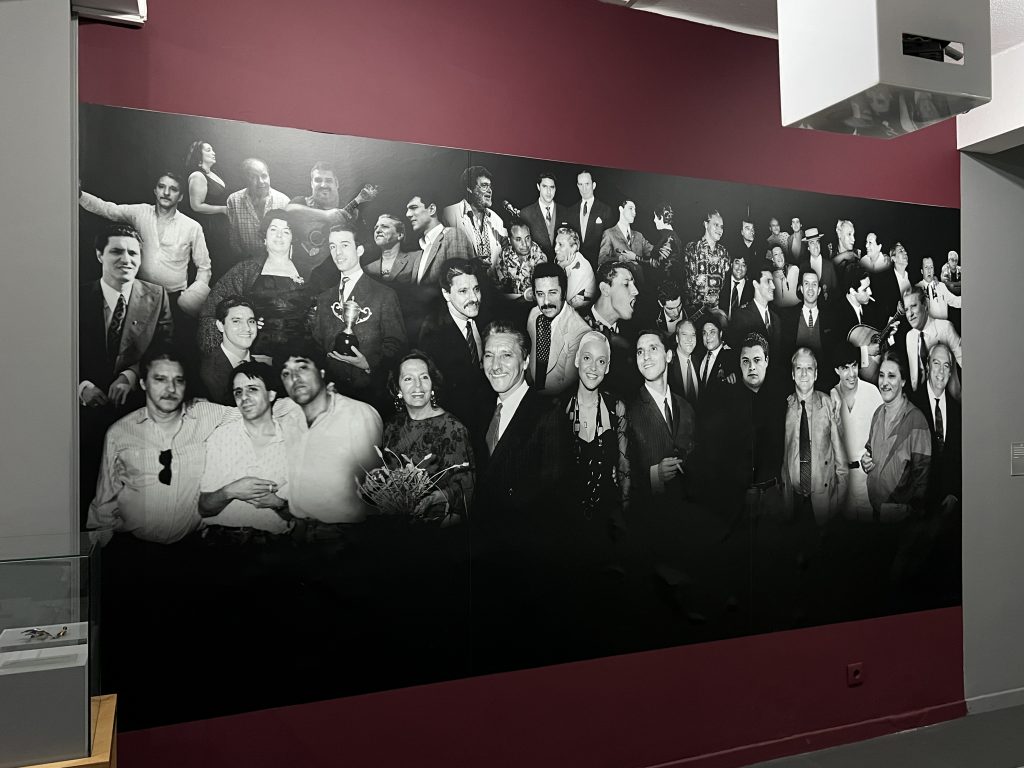
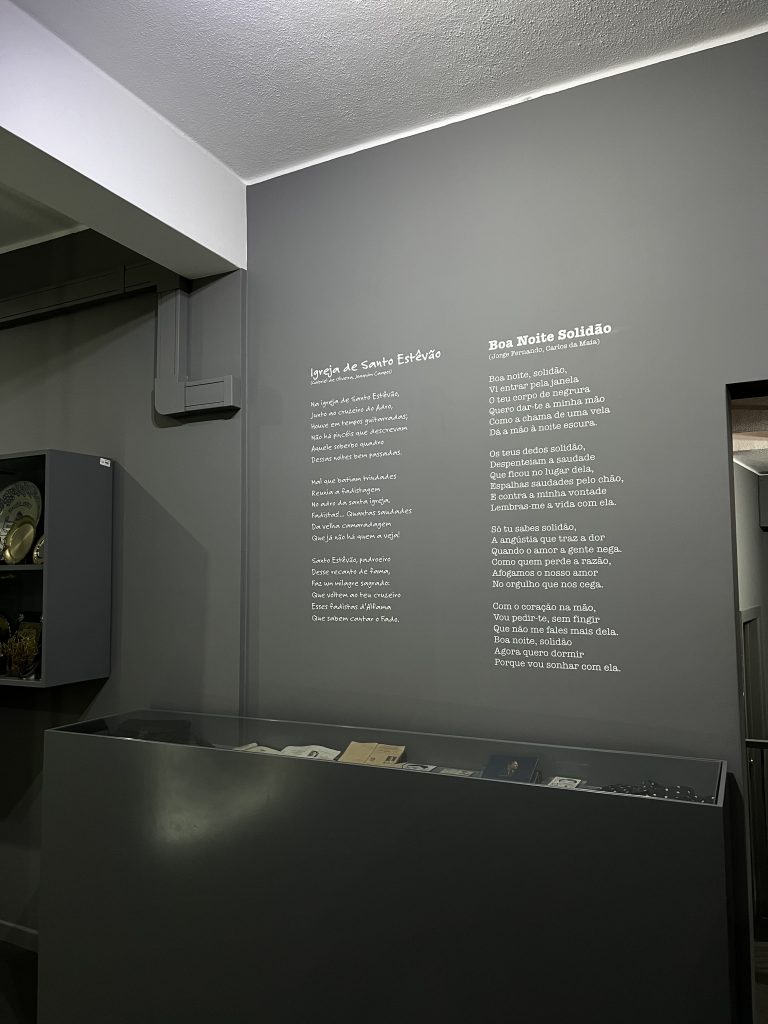
    Then we stumble into a museum-like house, where Pedro right away comes into chatting with the man working there. The museum is a homage to the famous fadista Fernando Maurício. He composed lyrics with the age of 16, parts of it can be read on the museum’s walls. Fado seems to flow through the vein of the Rua de Capelao: Fernando was born right in front of Maria de Severa’s birthhouse, just 100 years later. A coincidence?

    What the Fado magic is all about

    It’s the intensity of magic things happening that Pedro Moutinho loves so much about Fado. When he sings, he closes his eyes and stops the thoughts in his head. He is much more singing for himself than for others. In Fado he wants to convey truth. The best Fado concert experience for him is when he can feel that the audience is not just physically, but also emotionally with him. Even though they might not understand the lyrics, he can feel the difference between an emotionally absent or a present audience. 

    “In the Fado houses there is presented true and traditional Fado. Concerts on stage afford more innovational elements, a more modern melody in the songs. The special thing about stage concerts is, as Pedro describes, that the audience is only there for him. It is also more adrenaline connected to it; whereas the atmosphere in a Fado house is more intimate.”

    Pedro Moutinho

    As a fadista in a Fado house you usually don’t know before the night which musicians you will work with. Pedro Moutinho describes how this determines the spontaneity of a Fado night. He chooses one song after the other, without planning out the whole night in advance. Depending on the musicians that are there, he would choose what he thinks they can do best. 
    “It’s very spontaneous. Then I see, okay this guy, he used to play that song for me. So, I can do this one with him again. When I don’t know the musicians to much I have to go more traditional, that I know that they play to other people, too. I tell them the tune I need and they will have to play it for me.”

    Pedro Moutinho

    I visit Pedro in the evening after our walking tour at the restaurant Adega Machado, located in the Bairro Alto of Lisbon, where he sings up to 5 times a week. At dinner time the restaurant is usually fully booked, so Pedro recommended me to come after that round for a glass of wine. I arrive around 22h in the evening, when dinner time is about to end. Pedro Moutinho is outside the restaurant, giving his voice a rest. On a Fado night they are usually 2-3 singers playing in alternating sets. 

    Pedro Moutinho holds a special place in the Fado world

    When I enter through the main door I get into a cozy welcoming room, from where I can look through a narrow window into the main area of the restaurant: Sara Paixão is passionately expressing herself, through the walls I can only hear a glimpse of her beautiful voice. During the set it’s not allowed to go into the restaurant as it may cause disturbings. I use my waiting time chatting with Pedro and – looking through the guestbook I discovered. It combines souls and energies from places around the world. 

    Adega Machado is one of the Fado restaurants where you feel the beats from the past vibrating into the present. Every Fado night is a unique harmony of energies – the audience determines the musician’s mood and the musicians move the restaurant guests with their intuitively chosen Fados. 

    A little later when the restaurant has gotten emptier, Pedro plays another set in an intimate atmosphere. On that night, he said, he got the energy to sing with that much emotion only through Sara’s and my presence.

    However, sometimes he also has to deal with unpleasant guests…

    “Yesterday I stopped singing because someone was standing up and walking in the middle to take pictures – I told him, please sit down”

    Pedro Moutinho

    Home is where the Fado house is

    Pedro Moutinho was born into a Fado family. His grand-grandfather Gusippe Julio was already a famous singer. “I was born a fadista, but I grow up learning how to sing”. He feels the Fado in his veins and is convinced that a fadista doesn’t need voice, but soul to be a real good one. He remembers how his parents would take him to Fado nights as a child and how he would sleep on the chair until 2 in the morning. With his family he always listened to Fado on vinyl. He himself started his first serious compositions around the age of 15 – “the time when you begin to love and to feel life more intense”.

    What’s also essential for a good Fado concert are good musicians, and good sound systems. Nowadays Pedro recognizes more and more artists who start to perform as a Fado artist without knowing and acknowledging the tradition behind it. 

    “It is the same with jazz. There is real good jazz. And then there are people pretending to play jazz.”

    Pedro Moutinho

    However, he acknowledges that it is normal to see developments in a music style. There is also a movement among authentic traditional fadistas of embracing songs that aren’t considered a Fado. When Pedro does that, he would always announce it to the audience. The difference is in the melody: In Fado songs, there is only the A line of the melody. In other songs, there is also the B line, “a catchy melody” the so-called bridge between the refrain and the verse, that will be remembered by the listener, “Fado songs don’t have this B-line”. And still, they are remembered in our minds and souls.


    1. Quotes from my conversations with Pedro Moutinho in October 2025 in Lisbon ↩︎

  • Nostalgic paintings in Mouraria let Fado’s history vibrate into present

    Nostalgic paintings in Mouraria let Fado’s history vibrate into present

    Chapter 6: Street art by Camilla Watson and Lambert Rozema

    The neighbourhood of Mouraria is said to be the birthplace of Fado. This legend specifically refers to the first female fadista Maria de Severa, who was born in the year 1820 in the Rua do Capelão. Nowadays, this street presents an outside exhibition space – thanks to the artists Camilla Watson and Lambert Rozema. Together with the local community they have created artworks related to the history and the current developments in Mouraria.

    Dutch artist Lambert Rozema has created an artwork panel with buildings in different colours. In the short film about his project some inhabitants share their perspective towards the changes in their neighbourhood, like Paula Alexandra Pinto:1

    “Our Mouraria says a lot – I was born and grew up in the Mouraria neighbourhood. Where there were lots of people we were dozens of children playin in the street, jumping rope, playing hide and seek, catchin – we interacted. Parents would talk at the window, talking from one window to the other, while they were hanging or taking down the laundry… It was a very intimate atmosphere, where eyeryone trusted everyone. There were those peculiarities that we don’t see anymore. And that has left a lot of saudades.”

    Paula Alexandra Pinto (interviewed by Lambert Rozema, October 2024)

    Saudades – a main theme characterizing Fado and reappearing in its lyrics – is also felt in the everyday life among the people in Mouraria. Rozema has talked with locals as well as nomads who immigrated to Mouraria. Whereas retired immigrants are happy to have found such a culturally rich and sunny place like Lisbon for, locals are having ambiguous feelings towards the changes in their neighbourhood. The artist resumes: “They are indeed resilient and quite angry, you know, about how things have gone.”

    The sibling love between Mouraria and Alfama

    Some things change and some do never… Mouraria still is one of the poor neighborhoods of Lisbon, whereas Alfama has developed into a strong tourist magnet. In Mouraria there are investors trying to make profit out of buildings by renovating them.

    “My opinion about investors in Mouraria will always be good if they restore the buildings according to the typicality of the neighbourhood. The buildings are much more beautiful, much more refined, more appealing, with their balconies, with their attics, with their bright colours, with their tiles, with the joy and light that these neighbourhoods used to have and are no longer having.”

    Paula Alexandra Pinto (interviewed by Lambert Rozema, October 2024)

    Rozema himself furthermore analyzes that there has been some sort of competition between both neighbourhoods for a long time. “They want to always sort of do better than the other”. Back in the past, “it wasn’t even allowed for people to have a relationship between the two neighborhoods”. Today, his impression is that it is Alfama that gets even more attention from the tourists.

    “I’ve walked through Alfama a few times and I felt that it was this, that’s almost like a picture postcard. It’s almost finished in terms of tourism. In Mouraria there is still some sort of authenticity to be seen, compared to Alfama.”2

    Lambert Rozema

    Portraits of Fado with charismatic personalities

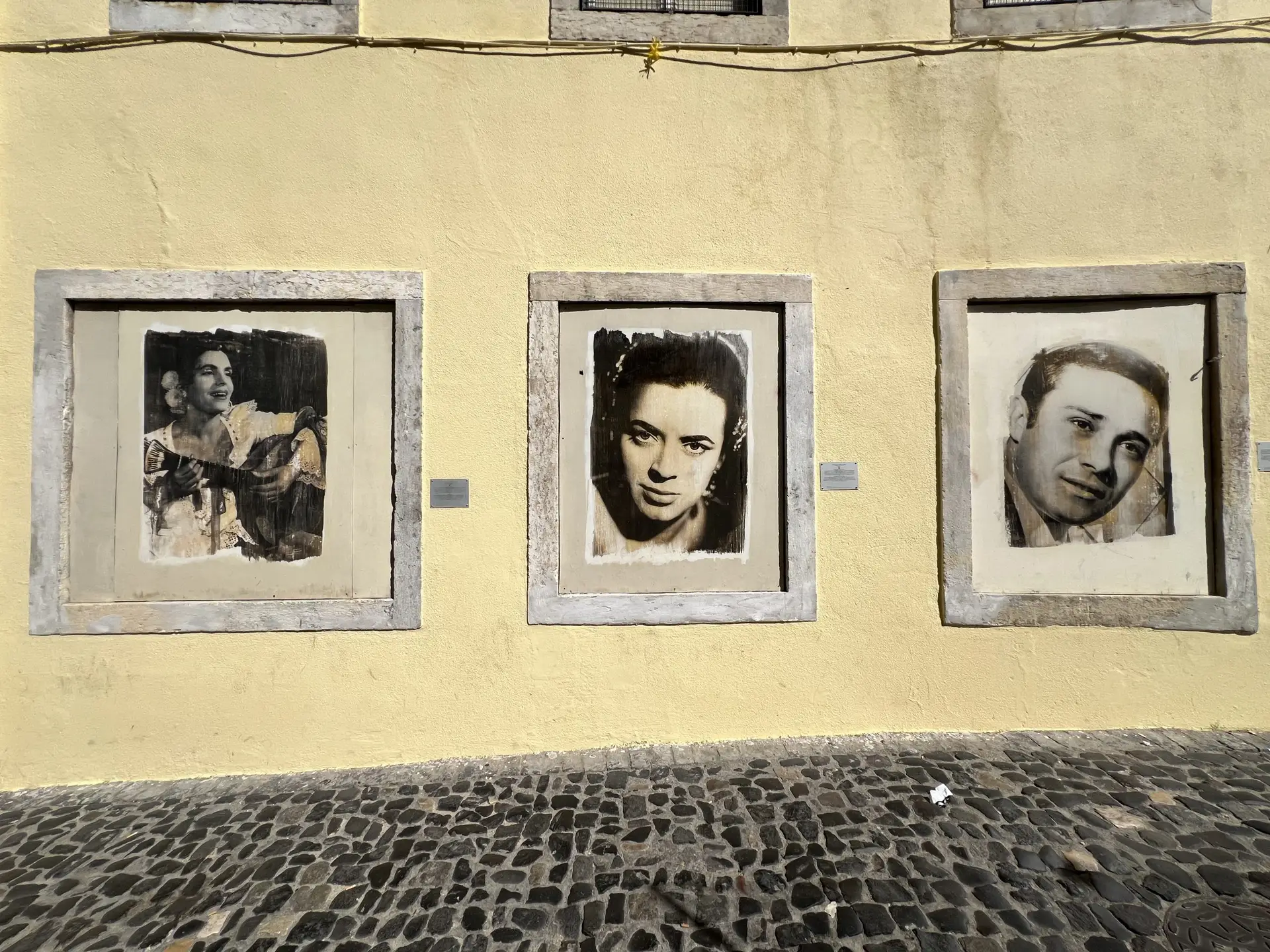
    According to the legend, the Lisbon’s neighbourhood of Mouraria is the birthplace of Portuguese national symbol and music style Fado. To make this connection visible on the streets of Mouraria, british artist Camilla Watson has painted the faces of famous fadistas on walls. The Retratos de Fado street exhibition has been inaugurated in 2013.

    Camilla Watson is originally from England and moved to Portugal. It didn’t take her a long time living in Mouraria until she got first in touch with Fado. “I mean, it’s just all around you and you hear it. You hear it in the streets.” One day, she had this inspirational experience that gave her the idea for the exhibition.

    “There used to be a supermarket on that corner in the square. And all the windows, which had been closed, looked onto the Rue de Capelão. It was just horrible brick and concrete. And I thought, my God, this is just perfect, you know, frames. So that was part of it. That was how I would do it. The reason why the idea came was also because even though the birthplace of Fado is in Mouraria, there was absolutely no indication visible sign for it.”3

    Camilla Watson

    So, she put her idea into practice; by collaborating with people from the neighbourhood who are very deep in the world of Fado. They chose the fadistas who should be part of the artwork. The result are portraits of musicians who were chosen by the people of Mouraria. And therefore “they feel it belongs to them, if something happens to a picture they’ll ring me up and go ‘Camilla this has happened!’” Even though the paintings are not perfectly visible anymore, the exhibition still fulfills its initials objective, which is…

    “…to highlight that Fado was born in Mouraria, to include the community in a project and to give them some kind of pride about their history. And to give them a voice in that sense as well… And it brings memories. It’s historical, so it brings history into the present.”

    Camilla Watson

    Walking along the street will make you connect with the souls of the people that are portrayed. You will get to read information about their lives on small panels, that have been researched and written by the fado museum, alongside the pictures.

    Portraying the Legends that got to be remembered

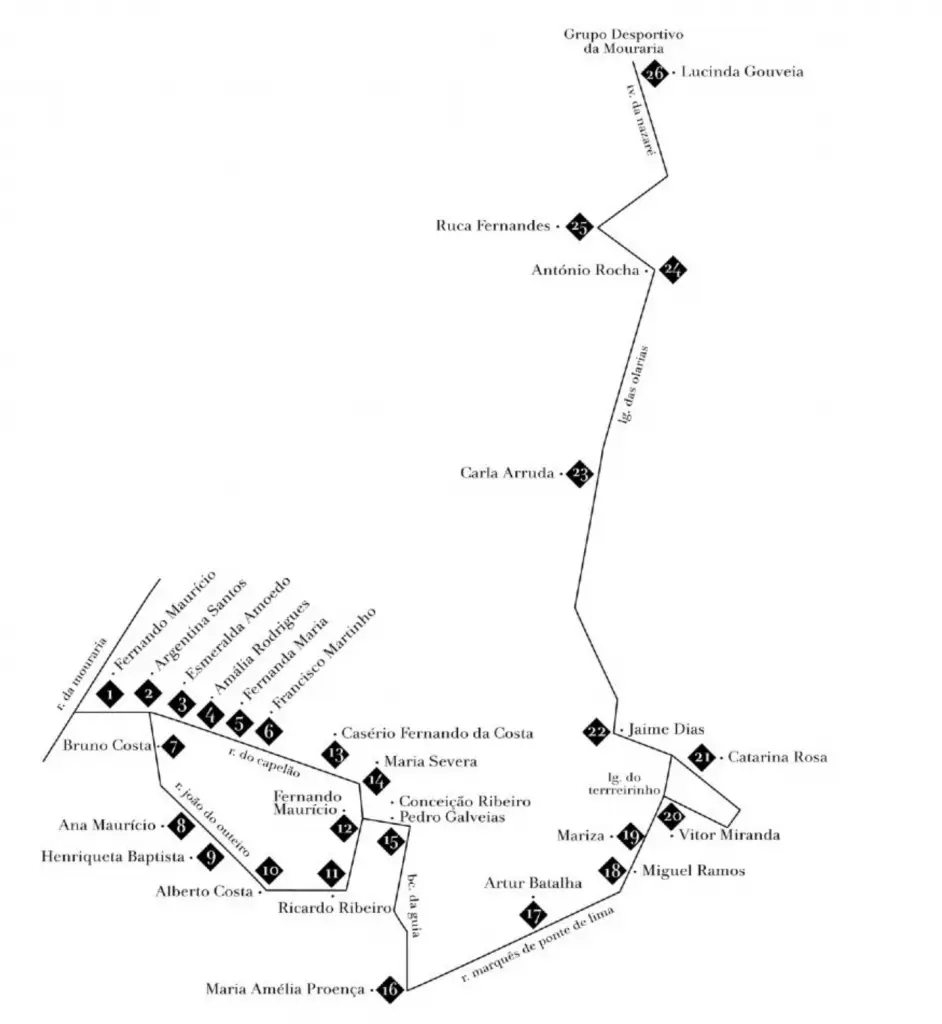
    The portrait of Fernando Maurício marks the beginning of the street. An informative panel next to the painting gives insights into his soul and life. The legend even appears twice in the exhibition – the Fado portrait no. 12 is also of Fernando Maurício, the fadista who himself was born in Mouraria. His former house is now open to the public.

    “Fado was his life and Mouraria was his home. Between the status of the big stage and living in the proximity of Mouraria, he always preferred the second. A great fadista, an authentic voice, a free spirit, Fernando Maurício created a style of Fado. His interpretative style is characterized by a deep authenticity; where each phrase is given a sublime intention, with the musicality of the voice revealing the music of the words, merging both into the voice of a poet.”

    The Fado museum about Fernando Maurício4

    The second and third fadistas of the exhibition are Argentina Santos and Esmeralda Amoedo, followed by the Fado Queen Amália Rodrigues.

    “With Amália Rodrigues Fado broke through borders and surpassed all ideological, poetic and musical barriers. Her voice conquered, once and for all, classical poetry. Her gifts took Fado to the world’s most prestigious stages. Acclaimed nationally’ and interationally as the Voice of Portugal, on a universal level she become a symbol of modem beauty for our arts and for our culture.“

    The Fado museum about Amália Rodrigues

    Among others, Camilla Watson chose to exhibit the Mouraria-born singers Fernanda María and Maria Ivone, fadista Francisco Martinho as well as Fernando Maurícios niece Ana Maurício. Contemporary famous singers Mariza and Ricardo Ribeiro are also part of the portrait collection. To feel their souls and stories, it’s worth taking a walk through the neighbourhood.


    1. Lambert Rozema (2024, October). Fachadas Da Mouraria [Video]. YouTube. https://youtu.be/3hD0vR4xQ4c ↩︎
    2. Quotes from my online interview with Lambert Rozema in October 2025 ↩︎
    3. Quotes from my online interview with Camilla Watson in September 2025 ↩︎
    4. Quotes from the panels alongside the Retratos de Fado exhibition ↩︎
  • Defining Fado’s identity through the eyes of singer Sara Paixão

    Defining Fado’s identity through the eyes of singer Sara Paixão

    Chapter 5: What real authentic Fado is about

    When something mysterious, a sweet portion of nostalgia and the painful missing of something that is far from here is mixed together, that emotion is definitely worth to be sung about. In Portuguese language the word saudade describes this feeling of longing for something far. May it be as a feeling or as part of the lyrics – saudade forms a basic part of Fado’s identity.

    In general, Fado melodies are simple. The lyrics, written like a poem, should oblate to the structure of the melody. There are two ways of composing a Fado melody, as Sara Paixão explains: A) take a traditional melody and write a poem specifically for this melody, which will make the song a new interpretation of an already existing melody; B) compose a new melody in alignment with new lyrics. To make a good Fado song “the tone of the words must fall in the tone of the song”. Sara compares it with “a dress that fits perfectly into a body”. Throughout the song, the same structure of a melody will be repeated several times.

    Is saudade really non-translatable?

    Most scholars relate the word saudade back to Latin origins, specifically the Latin word ‘soledad’ which literally means ‘loneliness’. However, a minority of researchers is claiming it to be connected rather with Arabic language, namely the word ‘saudá’, translated as ‘melancholy sadness’. Helena Ramos, Portuguese language expert, says: “The word saudade is celebrated as something very particular in our culture. But I think the meaning is very much like the German Sehnsucht”. It may not be the case in English language, but in general there are indeed languages that offer good translations for the feeling of saudade.

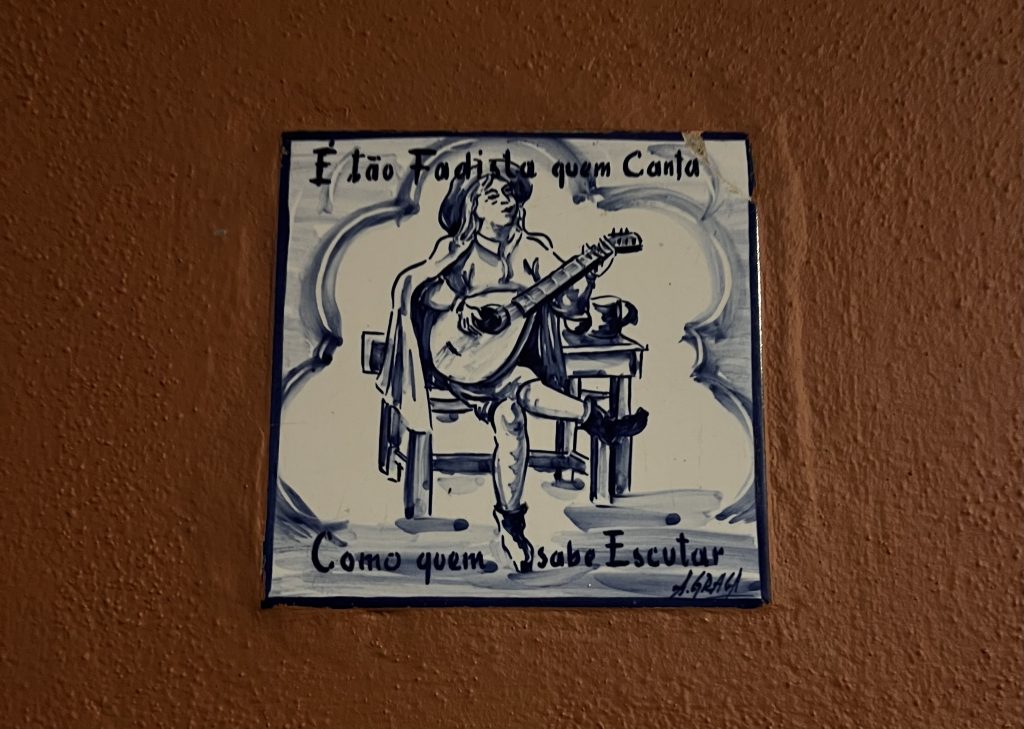
    Walking through the alleys of Alfama, you will find several panels on the buildings’ walls that carry quotes about Fado on it. One of them says: É fadista quem canta como quem sabe ouvir em silencio. (“A fadista is one who sings, just as one who knows how to listen in silence”). The phrase refers to the idea that listening to Fado attentively is also a skill. Therefore, not only singing Fado, but also listening to it in silence, can make you a real fadista.

    The mythical origin of Fado is related to the first female fadista Maria Severa. She was born at the beginning of the 19th century to a poor family in the Mouraria neighbourhood of Lisbon. Her romantic affair with Francisco de Paula de Portugal e Castro, the 13th Count of Vimioso, brought her and the Fado into aristocratic circles. She died in 1846. 

    “It was only in the 1920s and with the emergence of a new generation of fado singers, such as Berta Cardoso, Hermínia Silva, Ercília Costa, and Alberto Costa, added to the state intervention by creating the profession of fado singers and enabling the establishment of fado houses that the genre would achieve the status of a national symbol. (…) The radio broadcasting and the record created the conditions for Fado to spread out of the capital and abroad, characterizing it as typically Portuguese in the eyes of other countries since before the Salazar dictatorship. (…) In continuity with the National Dictatorship that erupted in 1926, Salazar institutionalized his power project in the so-called New State from the 1933 Constitution and would remain in power until 1968.”

    Barchi & da Cunha (2021)1

    Sara Paixão’s road into the Fado world

    When Sara Paixão heard a Fado song herself for the first time, she felt like having made a great discovery – with an even greater outcome. She remembers the story very specifically.

    “As a child, I used to share a mp3 device with my brother Tiago – one day it was mine, the other it was his. When listening to music I discovered the fado songs by Amalia Rodrigues. I would listen to them again and again. I loved and felt the songs so much that I investigated more about them and also about other fados. With time, I started singing along the lyrics.”2

    Sara Paixão

    In the beginning, she would do that only alone in her room. One day, when Sara was wearing headphones and was so soaked into singing the song that she didn’t realize it, her brother came into the room and heard her singing. He was so excited about her sister’s talent that he told the whole family about it. When their grandmother took note of it, she was especially proud of her granddaughter. Because there is something Sara herself didn’t know until then: Her grandmother’s mother was a Fado singer, too.

    With the age of 16, Sara participated in an amateur competition that marks her first performance in public. She used to sing songs by other Fado singers and make her own interpretation of them. Until today she has also published own songs, composed with the help of other professionals. She says: “I only sing what I feel… Sometimes I give my composers an idea of a place or a feeling they should write about”. Thus, the songs are based on Sara’s soul.

    How empathy and emotion shape Fado’s identity

    Over all the past centuries and the political changes in Portugal, Fado has kept close to its characteristics – its sounds, themes and rhythms.

    “The rhythm of fados is rocking and pendulous, reminding the waves of the sea. It surrounds the listener and takes him/her on a shared mood trip.”

    García-Falgueras (2023)3

    The emotional connection with listener and singer is probably the most precious thing in a live Fado performance. When she sings, Sara can feel the audience.

    “…whether they are attentive, empathetic listeners or just there to say they have been there. It’s this touristic issue around Fado. Some people are just there because someone told them to go.”

    Sara Paixão

    On some days it happens that the audience would give Sara the energy to sing well. And on other days, the audience might take energy away from her, which makes it more difficult for her to perform the emotions she would love to. There might be people asking questions like, ‘do you also play songs in English or is it just in Portuguese?‘ or ‘can you translate the lyrics?‘. Sara always tries to clarify that explaining backgrounds during the performance would make her lose the focus and the moment lose its magic.

    “What makes music so special is that it allows people to connect with each other, to connect with a singer, even when they sing in another language. For that, the listeners need to be open to receive. They shouldn’t be thinking too much, because it keeps them from letting their emotions flow. Music is connection, music is spirit.”

    Sara Paixão

    The powerful emotional effect of music has also been proven by a study about the effects of music, with the main finding: “While people are listening to or playing music, violence is far away from their minds” (García Falgueras, 2023).

    Fado’s traditional identity carried from time to time

    Traditionally, guitar players in the Fado scene have been men; at the same time the most recognized singers of the genre have been women. Thus, for Sara, as a young female Fado singer, it feels normal to be surrounded by men – may it be in fado houses or at stage concerts. The music experience differs very much in the different types of locations, both for the audience and the artists. As Fado houses have always been restaurants, they serve food, and people often eat during the presentations. This might be reflected in a lack of attention among the audience, especially in comparison to organized shows.

    “At the concerts I know that people are there for me. In Fado clubs it often happens that the audience is not so empathetic or isn’t listening very attentively.”

    Sara Paixão

    But still, the presentation in a Fado club feels “more intimate, more informal, more personal and closer to the audience (…) you can try out more things”. Singing in a Fado house all days of a week can be exhausting for body, voice and soul of a fadista. During the day they need to recharge so they can put all her emotion into the performance of the night. Sara loves to perform in different Fado houses, each of them offers their own charme. She sings at Adega Machado, Clube de Fado and Tasca de Bela.
    Is Tourism a curse or a blessing for Fado’s identity?

    Fado houses are usually fully booked, mostly of tourists. Somehow, it’s the tourists enabling the musicians to express what they are most passionate about – the Fado.

    “One of the great assets of Fado houses is the way they combine artistic performances with a characteristic menu, maximizing their profits. (…) The premature tourism, mainly foreign, generated a demand for both artistic expressions and constitutes up to the present time its strongest stability factor.”

    Barchi & da Cunha (2021)

    There might arise the question, if it is still an authentic Fado experience, when barely anyone in the audience speaks a word of Portuguese? Let’s say, as long as the fadista and the guitar players are true fado musicians, it should be considered an authentic Fado experience. And therefore, tourism can serve as a stabilizing element of Fado – strengthening it, expanding it in space, and conserving it in time.


    1. Barchi, F. Y., & da Cunha, F. L. (2021). Fado, Samba, and the interface between national identity, cultural heritage, and tourism on both sides of the Atlantic. In F. L. da Cunha & J. Rabassa (Eds.), Festivals and Heritage in Latin America: Interdisciplinary Dialogues on Culture, Identity and Tourism (pp. 29–43). Springer Nature. ↩︎
    2. Quotes from my conversations with Sara Paixão in October 2025 in Lisbon ↩︎
    3. García-Falgueras, A. (2023). Possible gender differences in classical music, Flamenco and Fado. Neuroscience Insights, 18, 26331055221147009. https://doi.org/10.1177/26331055221147009 ↩︎
  • The Caixa Alfama festival shows that Fado is more alive than ever

    The Caixa Alfama festival shows that Fado is more alive than ever

    Chapter 4: A choir of Fado echoes through the bairro

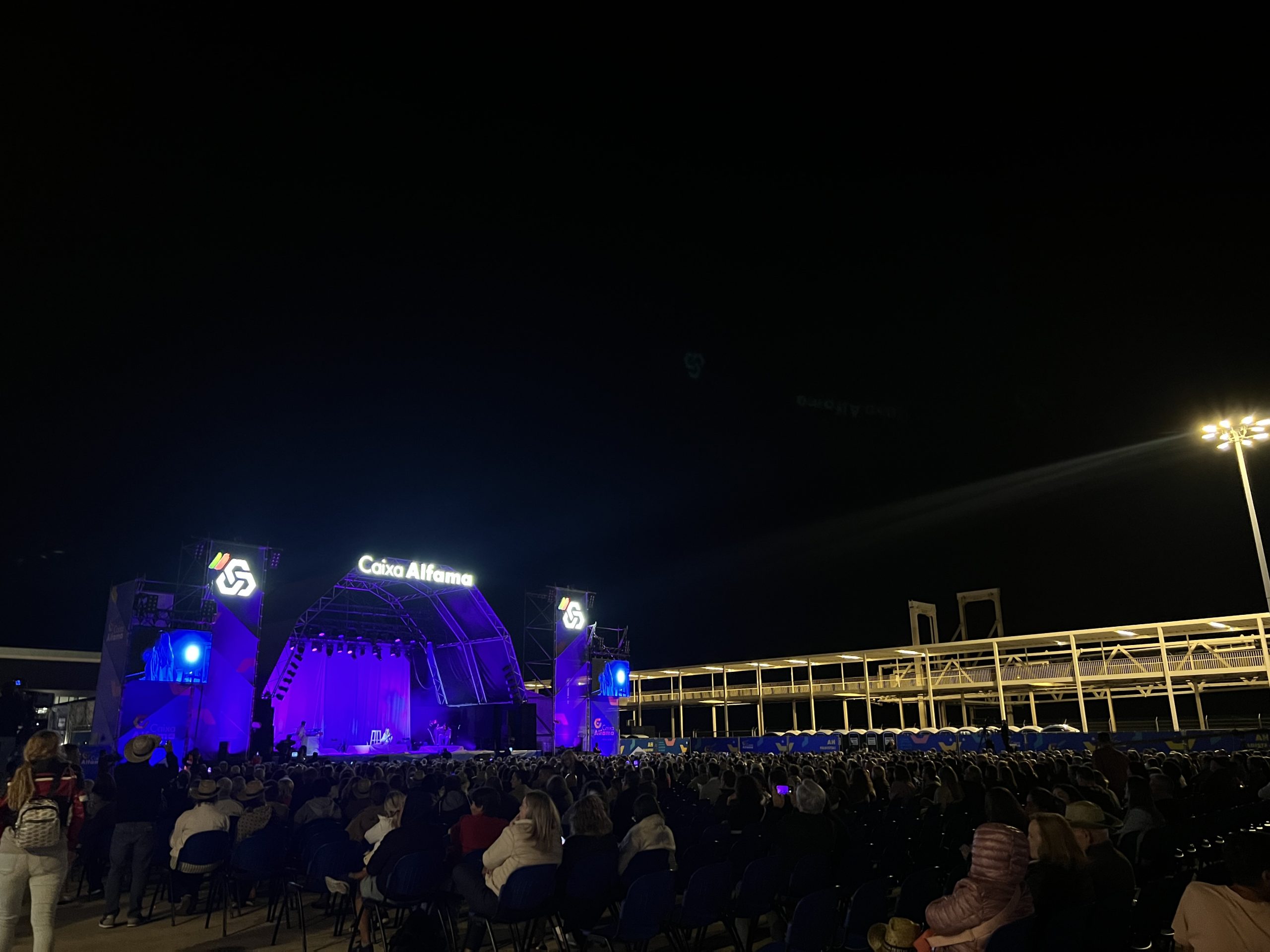
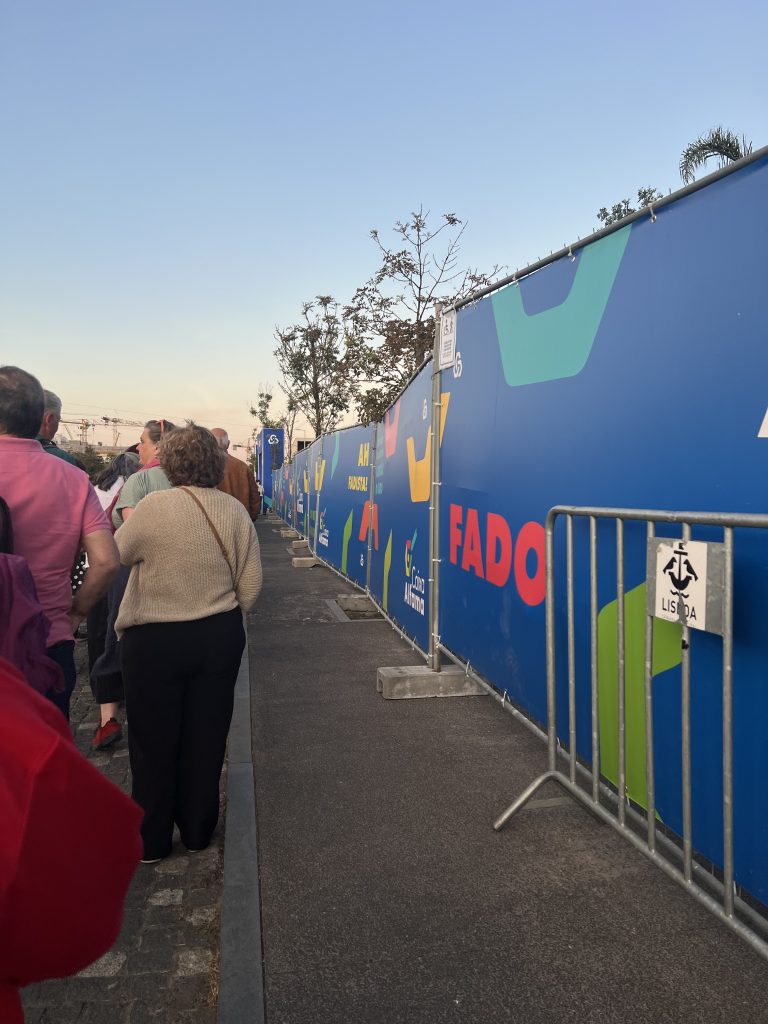
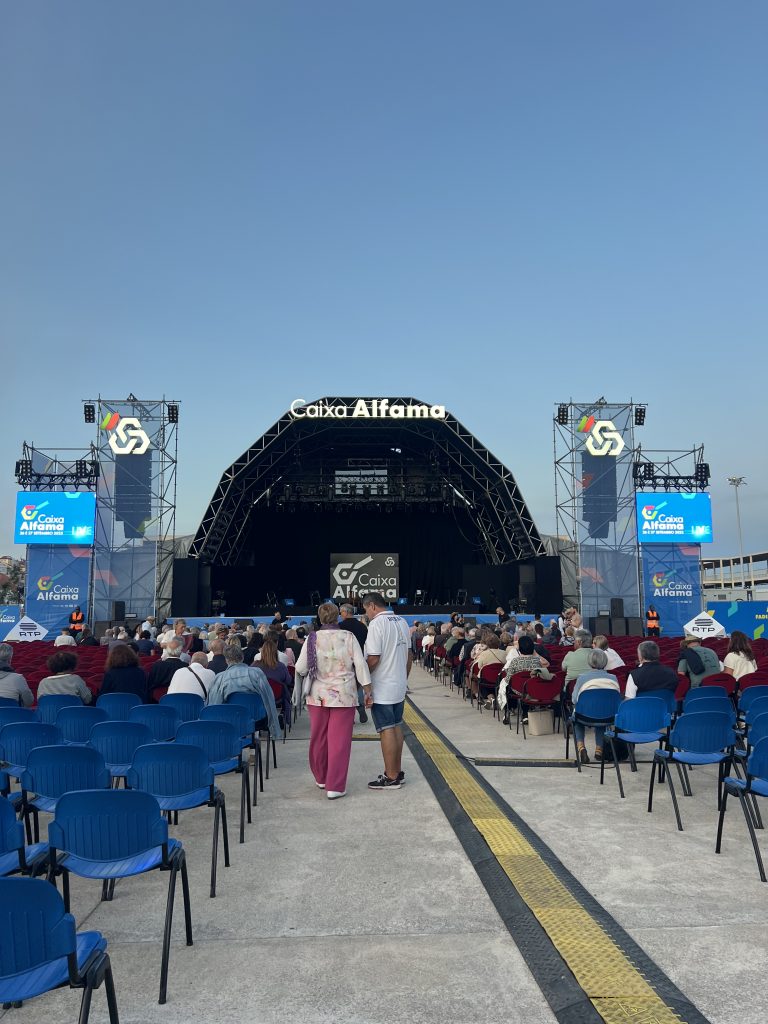
    “Silêncio, que se vai cantar o Fado” – the fences around the Palco Caixa give us a hint of what will happen there in the next two days. Fado is about to be sung. The Caixa Alfama festival turns the bairro into an all-day fado paradise. Throughout the whole year, people sing Fado in clubs and restaurants of Alfama. But during this festival weekend, the voices echo even louder through all streets.

    “Caixa Alfama is the festival that brings Fado, the intertwining of voices, the strumming of the guitar and the poetry sung on various stages in the streets and alleys of one of Lisboa’s most iconic neighbourhoods.”

    Tourism of Lisbon (2024)1

    On the 26th and 27th of September singers and musicians performed Fado on 12 stages across Alfama. The schedules were tight, so visitors had to decide which concert they prefer to experience. Before the opening of Palco Caixa, the main field of the Caixa Alfama Fado festival, the cue to the entry was longer than I expected. People wanted to get the best seats for the concert of Pedro & Helder Moutinho.

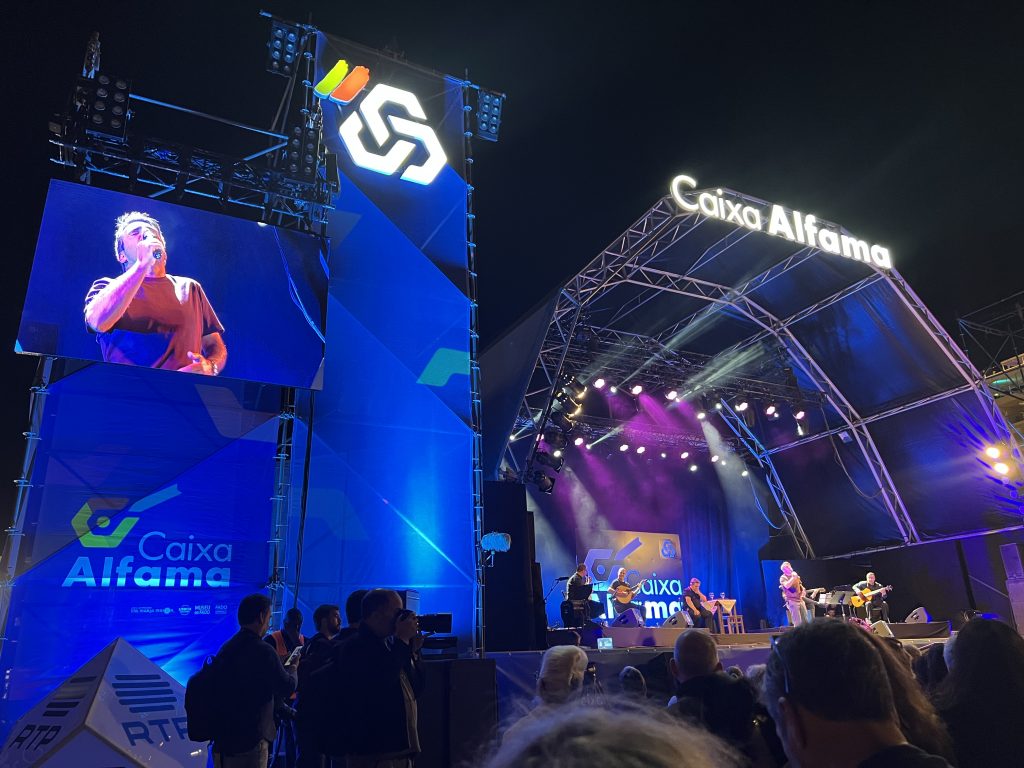
    After entering to the festival field, I move towards the first rows and choose an aisle seat on the left. When I sit down, I realize that I am right behind the woman who was before me in the cue – and I take it as a sign to stay there. At 20h the musicians, four male guitar players, come to the stage. The tuning sounds of their guitars give a first hint to the marvelous harmonies we will hear. They start playing a melody, then a voice appears from the back. It’s Pedro Moutinho singing, while walking towards the middle of the stage.

    For the second song, Pedro moves a few steps back to sit on a table with a glass of wine and to listen to his brother performing the song Ja não te Espero. The following classic Garota da Mouraria, also sung exclusively by Helder, brings a delightful and quicker rhythm to the stage. Pedro, still sitting, now moves his hands and feet according to the rhythm. Then it’s his turn. With Rua de Esperança he presents his popular own song.

    The magical opening of the Caixa Alfama festival 2025

    After a few verses, Helder comes to join Pedro for a duet of the Fado classic Igreja de Santo Estevão, originally by Fernando Maurício. Their interpretation of the song is an enchantable duet, sometimes taking turns by stanza and sometimes by verse – culminating in both voices singing together. Helder has a very full and deep voice. Pedro’s voice has another colour that seems to be generally higher, more accentuated. Together they are like complementary colours – both enlighten each other even more when they are together.

    Unfortunately, I cannot see the whole concert. The woman in front of me has already left when I get up from my seat. Maybe, just like me, she wants to see Sara Paixão. The Moutinho brothers don’t make it easy for me to leave. For a few minutes I watch the show standing behind the audience. From there, the concert feels different and – as they determine a big part of my sight, the audience somehow becomes part of the show. With my pretty fast walking pace, it’s only a five-minute walk from the main festival site to my second destination, the Igreja de São Miguel.

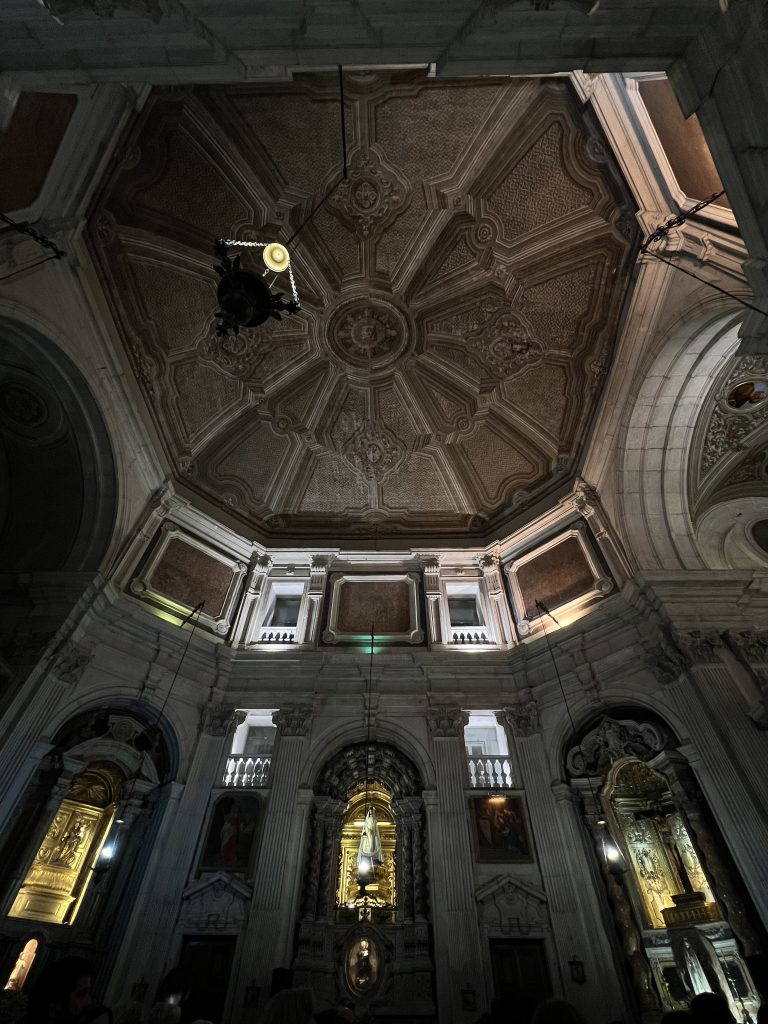
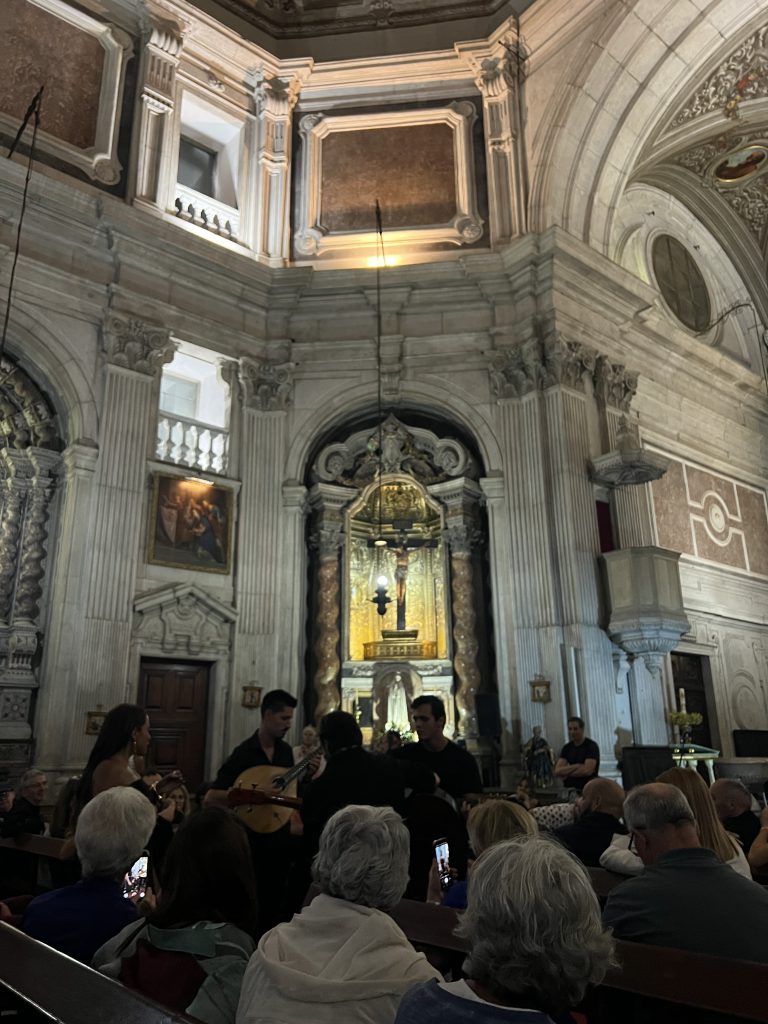
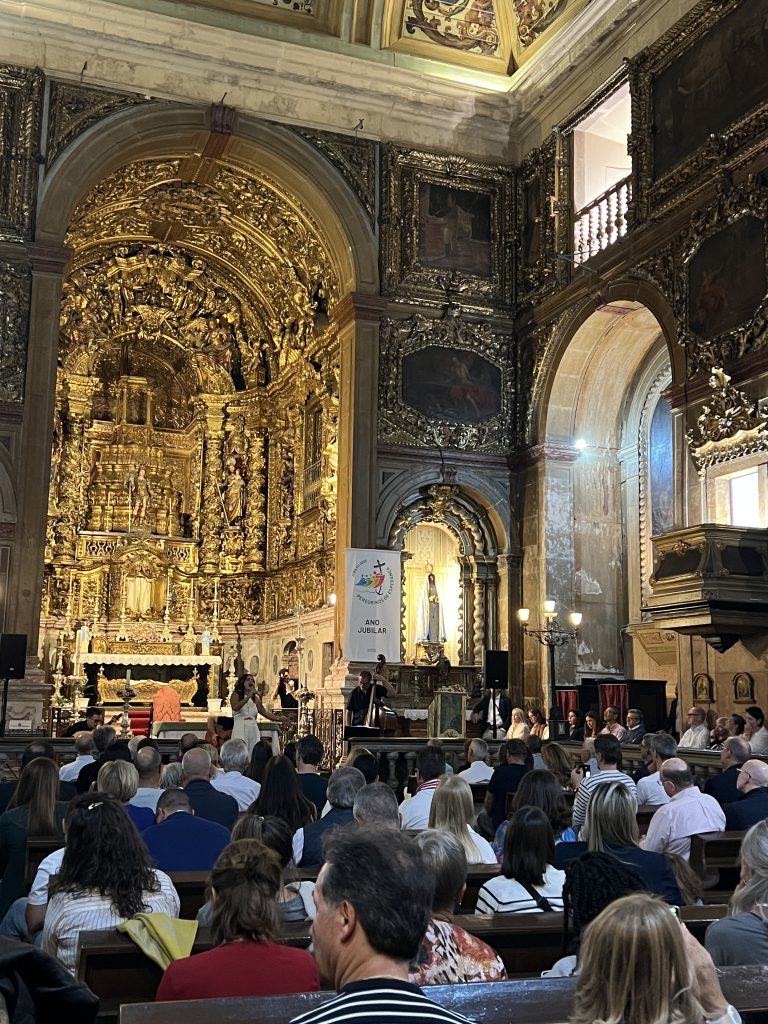
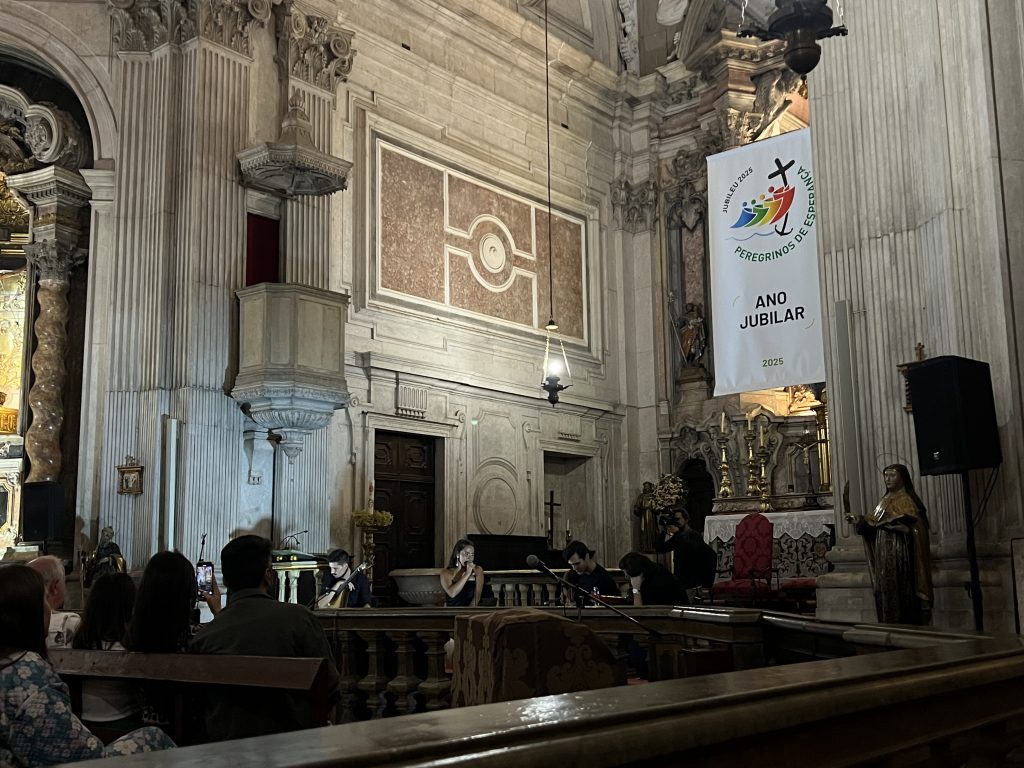
    The stairs in front of the church are crowded and one of the security members explains to a woman that it’s only possible to enter with a festival wristband – “You need this!”, he says, pointing at mine. Proudly wearing my wristband, I go into the church. The ambient is uniquely impressing. At Palco Caixa, Pedro and Helder had a big stage; in a church like São Miguel the ornaments and architecture are enough to create a festive performance spot for Sara and her musicians. With her beautiful white dress, she shines like a diamond at the front of the altar.

    A toast to traditional and emotional Fado

    As I arrived after the beginning of the concert, I don’t manage to get a seat. Instead, I stand behind the benches, and together with many other people I form part of a huge circle around the church. Sometimes, there are movements among the audience – people leave or join. Mostly, they are respectful enough to wait until the end of the song. Next to me there is a woman wiping tears from her cheeks. Sara Paixão touches the audience not only with her beautiful voice and appearance, but also with her authentic personality. She describes her motivation to sing on that evening as follows:

    “…because I believe music also has this power – the power to make us share what we feel. And I think we’re living in a time when we no longer know very well; I can’t even say what I feel, because it’s a mixture of emotions. I believe we’re all forgetting what’s essential, and that this divine stage reminds us that we are all made the same way – of the same matter.“2

    Sara Paixão

    She spreads her energy amongst the people in the room, it fills hearts with grace, eyes with tears and forms lips to smiles. When she sings the dramatic Bomba Branca, she almost screams her soul out of her body, making it visible for everyone in the room. The rhythm of Lágrima do Mar is more friendly, spreading the feeling of swaying slowly from side to side. Melancholy slowly drifts away when she announces the last song.

    “On the radio, in the car, right in the middle of traffic – when everyone’s tense – if this song starts playing somewhere, we love, the truth is we’re instantly transported and feel so much lighter. This song has a little choreography I’d like you to do with me. It’s very simple – I’ll even put the microphone down.”

    Sara Paixão

    Tapping her feet she shouts without microphone, tapping her feet, “Bate o pé!”, and then, clapping her hands: “E bate a mão!”. Sara animates the audience to practice this a few times and then make use of it in the following song. The acoustic conditions in the church are amazing and therefore this act, bringing together taps and claps from all corners of the hall, is a dignified end to a magnificent show.

    Fado in churches and stages all across Alfama

    The next concert is already waiting for me, in the next church, which was the title of the famous fado by Fernando Maurício we heard at the beginning: Igreja de Santo Estevão. When I walk through the steep alleys to get there, I hear the sounds of fado from all corners. Guitars and voices echoe from restaurants on the streets. I arrive at the church just in time for the singer appearing on the altar. Maria Emilia greets everyone, first with an impressing fado, then with some personal words:

    “I’m half Portuguese and half Brazilian – more Portuguese than Brazilian when I’m here, and more Brazilian than Portuguese when I’m there.”

    Maria Emilia

    And there is no song that would fit better to her roots than Saudades do Brasil em Portugal – which she sings now. Originally by David Mourão-Ferreira,the fado starts with the melancholic lyrics “The salt of my tears of love created the sea that lies between us – to unite us, and to separate us…”

    Also, with the following song choice she refers to her origins – it’s the Brazilian song De Volta pro Meu Aconchego by Elba Ramalho, that Maria Emília recorded herself as it is so important to her.

    “…between two countries, I had to record this theme, because it makes me think of home and my origins. It brings back so many memories from when I was a small child, listening to my mother sing this song.”

    Maria Emilia

    From Brazil to Portugal, with love and saudades

    The song is about the returning to an Aconchego – a Portuguese word for a familiar, protective place – carrying in her luggage so much saudades – the characteristic fado feeling of missing something that is not there.

    “…and forgive my audacity in singing a Brazilian song at a fado festival – but each of us gives what we have to give, and those who give what they can, cannot be asked to give more.”

    Maria Emilia

    Maria Emília also presents her most famous single Dona do meu nariz– telling the story of an empowered woman who is capable to decide the paths of her life on her own. A highlight of the concert at Igreja de Santo Estevão is when she comes into the middle of the church, leaving her microphone behind. There, the guitarists stand around her in a circle while she is ecstatically singing using body and hands for expressing her emotions.

    After the concerts at the two churches, I go back to the main festival place. It got dark and windy. I get myself a glass of wine and sit down to observe the people around me. With an inner smile, I reflect on the past hours, excited about what’s to come on the next day.

    After the sun, comes the rain

    On Saturday it got stormy in Lisbon. It took me some time to realize that bad weather conditions might influence the festival schedule. I stayed optimistic during the day, but at the same time reduced my objectives for the evening. And so it happened that my second festival day didn’t start as smoothly like the first one. From my first selected venue I was sent to another one, as the concert has been relocated due to weather conditions. Well, no problem I thought, I know the route to Igreja de Santo Estevão already.

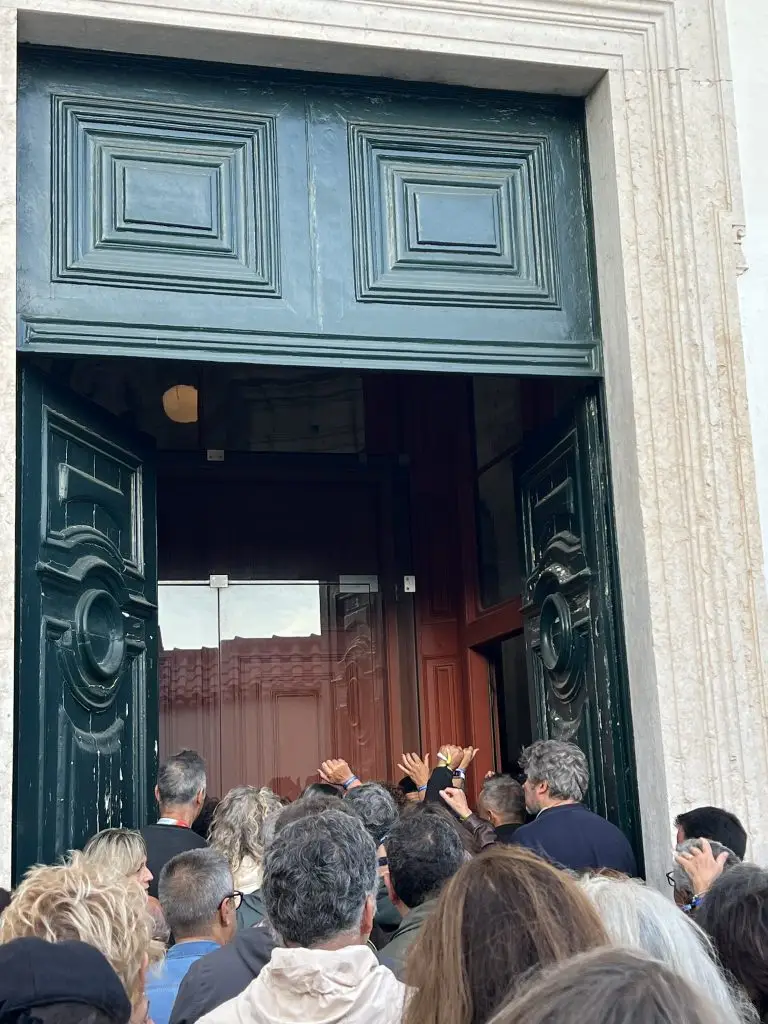
    It’s obvious that the church is too small for the audience. The crowd around the entry door makes it almost impossible to see or hear anything from the performance. On her way out, a woman says, “Don’t go in, não vale a pena”. So, I decide to go somewhere else. But where to? My intuition leads me down the road to the Fado museum, which is also part of the 12 festival venues. Not knowing who will play, I get into the cue.

    Adding theatre to the Fado performance

    All seats of the Fado museum’s auditorium are occupied, when the singer Vânia comes into the front area. She adds spark and lightness to the intimate atmosphere in the room. From the first moment, I can notice her background in acting and theatre. Her gestures as well as her mimics are strongly expressive, when she talks and especially when she sings. A charismatic aura lies in her sparkling eyes. Her voice is strong and so is she.

    “I’ve been a nurse, and I currently work in the field of fertility and women’s health. This song is dedicated to all mothers – and to all women who are not yet mothers, but already carry motherhood in their hearts – Mão de mãe

    Vânia Conde

    Somehow Vânia’s wonderful concert marked my personal finals of the festival. I knew it got windy and rainy outside, so I didn’t want to leave the museum at all. What I basically did then was moving from one place to the other, in the need for shelter, food and good fado. Unfortunately, it wasn’t easy to find any of it. On the main square at Palco Caixa they started tearing down the stage (without any kind of announcement). So, I went to Igreja de Santo Estevão again. There was a guy from the association Fado à Janela writing fados about concert visitors he talked with before. Another one presented them live for the first time. It made me think that in the end, each of our lives carries a Fado to be written.


    1. Description of the festival by Tourism of Lisbon, from https://www.visitlisboa.com/en/events/caixa-alfama-festival24 ↩︎
    2. All quotes originally recorded from the Caixa Alfama festival 2025, translated to English with the help of translator Helena Ramos ↩︎