
Chapter 8: Where Fado flows through the veins
The first day of the year 2021 marks a day of national mourning in Portugal. The country had to let go of the greatest male Fado singer. Of a man whose nickname was “Lisbon’s voice”. He was the first Portuguese to be awarded with the Latin Grammy. I’m talking about Carlos Alberto do Carmo Almeida, known as Carlos do Carmo. Thanks to his mother Lucília do Carmo who was a great fadista herself, Carlos felt Fado in his veins even before he was born. In 1947, when little Carlos was 8 years old, his parents bought a Fado venue which the family named “O Faia”.
When his father Alfredo Almeida died in 1962, Carlos started to manage the restaurant and would sing there every night together with his mother. In his over 50 years of career, he toured around the world. His concerts at London Royal Albert Hall, the Alte Oper in Frankfurt and the Olympic Stage in Paris are some of the many highlights. Carlos do Carmo has been an idol for many contemporary fadistas; some of them, as for example Camané or Mariza, even sang together with him on stage.
To enable embracing his artistic international career, Carlos do Carmo decided to sell the Fado house in 1979. Since then, O Faia lies in the hands of another family who have taken more than good care of it. On its website the history of the restaurant is described in detail…
“António Ramos was, at that time, hired to work as a bartender, a few years later, he was invited to be part of the society. In the mid-90s, with the two sons, Pedro and Paulo, he assumed the management of O Faia, which once again fulfilled his Fado (fate): being a family home, that of the Ramos family. The father and sons are there every night, paying attention to every detail, doing what they like the most with the passion they always have: welcoming at their place.”
At O Faia, we learn how to show appreciation
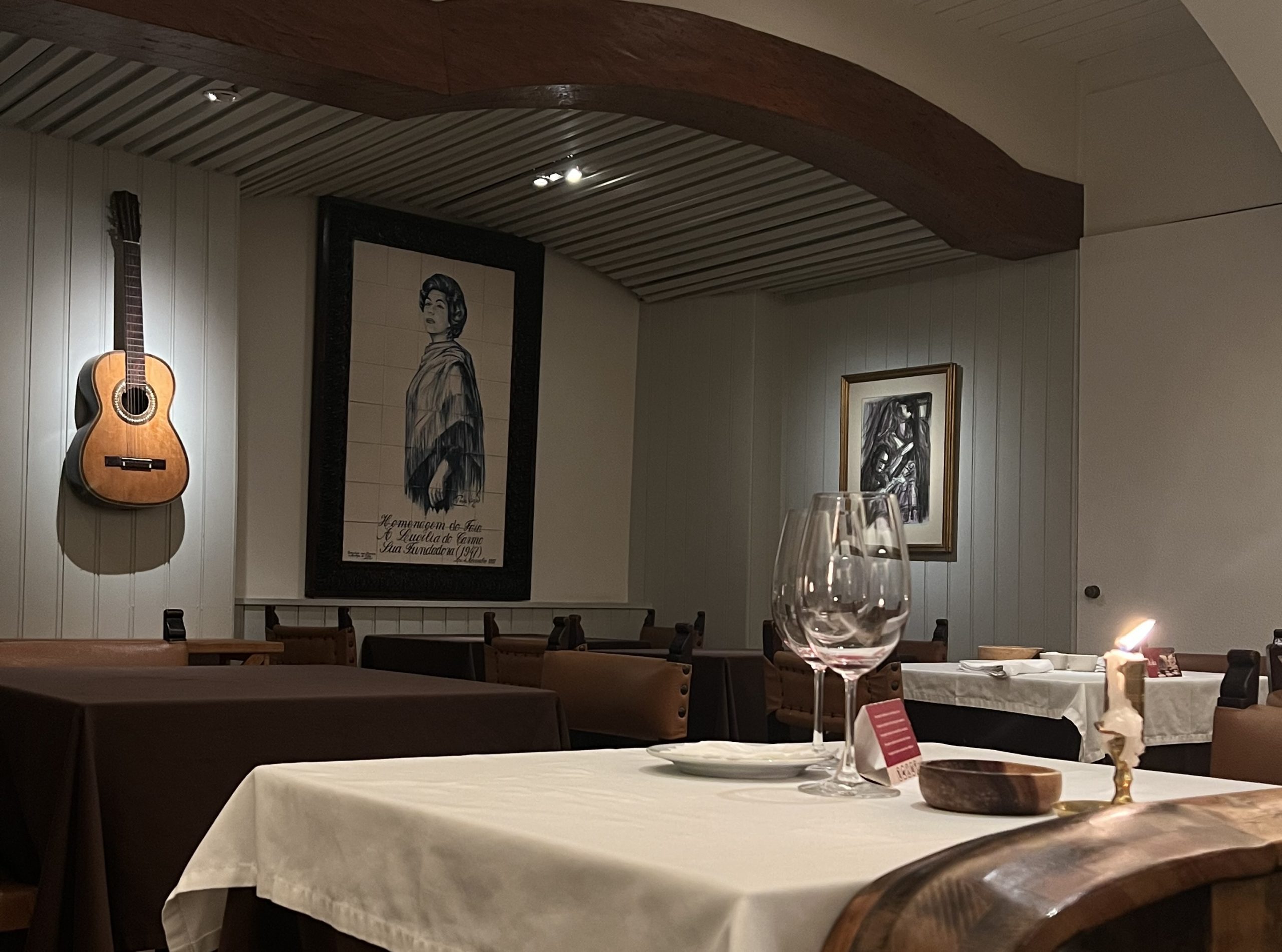
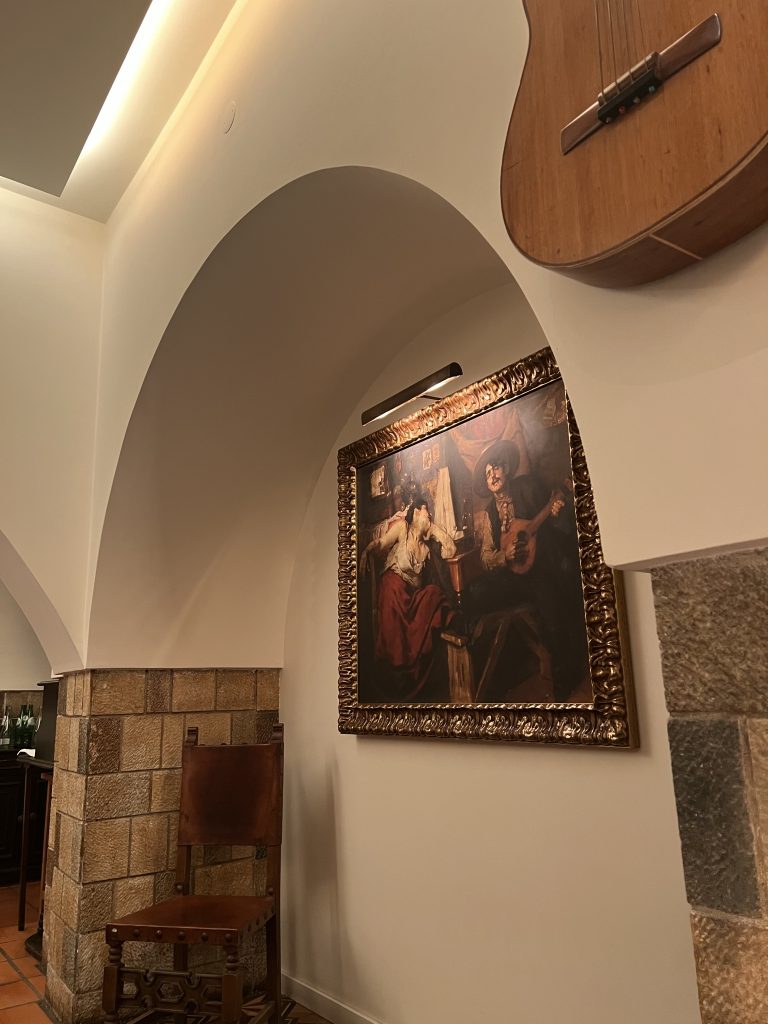
It’s true. When I go there on a Thursday night, the Ramos’ brothers welcome me. I arrive after dinner time, when the 2ndround of fado is about to start. The dinner round was fully booked, now it’s getting calmer. Entering the main room of O Faia in the Bairro Alto of Lisbon feels like walking into your parents’ living room. Seeing the brothers working together and breathing in the soulful interior of the restaurant create this comfortable feeling of home. Big bows form the ceilings, pictures of Fado legends and guitars decorate the walls. On my right there is an acoustic guitar, at the wall in front of me (some meters away) a Portuguese Fado guitar. Even three guitars are on the wall on my left. It’s like an exhibition of well-shaped guitar-bodies. The guests create a harmonious atmosphere. Most of them are young to middle-aged English-speaking couples.
Shortly after I arrive at my table, the waiter brings the wine menu. I look it through. Another waiter puts a candle on my table and lights it. As I’m alone I won’t take a bottle of wine. But still, it’s fun to see what they offer. In the end, I simply tell the waiter that I would like a glass of white wine. He asks “dry or something simple?”. “Dry” I say decisively, without any doubt. A few moments later, the waiter comes up to me with the wine bottle, pours a little sip to let me try it. It has exactly the taste I look for in wines. Accentuated but light. I watch some of the other guests tasting wines. Most of the glasses shimmer red.
An unforgettable Fado night at O Faia
Now, before the show begins, it’s the most stressful time for the waiters. During the Fado presentation there won’t be any service, it’s a matter of respecting the silence. Pedro Ramos, one of the owners of O Faia, tells me about the history of the restaurant and the changes happened over time in consuming Fado.
“It started with fadistas singing in taverns, mostly for free. It was until the early morning hours that people wouldn’t leave the Fado places. Today Fado is still rooted in the fundamental tradition of being connected with gastronomy.”
Pedro Ramos
A big change happened from the point when smoking was forbidden in restaurants, as Pedro Ramos notes. Thus, nowadays the fadista’s talent is appreciated and respected more by the guests in a restaurant. There is an official beginning and an ending of a show or a Fado set, and people pay a corresponding price for the experience.
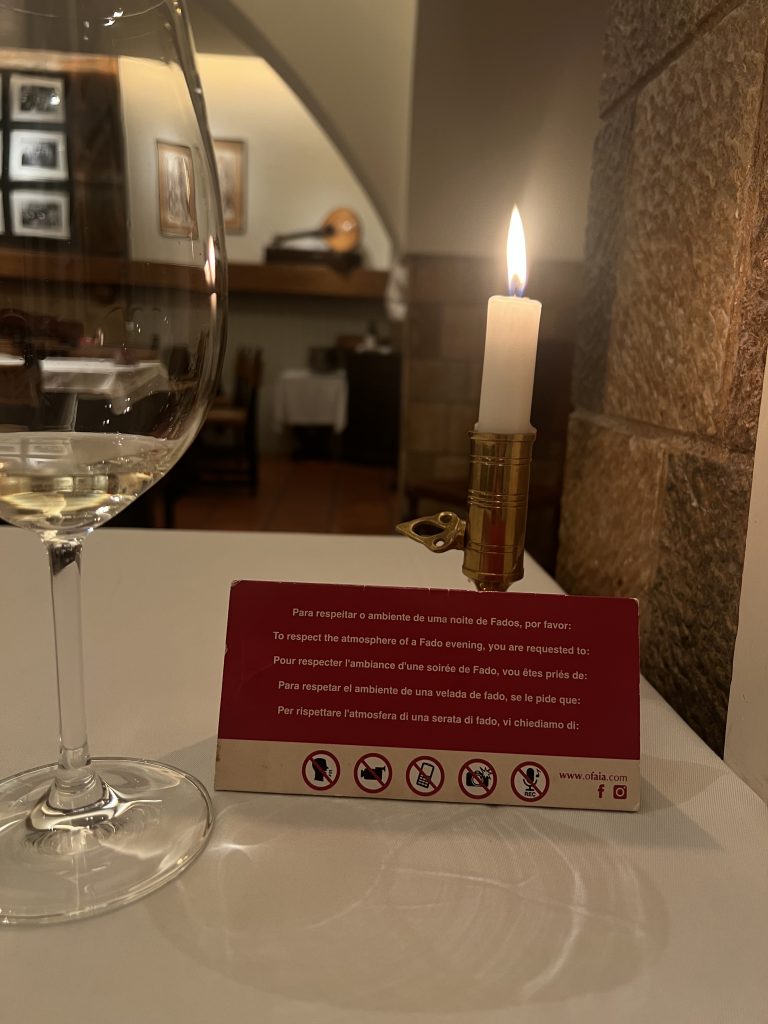
At 23:30h lights are slowly dimmed in the dining room of O Faia. Now, as the electronic lights are off, candle lights determine our views. Chatters transform into whispers, whispers into silence. It gets so quiet that I don’t even dare to eat my sweet potatoes chips. We hear a female voice singing, muffled by the walls dividing us from her. I wonder, is she doing a voice-warmup? The seemingly young voice fades, now we solely hear plucking guitar strings. And – the sound of a phone dropping to the floor. I guess, that wasn’t part of the show.
Listeners without phones, singers without microphones
The guitar players enter the room. They sit down, start chatting, tuning their instruments. “Ainda no” (=Not yet), they continue tuning, then slowly start playing a melody. The first fadista of the night comes into the middle of the guitar players: Maura Airez, a beautiful young woman dressed in black. She whispers to the musicians. They seem indecisive about the song choice. “Ela!” (=That one!), Maura says with a laugh. As she starts singing, my heart slowly contracts. The Portuguese guitar, the acoustic guitar and the singer’s voice seem like gears mashing perfectly into each other.
The acoustic guitar player, who is one of the Ramos’ brothers is placed right in front of my table. He plays in a uniquely passionate way. His head is close to the guitar neck, he almost hugs the instrument. I can hear his breaths in the rhythm of his playings. When I dare to take my eyes away off him, to let them wave through the restaurant, I see that each and every one looks towards the front. The best thing is that there are no phones allowed, thus everyone sees the magic through their own eyes – not through a camera lense.
At O Faia, one emotional highlight chases the next
After a few songs, Maura leaves the stage. I hear the echoe of an applause and see redwine sparkling in the candlelight. Strings are retuned. Happily delighted of the energy in the room, the guitar player continues to breathe in the rhythm of his playing. The next renowned fadista is on his way: Ricardo Ribeiro.
He takes a step back to place himself a little behind the musicians. His eyes are closed when he begins to sing. I can’t believe how much power his voice carries. I heard his name before, but never have I heard his voice in a live performance. The volume reaches into every corner of the room; and it seems that each sound he produces glides back to him, filling him with even more power. The guitars get louder and so does his voice. He sings himself from the fado classic “Mas fadistas que fados” to “A minha janela”. Ricardo thanks the audience for the applause, moving his lips to “obrigado”. I can’t hear a tone, maybe his voice is in singing mode only right now.
Another tuning break, another change of singers. Three women use the little break to get up from their tables and head towards the door to leave the room. A waiter accompanies them on their way out, then sneaks himself through the curtain back into the main restaurant room. Meanwhile, I observe the shadows of the guitar bodies, which rise all the way up to the ceiling. The guitars are playing an instrumental now which seems to turn out longer than planned. We all wait for the next singer to appear.
Impressive appearance meets breathtaking voice
The Portuguese guitar player Bernardo Romão looks behind him over his right shoulder to check if someone comes. The instrumental continues. A waiter, who seems to feel responsible for resolving the waiting situation, walks back to look for – Lenita Gentil, there she comes. “Boa noite” – she is the first artist of the three to talk before and in between the fados she presents. “Canto un fado tradicional. Me passo con ela mi rua”.
From my little Portuguese knowledge I understand that she will sing a traditional fado that has accompanied her on her path. Her voice moves my body; my heart jumps in circles and my skin is bathed in goosebumps. It’s the most intense Fado experience I have had until then. Lenita Gentil claps with the rhythm – her energy is unique. She still stands on the side, giving me the impression that she doesn’t like to be in the centre. “Laleuilauleiiii” – together with the audience she starts a beautiful choir, that marks the end of a magic Fado night at O Faia.
Lights are turned back on. Glasses are getting empty. The waiters empty the last open wine bottles. Some candles are already burnt down, others not. Tablecloths are removed. The air in the room smells different now than it will tomorrow.
Leave a Reply