

Chapter 14: Nuances of voice and guitar strings
Lisbon has Lisbon Fado – Coimbra has Coimbra Fado – and Porto… has both!? An obvious phenomenon for every tourist walking through the streets of Porto is the promotion for the “authentic” and “traditional” Fado shows in the early evenings. Among all these offers, Casa da Guitarra and Fado Maior do Porto are outstanding places. They teach visitors about the characteristics of the Portuguese Fado traditions: the Lisbon and the Coimbra Fado.
Travelling the world of string instruments
Closely connected with both Fado styles is the Portuguese guitar, which may appear in different forms. In the free exhibition at Casa da Guitarra, you will get to know instrument makers, artists and a huge variety of string instruments. And, right in the traditional instruments shop, there are offered guitar workshops as well as daily Fado concerts.
As displayed in the exhibition, Portugal has a long musical tradition of string instruments: they have been part of the population’s daily life for centuries, in both work and leisure. Above all, it’s the sound of the Portuguese guitar that fascinates people from other countries. In Fado, the instrument has the unique ability to express feeling and create a narrative through responding to the singer’s melody without resorting to words.
Thus, the guitar is a symbol for the Portuguese cultural identity. Its origin is linked to a line of evolution that goes back to the European cittern and the English guitar. Probably it were British merchants and musicians who brought the English guitar to where local artisans adapted the instrument to their preferences. That being said, it acquired new technical, aesthetic, and sonic characteristics.
Crafted with love and attention to detail
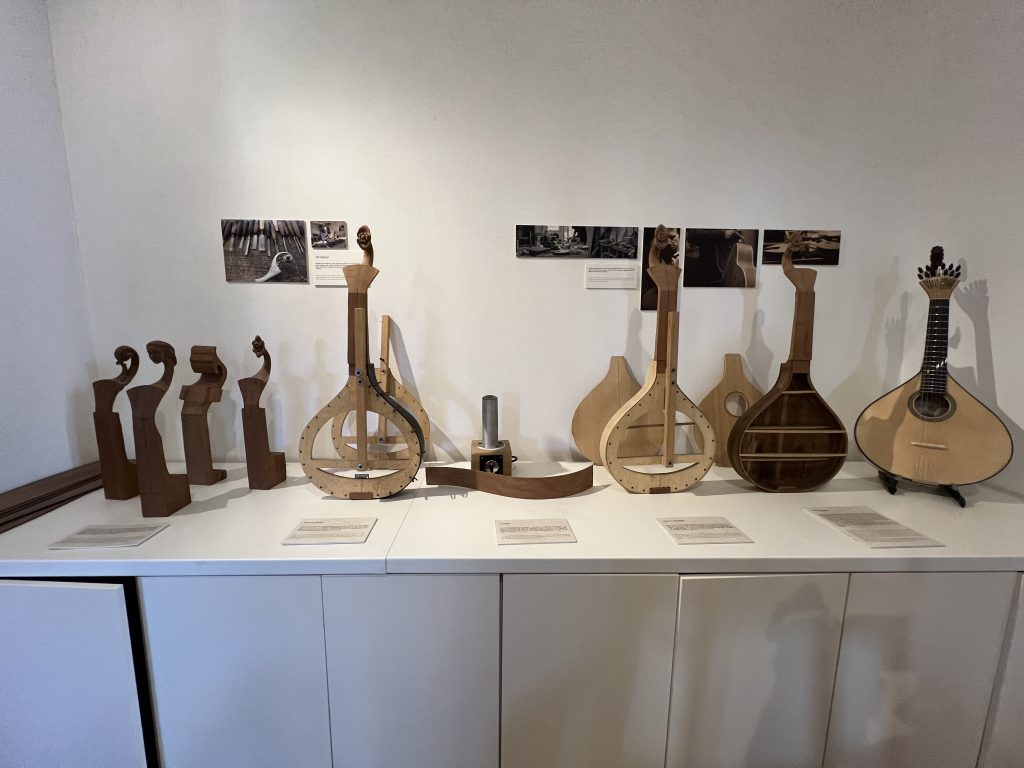
To build a guitar, craftsmen from different areas need to work together, as the instrument consists of various materials. Metal is need for tail pieces and tuning machines, bone for saddle and nut and the guitar head is carved of wood. At Casa da Guitarra one can see “the assembly of the neck with the mold of the instrument to be built”. Decorative elements can be crucial when differing between the Lisbon and the Coimbra guitar model.
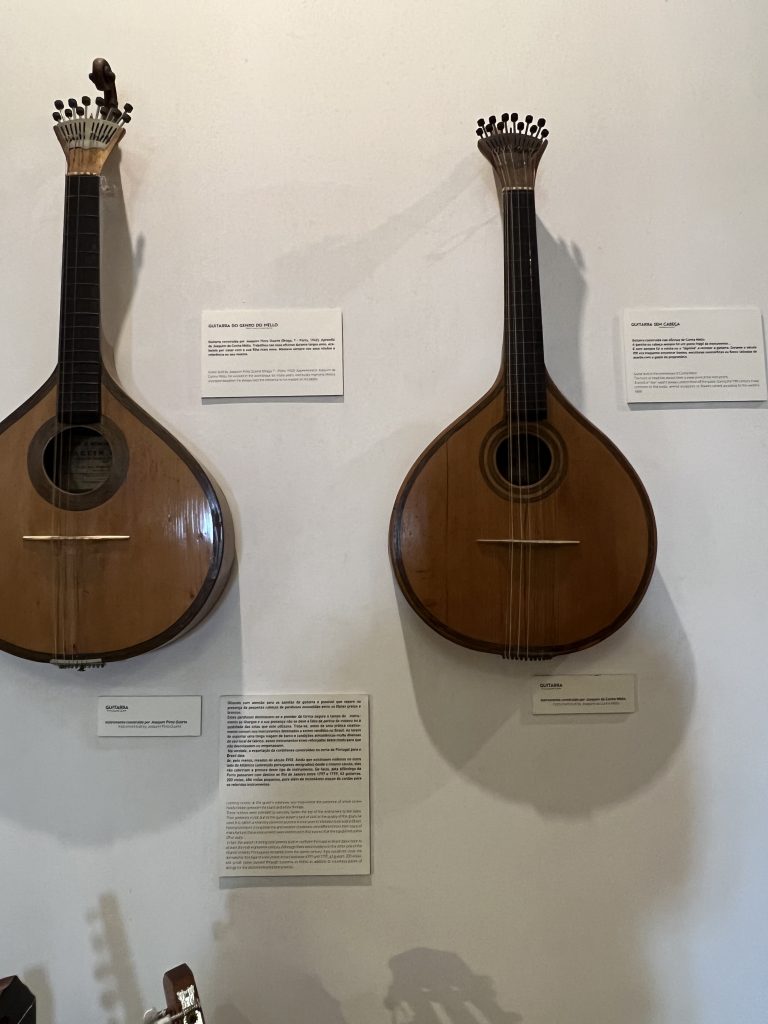
“Nowadays it is common to identify the model of the guitar by its headstock hook. The scroll (or snail) tops a Lisbon model guitar; a simpler teardrop-shaped hook identifies a Coimbra guitar, while a more elaborate head, in the shape of a flower, animal, or human, corresponds to a Porto guitar.”
Casa da Guitarra
After the decoration is built, artisans need to be patient: it’s time for bending the thin and delicate strings around the mold, which is only possible with the use of heat. In the next steps, they glue the different parts of the guitar carefully together.
“The top is also an essential piece for the mechanical-acoustic functioning of the instrument as it directly receives the vibrations produced by the strings and transmitted by the bridge. The braces, in varying numbers and arrangement, are first glued inside.“
Casa da Guitarra
Finally, the fingerboard completes a guitar – it is made of high-density wood and will support the frets that allow you to stop the string according to musical notes.
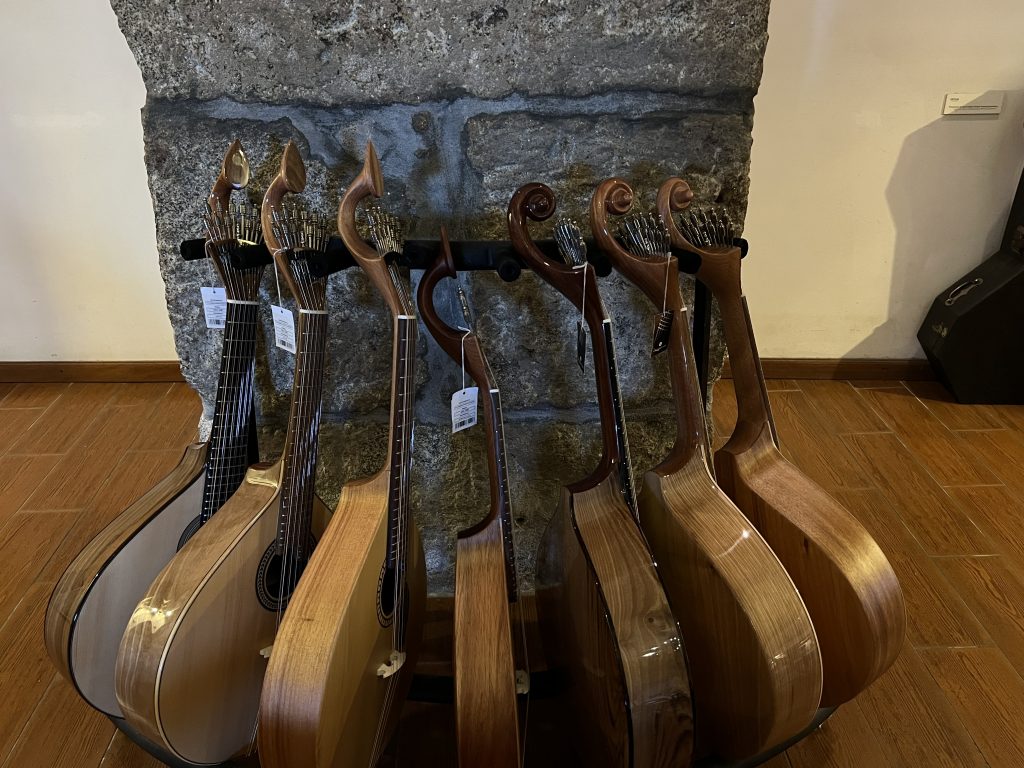
The huge diversity of guitar models reflects the creativity of their creators who used different shapes, dimensions and materials.
The names behind the shapes
With the emergence of large music stores, it has become increasingly common for instrument labels not to identify their manufacturers. The exhibition at Casa de Guitarra highlights some of the most important guitar builders, whose names deserve to be remembered:
- António Duarte founded his first workshop in 1870 at Rua da Banharia. He is appreciated for his careful choice of materials and the precise calculation of the fingerboard. He won a silver medal at the 1908 National Exhibition in Rio de Janeiro.
- José Carvalho, born in 1953, is one of the most famous artists in the field of wood carving. He has dedicated himself to carving guitar necks for 30 years until now.
- Joaquim da Cunha Mello established himself as a guitar maker at the end of the 19th century. His sons and sons-in-law worked together in his workshops, where they produced guitarras, cavaquinhos, mandolins and banjolins. The family decorated the instruments with details and sold them at affordable prices.
- Alfredo Teixeira is the founder of the Casa da Guitarra project. He has played string instruments since he was 13. Later, he learnt by himself to build the instruments, which he has been doing since 2007. In 2012, he opened the Casa da Guitarra.
Over time, many guitarists have become true legends for their virtuosity and emotion. The most recognized ones are Armandinho (Armando Augusto Freire), Carlos Paredes, Pedro Caldeira Cabral and António Chainho.
Fado Maior do Porto unites 2 traditions in 1 show
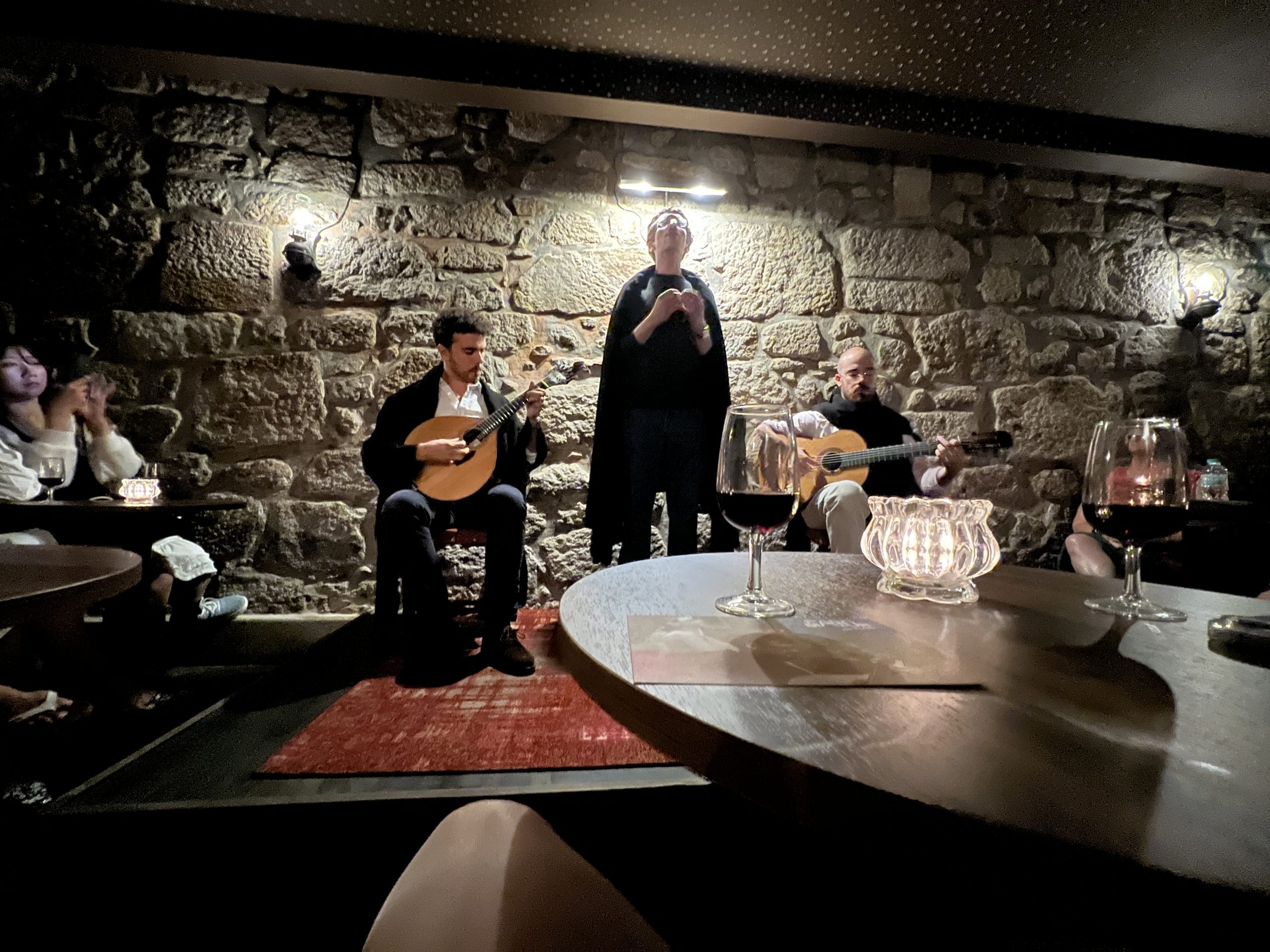
Not far away from the Casa da Guitarra one can experience both styles of Fado in only one concert – Fado Maior do Porto makes this unique experience possible. Every evening at 19h, they open their stage on the riverside of Porto to the music group Canto do Rio and other Fado singers. The combination of Coimbra and Lisbon Fado makes this show stand out from others.
At 18.30h guests already arrive in the intimate venue of Fado Maior do Porto. With walls out of stone and low ceilings, the place seems to like a comfortable mix of a restaurant and a living room. It’s worth coming early to save yourself seats close to the small stage in the middle of the room.
I get to sit in the first row. The woman who welcomed me at the door lights the candles and brings everyone a glass of port wine. Impatiently, I look at the red chairs and carpet on the stage in front of me. I clink wine glasses with the guest next to me.
In Porto, the love for Lisbon and Coimbra meet
A few minutes after the official beginning musicians come to the front. They wear black ropes, which is a characteristic for Coimbra Fado. the singer jokes, “we don’t wear them because we think we are superheroes”. He also explains the music style’s connection with university students in Coimbra. When the fadista of the Canto do Rio group sings Olhos Claros, his voice slowly gets more voluminous from tone to tone, culminating in an operatic way of singing.
The set of Lisbon Fado is presented by a woman. She brings femininity and, of course, a lot of saudades to the stage. I automatically compare her way of singing to the Coimbra Fado set we’ve heard before. And my impression is that the Lisbon Fado is more playful and more diverse in terms of emotion and soulfulness.
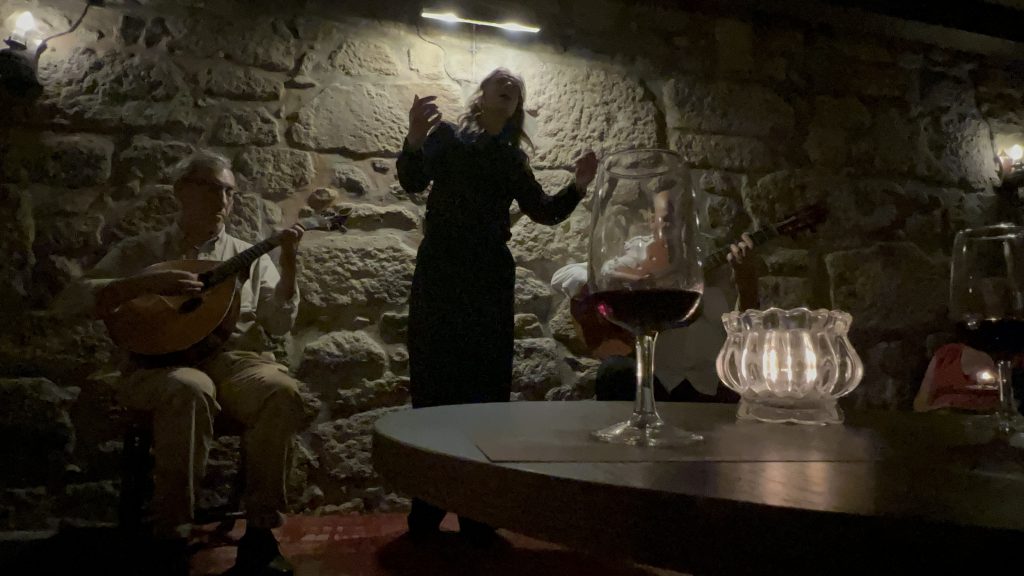
At the end of the show, the Italian guy next to me shares his opinion with me. He resumes about his first ever Fado experience: “I prefer the voice of a woman for Fado” and “I didn’t like so much that they talk between the songs, because that took me out of the feeling.” Others might think the exact opposite. Explanations may help for understanding the content of a song. The beautiful thing is that each visitor makes their individual experiences in the concerts, each of them listens and receives the music with their very own heart.
Leave a Reply