

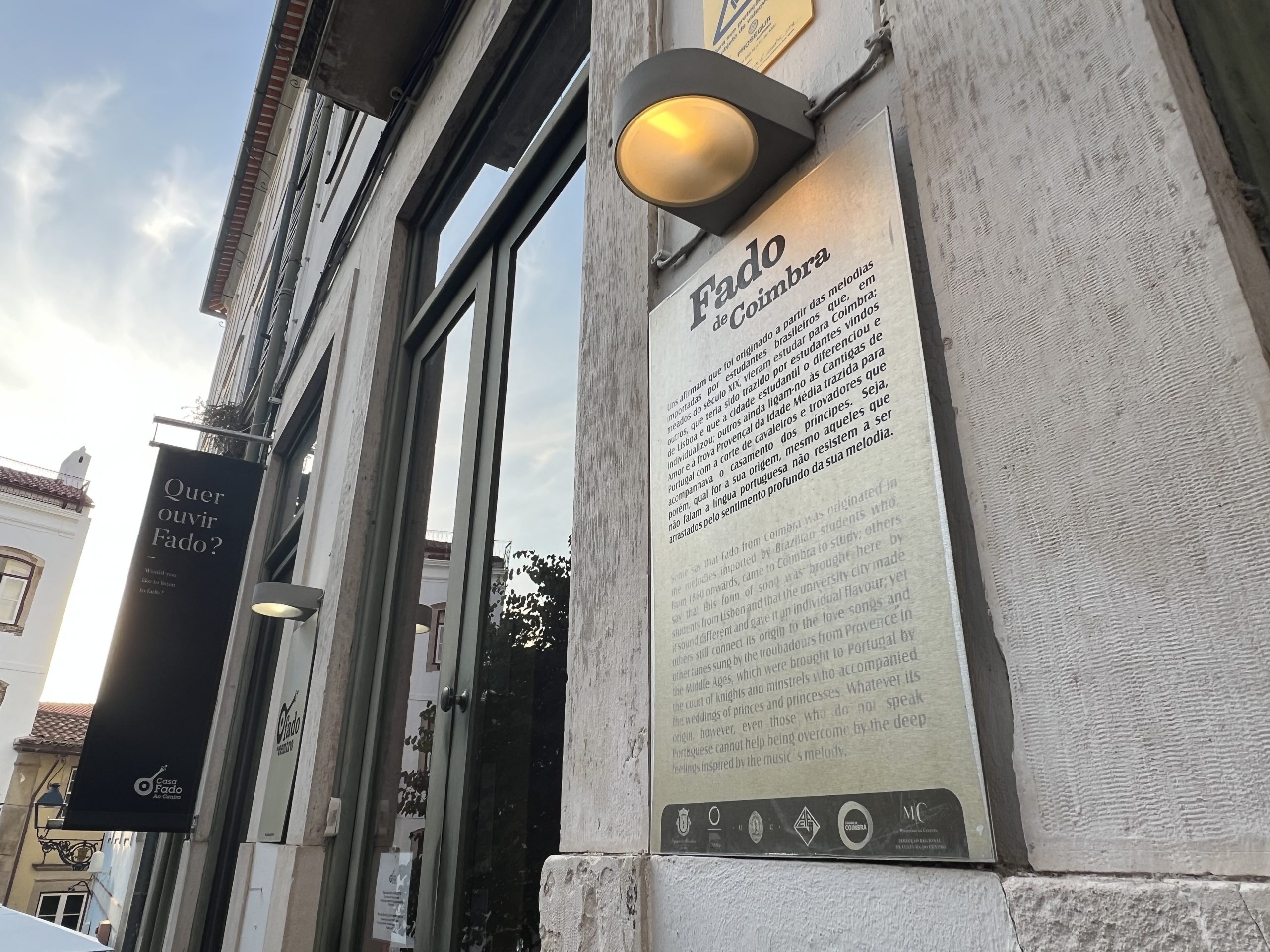
Chapter 15: Students’ operatic love serenades
Impatient guests wait in front of the door to the Fado ao Centro concert room and I am one of them. The Coimbra Fado presentation starts at 6 o’clock in the evening. Only a few minutes before they finally open the doors and let us enter. Free choice of seats. Amazed by the darkness in the room and the pictures on the walls, I take an aisle seat in the second row.
When you spend a day in Coimbra, you will realize that there is not much to do than visiting the university. It seems like it has always been like this. Usually, students are busy with studying. However, in the past the students of Coimbra got creative. Apart from studying, they found love in putting rhymes together for the women they admired. In the second half of the 19th century male students started singing these poems on the streets of Coimbra – and the Fado do Coimbra was born.
Please, turn the lights on, my dear…
When everyone has found a place in the fully booked venue, the black curtains to the black backstage zone are slowly getting closed. A film starts playing, introducing everyone to the tradition of the Fado of Coimbra. The following Fado presentation will be completely different from those I experienced in Lisbon. Coimbra fadistas are even more expressive and operatic with their way of singing; and their poems talk rather about love than about Lisbon. Some of the classics presented at Fado ao Centro are E Alegre se fez triste, composed by Manuel Alegre, the guitar instrumental Variations in G Major by Artur Paredes, or Raul Ferrão‘s famous Coimbra – internationally known as April in Portugal.
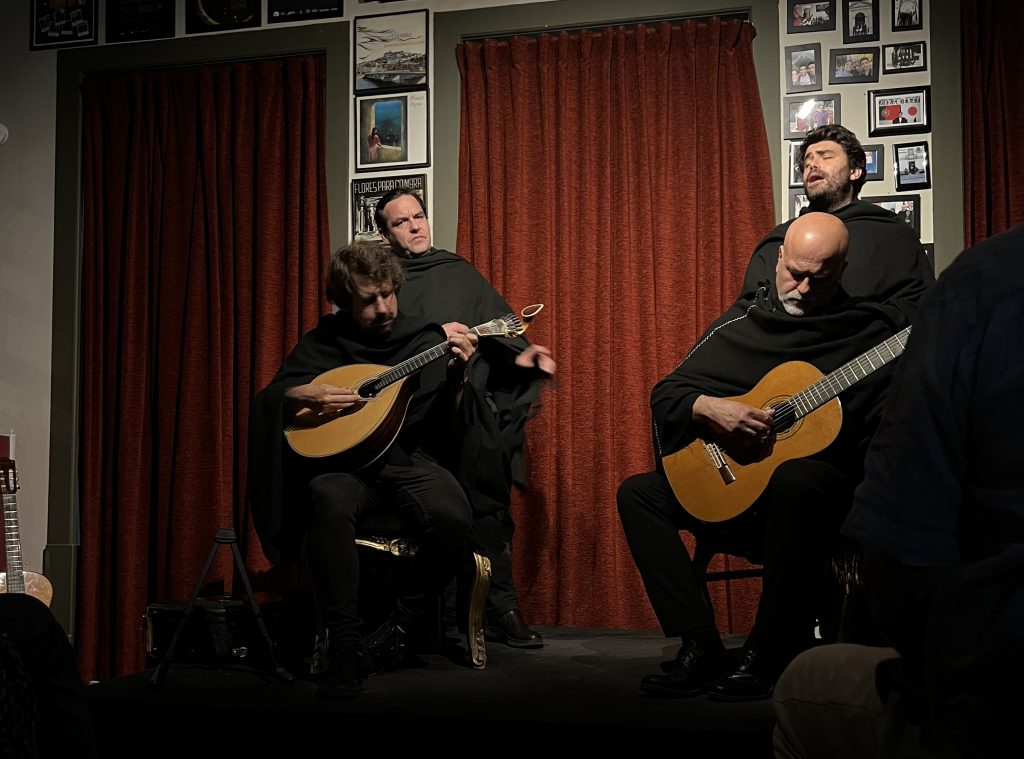
The classic expression of the Fado of Coimbra is the serenade, in which a suitor sings at the door of a potential lover, who may respond by appearing at the window or by switching the lights of the bedroom on and off if she liked it. These and more characteristics of the Coimbra fado are presented live at Fado ao Centro in the most traditional way possible. João Farinha founded the space in the centre of the city to keep the precious tradition of Coimbra Fado alive. I talked with him after his show on a Friday evening in October.
SG: When did you start doing these fado concerts here & how did you came up with the idea?
JF: 15 years ago, I quit my job and opened this place with two befriended guitar players. It was my idea to do this as a business. Before singing was my hobby and when there was the chance of having this place for us in the oldtown, I thought it would be a good idea to make this our place. At the beginning everyone said, fado houses are at night. But we thought, well the street is full of people during the day, so why not do Fado during the day? So that’s the main principle and it’s without food.
SG: The offer of these daily shows is now actually growing.
JF: Yes, and we were the first ones.
SG: And I think there is a difference between Lisbon and Coimbra Fado. Because Lisbon Fado has its origin in the taverns but Coimbra Fado comes from the streets.
JF: Yes, and from the old salons of the upper-class. And the students would go there to play.
SG: And is it still happening that students play on streets?
JF: Sometimes, sometimes they do. Not as much as many years ago. The buildings are higher now. So, it’s more difficult.
SG: And would you say that you as a Coimbra fadista you can also sing Lisbon Fado?
JF: The technique is completely different. Because the Coimbra kind of Fado is more lyrical. It has also some technique from Belcanto. And about the Lisbon kind of Fado some say that you don’t even have to have a voice to be able to sing it. Because it comes straight from the soul. And you don’t need a great voice. On of the greatest of all times was Marceineiro. He had very little voice, but he touched the people with his way of singing. But the Coimbra kind of Fado lives on the performance of the singers. Of course, in Lisbon fado there are also many singers, especially women, with powerful voices, spectacular voices. But you don’t need that in Lisbon. And here in Coimbra you need it.
SG: To me it also seemed a bit like opera.
JF: Yes, it’s a bit operatic. Because the students in the 19th century tried to sing like the opera singers did at that time, their hometown songs, love songs to sing for the girls. The opera was the fashion music of that time.
SG: And are you afraid that this tradition will die? There are only very few places where it’s still played.
JF: Yes, abut there have been time where it was worse. Now lots of people are singing and playing. I believe it can change. Now. The first girls are playing too. But actually, we have this kind of places that didn’t exist 20 years ago. So, the musicians had no place to play. Now there are professional musicians of Coimbra Fado, it’s something new that never had been. So, I believe the future is good.
SG: I also saw that there are several music schools in Coimbra.
JF: Yes we have a school that teaches the Coimbra Fado, the instruments and the singing. And there are also some other privat schools.
SG: And do you also think that Coimbra Fado might have a perspective outside of Coimbra? For example, in Lisbon, where there are much more people to reach.
JF: there have been places like that, there was one in Lisbon called “Coimbran tavern”. Cause there are lots of former students from the Coimbra university that live in Lisbon. And they tried to do something like that in Lisbon. But I think they were open for about ten years and then closed when the pandemic came. But in Porto there are also former students. And there is also the tradition of the Coimbra Fado. There are some places where they play the two kinds of Fado.
SG: Yes I was at one. The Fado Maior do Porto.
JF: But the unique one in is our place here in Coimbra.
SG: So you sing here every day?
JF: Almost. During the week I usually sing here. On weekends we have concerts in other places of Portugal and the world. Or sometimes I also just need one or two days to rest.
SG: But this here is your place and you own it, right?
JF: Yes, yes.
SG: And now it’s already time for the next show?
JF: Yes, it’s high season now. September, October. April, May, June. And sometimes we get the 6 o’clock session crowded and then we open another one.
SG: So you always do that when it’s full?
JF: Yes, we always open another one then. Sometimes we also have concerts in the morning, afternoon or evening for private groups.
SG: Ah I see, so before 6 o’clock there was one of those private concerts.
JF: Yes, it was a private group from Taiwan. So, it’s a way of living now. It was something that the older guys never thought of and never thought it would be possible. And it was even not very well seen to make a living out of this. Because most of the guys that study at the university they would be lawyers, architects or engineers. I took economics and management. And my father also sang but he was skeptical to make it as a fulltime profession. I worked as a manager for about 10 years and then I quit my job for this place. But it was something new. You can have lawyers singing.
SG: You give musicians actually the chance to live from their passion.
JF: The guitar player he is an architect. And he quit his job for the music.
SG: And you make that possible. Thank you for talking with me João.
Let’s enrich the future of Coimbra Fado!
From the conversation with the passionate Coimbra fadista João Farinha the great differences between the Lisbon and Coimbra fado traditions became clear. The Fado of Lisbon is played in lots of places, whereas the presentation of Fado of Coimbra is limited to very few venues in the town. But still, the musical characteristics are pretty similar: a singer accompanied by a Portuguese guitar and an acoustic Fado guitar. Some scholars (Nunes, 1999 / Nery, 2012) “trace the genesis of the Fado of Coimbra back to a process of regionalization of the Lisbon Fado”.[1]
At its beginnings, Lisbon Fado was associated with taverns located in workers’ districts. Coimbra, on the other hand, has been determined by a highly educated population. It was the sons of the nobility who started spending their nights in bohemian taverns where popular Fado was sung. Continuously, “this genre was progressively introduced into the private homes of the upper classes”. In 1853, the first academic anthem was sung, written by Cristiano O’Neil Medeiros and José Augusto Sanches da Gama and it became a tradition for graduating students to sing some of these songs as a ‘gift’ to the city. Nowadays, travellers can give a gift to the city, too. It is listening to and thereby appreciating the serenades of Coimbra Fado…
[1] Costa, J., & Nossa, P. N. (2017). Beyond Sight and Sound: Fado of Coimbra, Intangible Heritage with Touristic Value. Rosa dos Ventos – Turismo e Hospitalidade, 9(4), 557-568. https://doi.org/10.18226/21789061.v9i4p557
Leave a Reply