
Chapter 13: Home is a feeling and so is Fado
It’s a windy Thursday night in October when I walk through the streets of Porto with a clear destination: the restaurant Fado Português. There are some Fado houses in the center of Porto, but I choose this one and only Fado house at the other side of the river, in Vila Nova de Gaia. The restaurant was founded in 2021 by Sandra Correia, a renowned Fado singer. She started singing professionally at the age of 16 – since then, she has amazed audiences with her voice in many countries and of course in the Fado houses of the capital Lisbon.
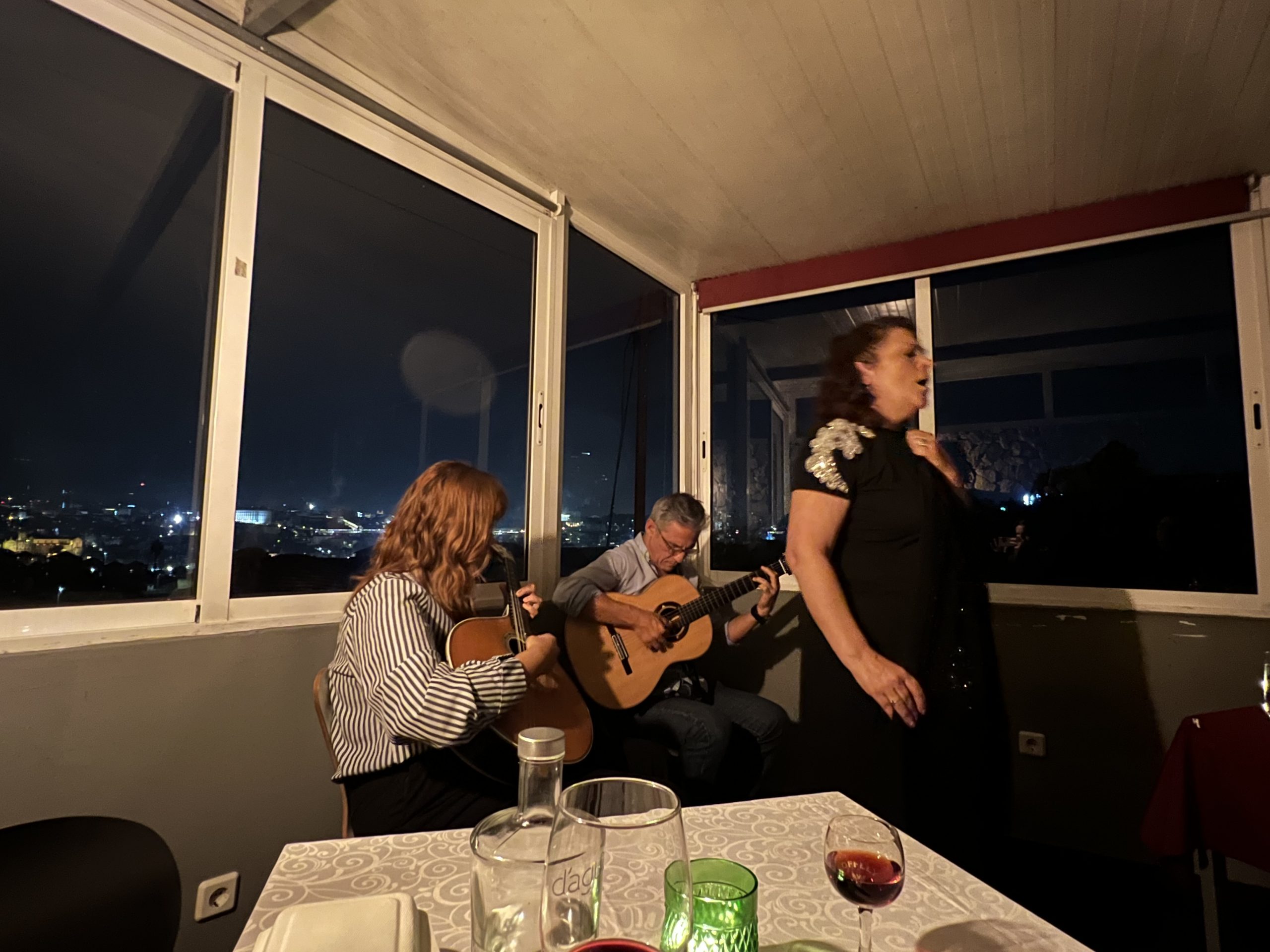
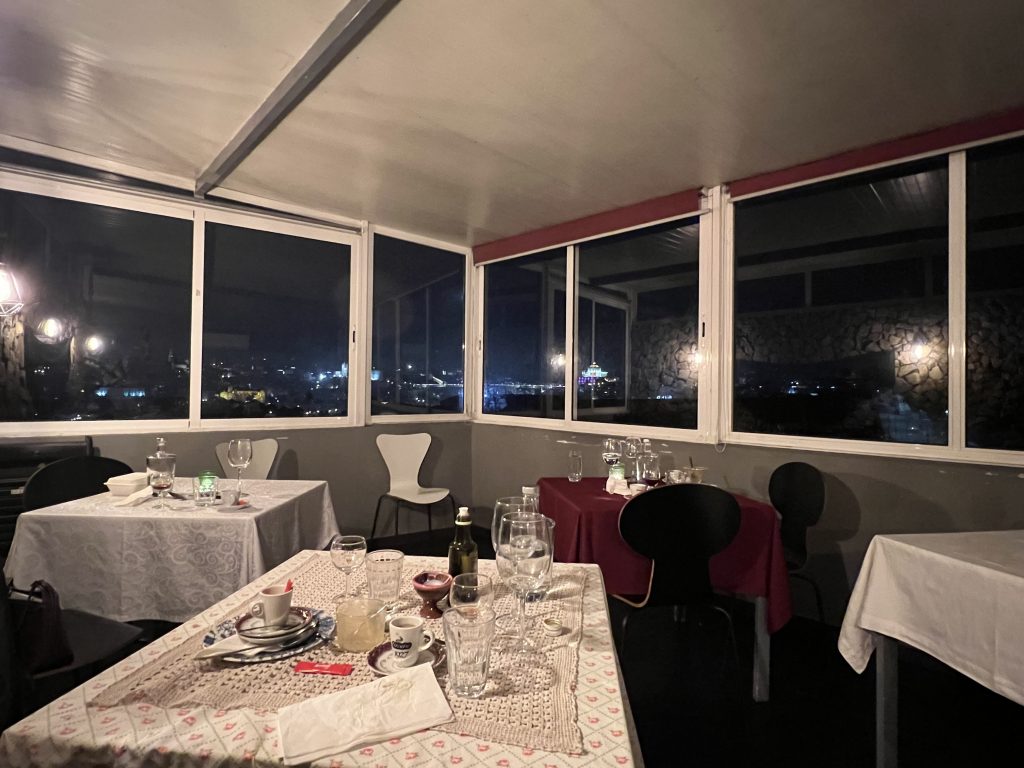
Going into the restaurant warms me not only physically but also emotionally. Sandra Correia welcomes me kindly and points me to the second room of the restaurant, where tonight’s dinner show will be presented. Today, there are less guests than usual, so the front area of the restaurant is left free, and everyone can enjoy their evening with a magnificent view over Porto. The room is fully framed with floor-to-ceiling windows, the bridge lights glitter on the seemingly far horizon. They are reflected in the Douro River, that gently bends to the right and finally disappears in the dark.
“You won’t be able to explain it, but you will want to hear it again.”
The atmosphere in the room is intimate and it seems more silent than in Lisbon Fado houses. I sit down and get a glass of red wine. A man walks from table to table. It’s João Costa Menezes, who has worked as a producer for many years. He gets to know the guests and introduces them some facts about the restaurant. If I hear it right, I am part of an audience with a Portuguese couple, another two Portuguese friends and an US-American group, who have never listened to Fado before.
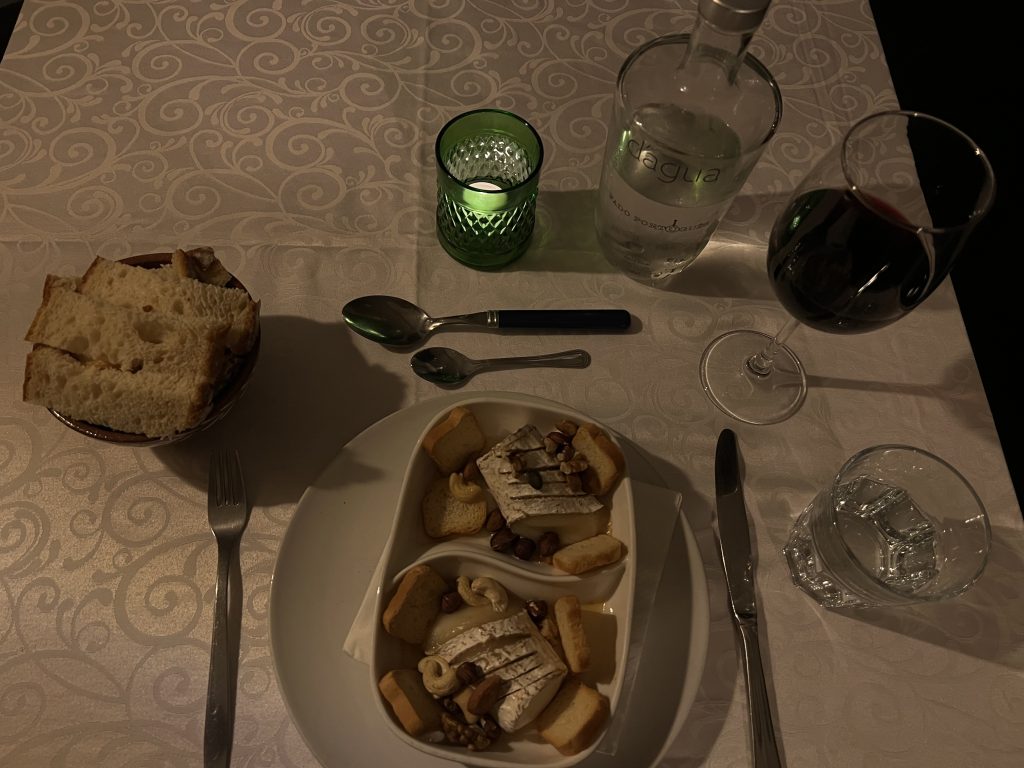
At 21.05h João lights the candles, “they are getting ready” he whispers to me, referring do the musicians. Do I look impatient?, I think to myself, because yes, I am. Before the first live set is played, starters are being served. The delicious goat cheese with honey and walnuts prepares me well for the exquisite Fado presentation.
Three courses, three sets of Fado
After some minutes, João steps to the front to present some introductory information about Fado. He describes how Fado spread through the streets and taverns, where people started singing spontaneously – today known as fado vadio. “The base for Fado are poems, singers interpret these poems and the Portuguese guitar answers to the singer’s melody.” Then, he makes the space free for the musicians.
Surprisingly, today’s Portuguese guitar player is female, which is very unusual. Sandra Cristina is the first singer – with her blond hair and knee-long pink dress her appearance kind of falls out of the typical fadista image I had until then. She sings a quick and expressive Fado. I look to the table next to mine, where one of the two Portuguese men looks towards the singer with tears in his eyes. For me, it takes some minutes to connect with her voice and way of singing. The longer she sings, the more I like it.
As I sit there, surrounded by warm people and soulful music, looking at the night views over Porto, drinking an excellent sip of red wine, having another taste of the warm goat cheese – it feels like the best place I could be in that moment.
Before the next set, main dishes are served – I get some couscous with roasted vegetables.
Eyes bring us closer to each other
With the next singer I connect right from the first moment I see her. Mia Morgado holds intense eye contact with the guests in the room. When she looks at me, it feels like she looks into my soul and I into hers. I tell her after the set how much I liked that, and she explains to me that she does it intentionally.
“Many Fado singers close their eyes, which makes them seem very deep inside the song, inside themselves, inside their souls”
Mia Morgado
However, for Mia, a part of carrying these emotions to the audience, is looking right into their eyes.
“Now it’s getting epic, she’s one of the best Fado singers of the country.” Mia says about the restaurant owner, who will be the third and last singer of the night. Dessert is now served on the tables. I find the way back to my seat.
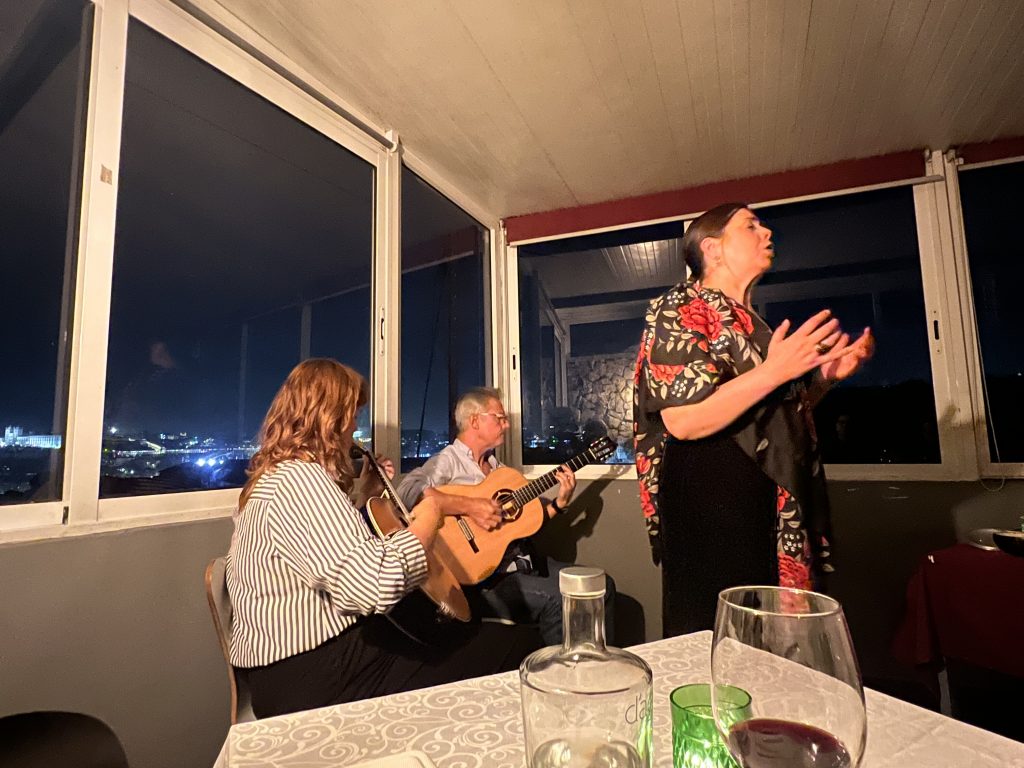
Sandra Correia starts singing expressively while she slowly walks to the front of the room. She has the unique power of captivating the audience; even in the moments she doesn’t sing. When she stands in the front and closes her eyes, I am with her. She feeds my soul with so much emotion, from sadness to joy and love. I feel an enormous gratitude for experiencing this with her. Suddenly, a voice from the back joins her, it’s Sandra Cristina, the first singer of the evening. And then Mia Morgado follows them both. Together they create a powerful voice trio that echoes across all corners of the restaurant.
“Fado cannot be explained, it must be felt” is the spirit of this restaurant. And once you have been there to experience it, you will realize how much truth lies in that phrase. It starts from the perspective of the singers who intuitively decide on their song choice. As Sandra Correia puts it:
“I have a lot of experience. I feel the people in the room, my feeling in the moment and then I know what I would sing.”
Sandra Correia
Fado singers feel the energy in the room they sing
An interplay of feelings of the present moment determines the music that is played. Sandra Correia played for many years in the fado houses of Lisbon, for example at Club de Fado. She gets nostalgic when she thinks of that time. “Alfama is my home” she says with a smile, and “here in this fado house I also carry with me all the places I sang in”. She is proud of having created this space for herself and for everyone else. When I ask her whether it feels different to sing in Porto than in Alfama, where she used to be surrounded by many other fado houses, she looks around in her restaurant and realizes:
“This place brings the soul of Alfama to Porto.”
Sandra Correia
Lisbon is magical and so is this incredible view over Porto. Now, she is not anymore singing in her ‘home’ Alfama. Instead, she is in her home region, close to her parents. “I visit them every day, and I’m very thankful that it’s possible”.
Fado, a feeling of home
Together with João Costa Menezes as the manager, Sandra Correia is at her restaurant every evening. Sometimes, she plays concerts in other places. But mostly, she amazes the guests in her own space at Fado Português. João is there to build the connection with the each of the visitors; he answers their questions and talks with them about where they are from and whether they experienced Fado before. He tells me that every night he adapts to what he feels among the audience – sometimes he explains more and sometimes less backgrounds about Fado.
When I mention my impression of the Fado offer in Porto, João agrees with my observation that there are many more “touristic Fado shows” than traditional Fado houses. He states that “the daily fado shows kill the Fado houses. It happens in Porto and will probably happen in Lisbon.” Whatever happened or will happen, Fado is alive. And at Fado Português in Porto, it awakens at night.
Leave a Reply