
Chapter 12: Fado shows outside the restaurants
Apart from traditional Fado houses there is another, more modern version of Fado experiences. From Algarve over Lisbon to Porto – the touristic Fado shows in historic venues have spreaded all across Portugal. Though shows are sung by authentic fadistas, the Fado experience is different from a dinner night at a restaurant.
In Alfama, close to the Fado houses, Fado e Fado offers daily shows in a historic venue. The venue is hidden in the basement of a building with symmetrically impressing bows on the ceilings. I get to sit in the first row chairs; next to me I hear Germans speculating about the two chairs on stage. “Will the singers sit down?“ – the other one retorts “but I thought it’s only one singer?”
Fado lessons for tourists
I explained them that the chairs are for the guitar players, one will play the Portuguese and the other the acoustic guitar. They are fascinated by my knowledge, asking more and more questions. Lucky them – before the show starts, a woman explains all basics of the Fado music to the tourists in the room. The ‘lesson’ begins with some bits of the origins of Fado. It moves on to the characteristics of traditional Fados and the different kinds of guitars.
An elderly male fadista opens the concert. Then he announces “the beautiful Nadine” to stage. In the end, they even sing a duet together and are honored with a huge applause from the audience. The atmosphere in the room is different in comparison to Fado restaurants. People sit in rows, as you would expect it from a small concert venue. The show is fully booked on this Saturday night of October.

At the Fado e Fado experience singers will explain the gist of a song to the visitors. When I talk to the singer Nadine after the show, she tells me that this is especially important for her. “It makes it easier for listeners to connect with the feelings in the song”, she states. Nadine also thinks that the setting makes it easier for guests to focus on the music. In restaurants they may sometimes be distracted by the food, which distracts her when she sings.
Fado shows beneath the ground
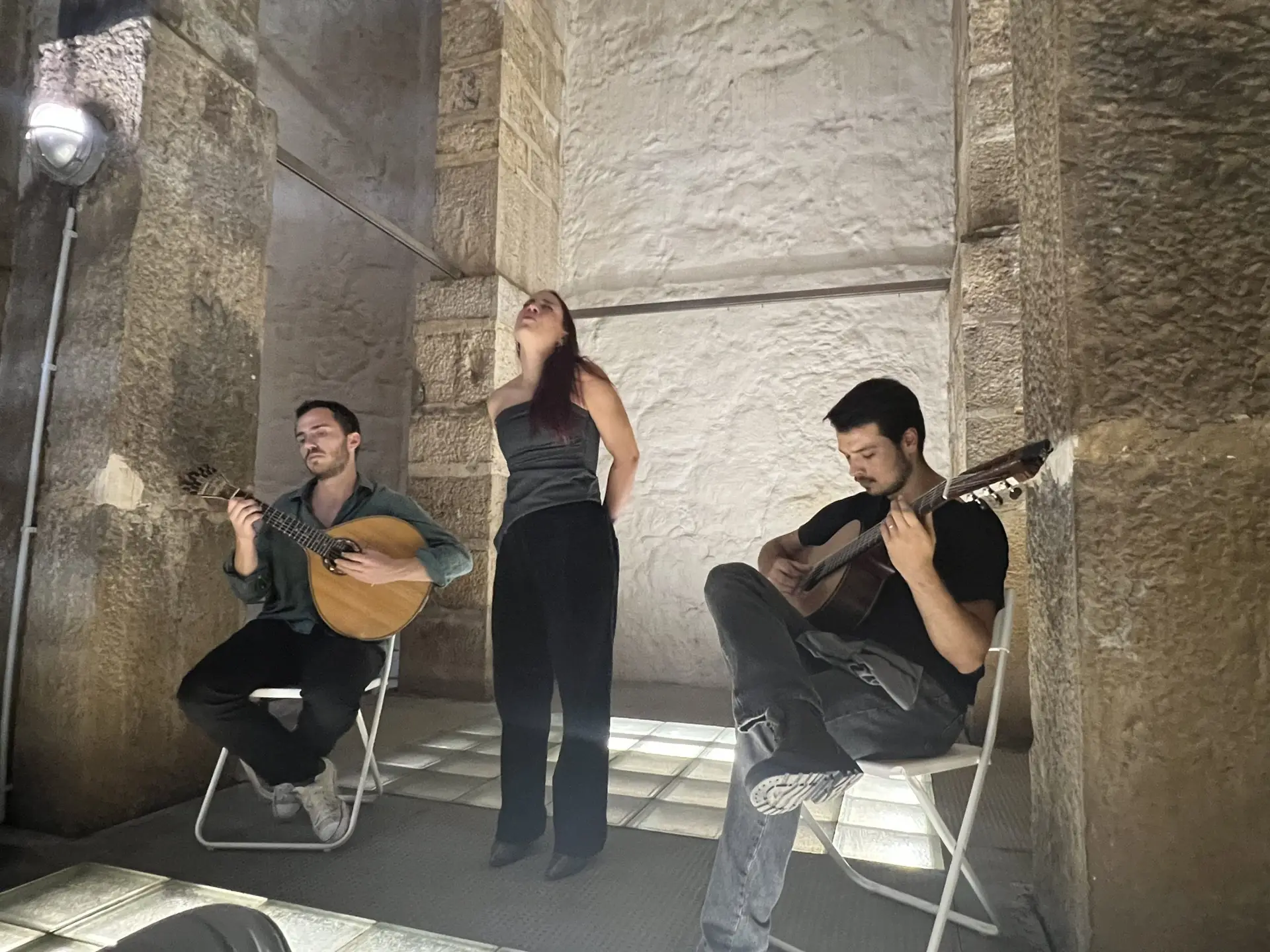
We move on to the next modern Fado place, located in the middle of Jardim do Príncipe Real in Lisbon. Real Fado Concerts has turned a 19th century underground water reservoir into a Fado concert room. The Reservatório da Patriarchal has no windows, and is hidden from the surrounding world. Next to the playground of the park, organizers of the show will lead you downstairs. Stepping into the natural venue of stones and bows feels like entering a secret space of the city.
A few minutes after 19h the musicians come to the front – two young men. They start with an instrumental, then, kind of surprisingly, a soft voice joins them on their song. Filipa Biscia opens the show with Fadista Loca and then continues with Saudade de lo bem. She enchants everyone in the room with her fine and precise voice. My gaze goes from her to the acoustic guitar, to her, to the Portuguese guitar and all the way back. The trio fits well together.
Filipa explains the importance of the feeling saudade in Fado. She also makes clear, that in traditional Fados the singers can choose the poems they would sing. The poem she would sing now is: “I love your eyes. But I love mine even more. Because if it weren’t my eyes. I couldn’t see yours”.
The show continues with famous classics: “Strange way of life”, which, as Filipa presents, was written by Amália Rodrigues and originally sung by Alfredo Marceinero – two names in the history of Fado that everybody must know. Another traditional Portuguese song “Lisboa a Noite” that is usually played at the parade around St. Anthony in June.
Tourists show their enthusiasm about Fado
When the musicians take a short break, I listen to the conversation of excitement between a man and a woman next to me. I can only get some bits of it.
‘she has such a quiet voice it’s beautiful‘ – ‘the end of a line always drops, do you notice?‘ – ‘I love that guitar‘ – ‘I saw he only plays with two fingers‘ – ‘It looks like he two strings in one‘ – ‘They are singing to someone who is gone‘
The show continues with a beautifully played instrumental. Both guitar players seem excellent for their age. I wonder that with the experience they will gain in the future they will get even better from day to day or if at some point, they will reach the top of their talent-mountain. Filipa finishes the show with the beautiful gesture of shaking hands with everyone – singing “Ola, muito obrigada!”.
Where architectural and vocal miracles meet
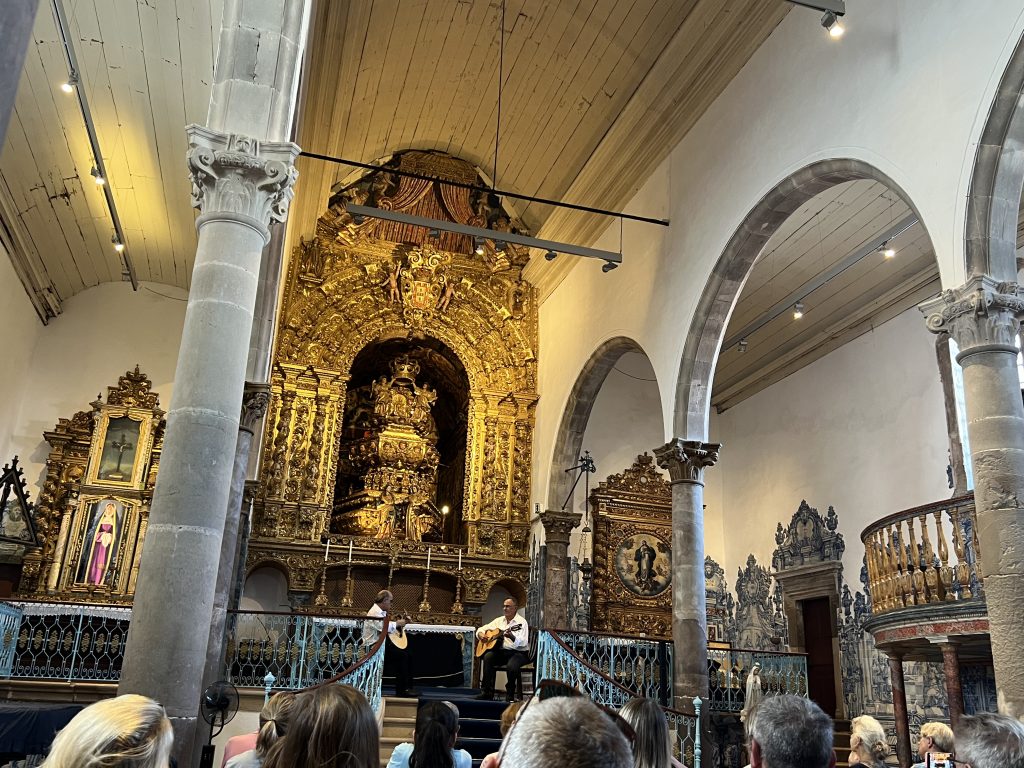
Tavira is a little town in the South of Portugal. I take a train from Faro to get there. From the train station I walk towards the location of Fado com História, close to the river. The beautiful concert venue Igreja de Misericórdia is somewhat hidden in a side street. On the right side of the church there is the auditorium, where usually one of the two daily concerts by Fado com História takes place. The auditorium is a small and intimate hall, with a living room kind of feeling. Pictures on the walls and chairs in rows, Fado music on playback echoes onto the small alleys outside.
“Today both presentations are in the church, because we have a big group coming”, Vírgílio Lança, host of the shows and acoustic guitar player tells me. I am happy about that, because I was even more excited to see the interior of the church and to hear the singer’s voices echoing in the big hall. And I don’t get disappointed: Benches are filled with people from front to back, from left to right. The high ceiling of the Renaissance building is supported by eight columns – a set of blue and white tiles from the 18th century decorate the walls.
Surrounded by tourists, tourists, and tourists
The two guitar players come towards the front of the church, they take the stairs up to the altar and sit down on the prepared chairs – Giuseppe on the Portuguese guitar and Vírgílio, the host, on the acoustic guitar. After fixing some issues with the microphone, Vírgílio Lança welcomes everyone. “Temos Portuguesa?”– silence. “No Portuguese people”, he detects. So, he continues his introduction about the importance of Fado for Portuguese culture in English, and then also in French.
They start playing an instrumental, the pace of the song lets their fingers move quickly. Some delayed visitors sneak themselves into the church. After giving the audience a great first impression of the magic Fado guitar sounds, the host introduces today’s singer: “She is beautiful and has a powerful voice, but above all, she sings with her heart – Helena Candeias!” I remember Helena’s uniquely energetic and emotional powerful voice from my first Fado night at O Castelo; when she sings, I cannot take my eyes of her. Because she doesn’t just sing with her voice, but with her whole body.
Operatic voice, traditional Fado
She starts with a traditional Fado, which are “the most important ones”, as Vírgílio explains. “The musicality of a traditional Fado is always the same”, he goes on, “the singer chooses the lyrics without the musicians knowing about it”. Within the evolution of Fado, the musical foundation of the Fados hasn’t changed a lot. However, the lyrics are composed in a new way to fit to the old traditional melodies.
With Maria Lisboa Helena sings her soul out, holds tones until the infinite that echo into the upper corners of the church. She continues her show with April in Portugal, one of the most famous Portuguese songs: the first original release has been followed by 1000 official recorded versions.
At the end of the show, I talk to Helena and share my fascination about her powerful voice echoing into every corner of the church, even without a microphone. Helena tells me that in the church, they normally sing with microphone. But on that day, Vírgílio Lança had the idea to sing without microphone and eventually he got to persuade her. Lucky audience.
Leave a Reply