Chapter 5: What real authentic Fado is about
When something mysterious, a sweet portion of nostalgia and the painful missing of something that is far from here is mixed together, that emotion is definitely worth to be sung about. In Portuguese language the word saudade describes this feeling of longing for something far. May it be as a feeling or as part of the lyrics – saudade forms a basic part of Fado’s identity.
In general, Fado melodies are simple. The lyrics, written like a poem, should oblate to the structure of the melody. There are two ways of composing a Fado melody, as Sara Paixão explains: A) take a traditional melody and write a poem specifically for this melody, which will make the song a new interpretation of an already existing melody; B) compose a new melody in alignment with new lyrics. To make a good Fado song “the tone of the words must fall in the tone of the song”. Sara compares it with “a dress that fits perfectly into a body”. Throughout the song, the same structure of a melody will be repeated several times.
Is saudade really non-translatable?
Most scholars relate the word saudade back to Latin origins, specifically the Latin word ‘soledad’ which literally means ‘loneliness’. However, a minority of researchers is claiming it to be connected rather with Arabic language, namely the word ‘saudá’, translated as ‘melancholy sadness’. Helena Ramos, Portuguese language expert, says: “The word saudade is celebrated as something very particular in our culture. But I think the meaning is very much like the German Sehnsucht”. It may not be the case in English language, but in general there are indeed languages that offer good translations for the feeling of saudade.
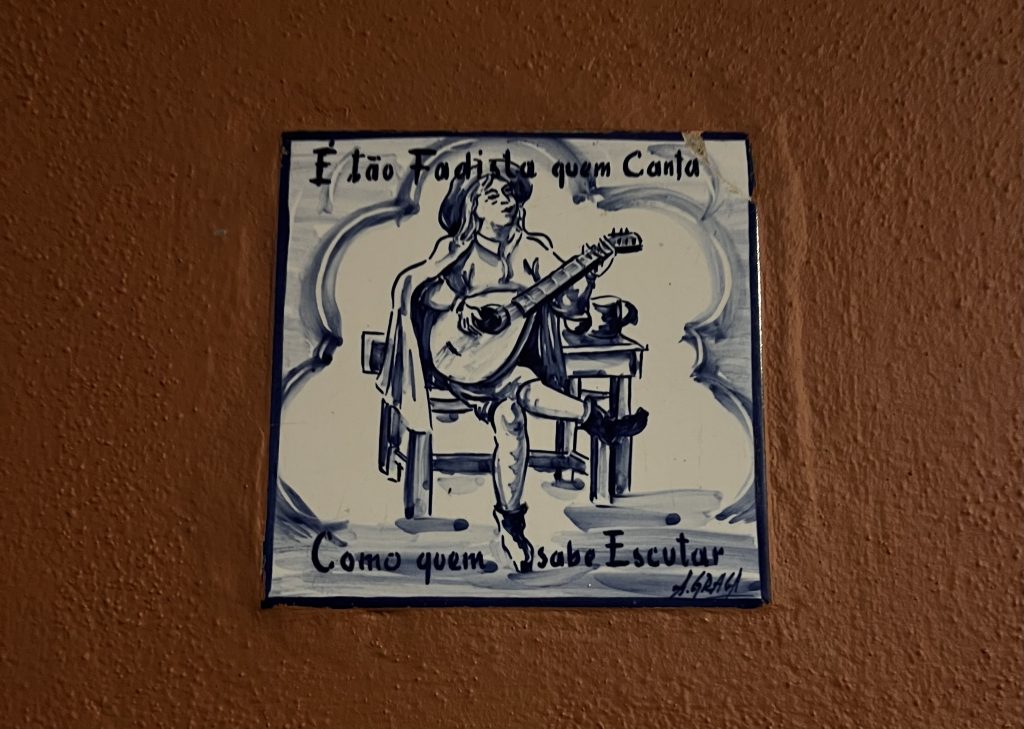
Walking through the alleys of Alfama, you will find several panels on the buildings’ walls that carry quotes about Fado on it. One of them says: É fadista quem canta como quem sabe ouvir em silencio. (“A fadista is one who sings, just as one who knows how to listen in silence”). The phrase refers to the idea that listening to Fado attentively is also a skill. Therefore, not only singing Fado, but also listening to it in silence, can make you a real fadista.
The mythical origin of Fado is related to the first female fadista Maria Severa. She was born at the beginning of the 19th century to a poor family in the Mouraria neighbourhood of Lisbon. Her romantic affair with Francisco de Paula de Portugal e Castro, the 13th Count of Vimioso, brought her and the Fado into aristocratic circles. She died in 1846.
“It was only in the 1920s and with the emergence of a new generation of fado singers, such as Berta Cardoso, Hermínia Silva, Ercília Costa, and Alberto Costa, added to the state intervention by creating the profession of fado singers and enabling the establishment of fado houses that the genre would achieve the status of a national symbol. (…) The radio broadcasting and the record created the conditions for Fado to spread out of the capital and abroad, characterizing it as typically Portuguese in the eyes of other countries since before the Salazar dictatorship. (…) In continuity with the National Dictatorship that erupted in 1926, Salazar institutionalized his power project in the so-called New State from the 1933 Constitution and would remain in power until 1968.”
Barchi & da Cunha (2021)1
Sara Paixão’s road into the Fado world
When Sara Paixão heard a Fado song herself for the first time, she felt like having made a great discovery – with an even greater outcome. She remembers the story very specifically.
“As a child, I used to share a mp3 device with my brother Tiago – one day it was mine, the other it was his. When listening to music I discovered the fado songs by Amalia Rodrigues. I would listen to them again and again. I loved and felt the songs so much that I investigated more about them and also about other fados. With time, I started singing along the lyrics.”2
Sara Paixão
In the beginning, she would do that only alone in her room. One day, when Sara was wearing headphones and was so soaked into singing the song that she didn’t realize it, her brother came into the room and heard her singing. He was so excited about her sister’s talent that he told the whole family about it. When their grandmother took note of it, she was especially proud of her granddaughter. Because there is something Sara herself didn’t know until then: Her grandmother’s mother was a Fado singer, too.
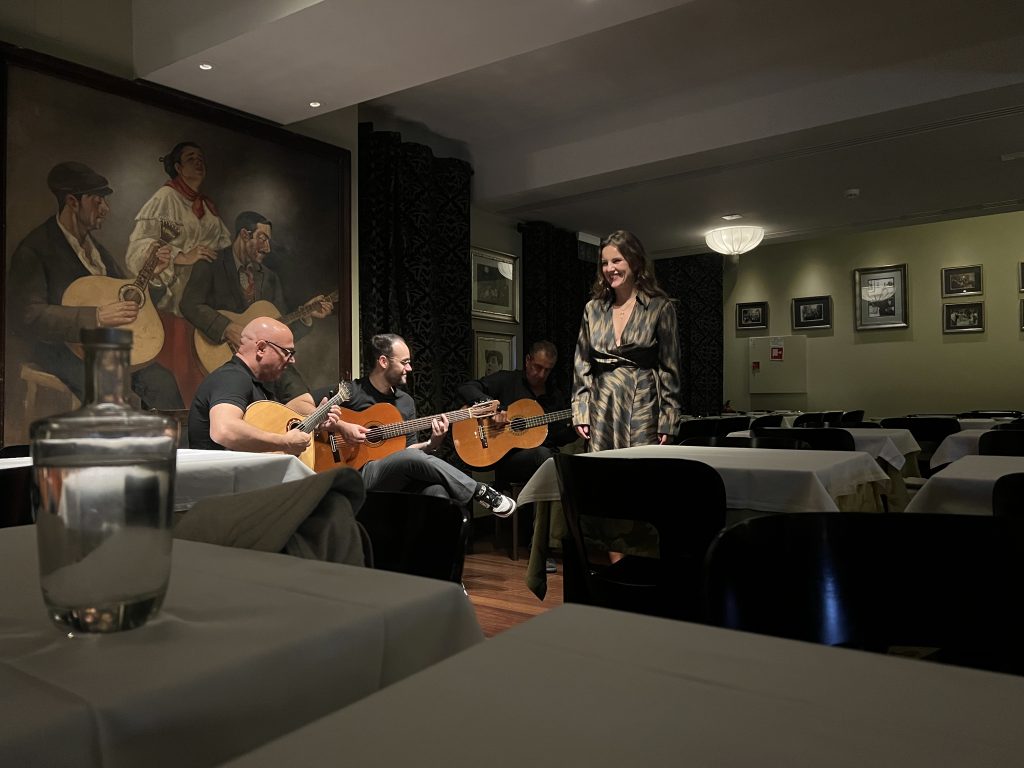
With the age of 16, Sara participated in an amateur competition that marks her first performance in public. She used to sing songs by other Fado singers and make her own interpretation of them. Until today she has also published own songs, composed with the help of other professionals. She says: “I only sing what I feel… Sometimes I give my composers an idea of a place or a feeling they should write about”. Thus, the songs are based on Sara’s soul.
How empathy and emotion shape Fado’s identity
Over all the past centuries and the political changes in Portugal, Fado has kept close to its characteristics – its sounds, themes and rhythms.
“The rhythm of fados is rocking and pendulous, reminding the waves of the sea. It surrounds the listener and takes him/her on a shared mood trip.”
García-Falgueras (2023)3
The emotional connection with listener and singer is probably the most precious thing in a live Fado performance. When she sings, Sara can feel the audience.
“…whether they are attentive, empathetic listeners or just there to say they have been there. It’s this touristic issue around Fado. Some people are just there because someone told them to go.”
Sara Paixão
On some days it happens that the audience would give Sara the energy to sing well. And on other days, the audience might take energy away from her, which makes it more difficult for her to perform the emotions she would love to. There might be people asking questions like, ‘do you also play songs in English or is it just in Portuguese?‘ or ‘can you translate the lyrics?‘. Sara always tries to clarify that explaining backgrounds during the performance would make her lose the focus and the moment lose its magic.
“What makes music so special is that it allows people to connect with each other, to connect with a singer, even when they sing in another language. For that, the listeners need to be open to receive. They shouldn’t be thinking too much, because it keeps them from letting their emotions flow. Music is connection, music is spirit.”
Sara Paixão
The powerful emotional effect of music has also been proven by a study about the effects of music, with the main finding: “While people are listening to or playing music, violence is far away from their minds” (García Falgueras, 2023).
Fado’s traditional identity carried from time to time
Traditionally, guitar players in the Fado scene have been men; at the same time the most recognized singers of the genre have been women. Thus, for Sara, as a young female Fado singer, it feels normal to be surrounded by men – may it be in fado houses or at stage concerts. The music experience differs very much in the different types of locations, both for the audience and the artists. As Fado houses have always been restaurants, they serve food, and people often eat during the presentations. This might be reflected in a lack of attention among the audience, especially in comparison to organized shows.
“At the concerts I know that people are there for me. In Fado clubs it often happens that the audience is not so empathetic or isn’t listening very attentively.”
Sara Paixão
But still, the presentation in a Fado club feels “more intimate, more informal, more personal and closer to the audience (…) you can try out more things”. Singing in a Fado house all days of a week can be exhausting for body, voice and soul of a fadista. During the day they need to recharge so they can put all her emotion into the performance of the night. Sara loves to perform in different Fado houses, each of them offers their own charme. She sings at Adega Machado, Clube de Fado and Tasca de Bela.
Is Tourism a curse or a blessing for Fado’s identity?
Fado houses are usually fully booked, mostly of tourists. Somehow, it’s the tourists enabling the musicians to express what they are most passionate about – the Fado.
“One of the great assets of Fado houses is the way they combine artistic performances with a characteristic menu, maximizing their profits. (…) The premature tourism, mainly foreign, generated a demand for both artistic expressions and constitutes up to the present time its strongest stability factor.”
Barchi & da Cunha (2021)
There might arise the question, if it is still an authentic Fado experience, when barely anyone in the audience speaks a word of Portuguese? Let’s say, as long as the fadista and the guitar players are true fado musicians, it should be considered an authentic Fado experience. And therefore, tourism can serve as a stabilizing element of Fado – strengthening it, expanding it in space, and conserving it in time.
- Barchi, F. Y., & da Cunha, F. L. (2021). Fado, Samba, and the interface between national identity, cultural heritage, and tourism on both sides of the Atlantic. In F. L. da Cunha & J. Rabassa (Eds.), Festivals and Heritage in Latin America: Interdisciplinary Dialogues on Culture, Identity and Tourism (pp. 29–43). Springer Nature. ↩︎
- Quotes from my conversations with Sara Paixão in October 2025 in Lisbon ↩︎
- García-Falgueras, A. (2023). Possible gender differences in classical music, Flamenco and Fado. Neuroscience Insights, 18, 26331055221147009. https://doi.org/10.1177/26331055221147009 ↩︎
Leave a Reply