
Chapter 3: A marine biologist between ocean and stage
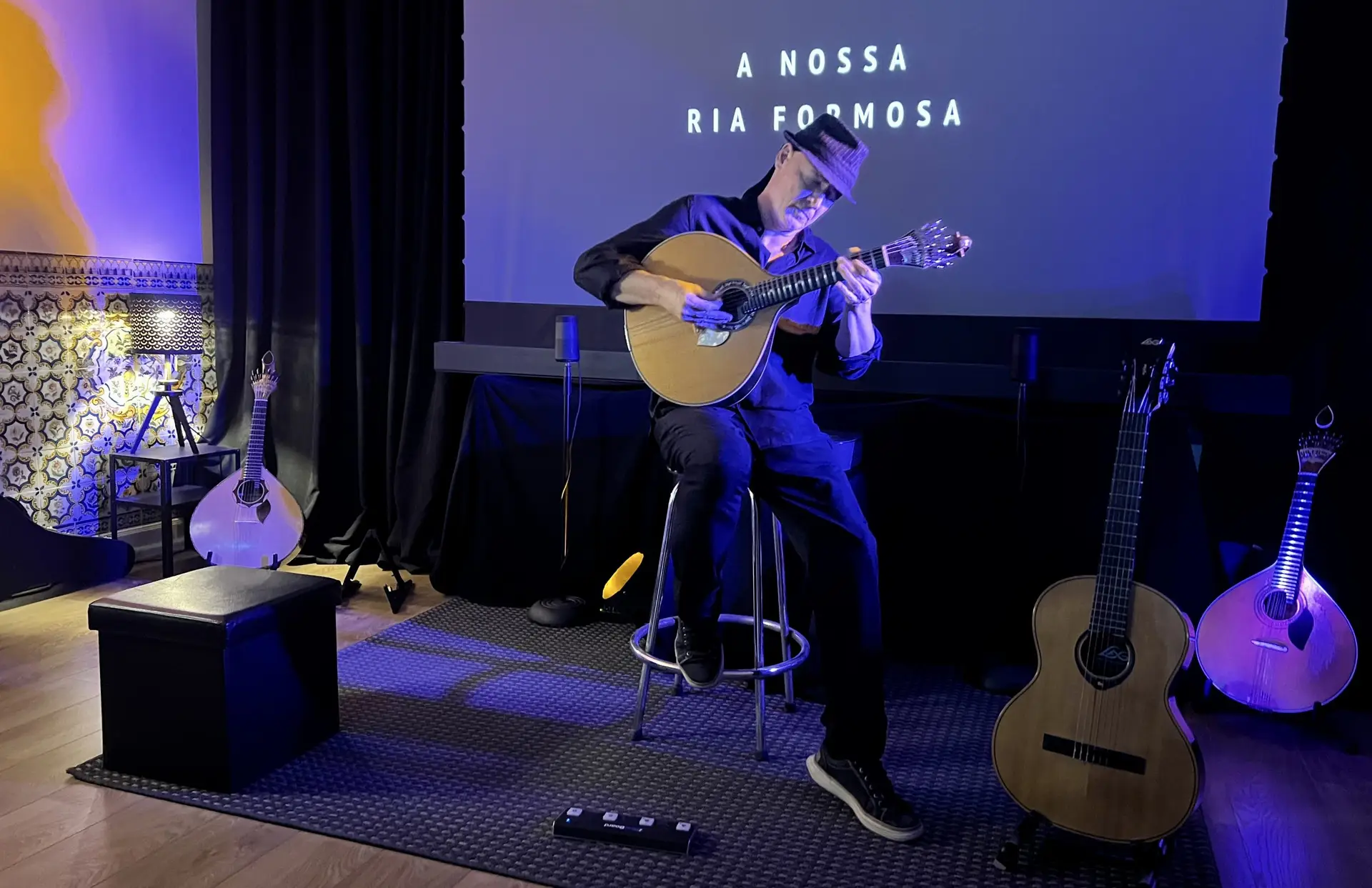
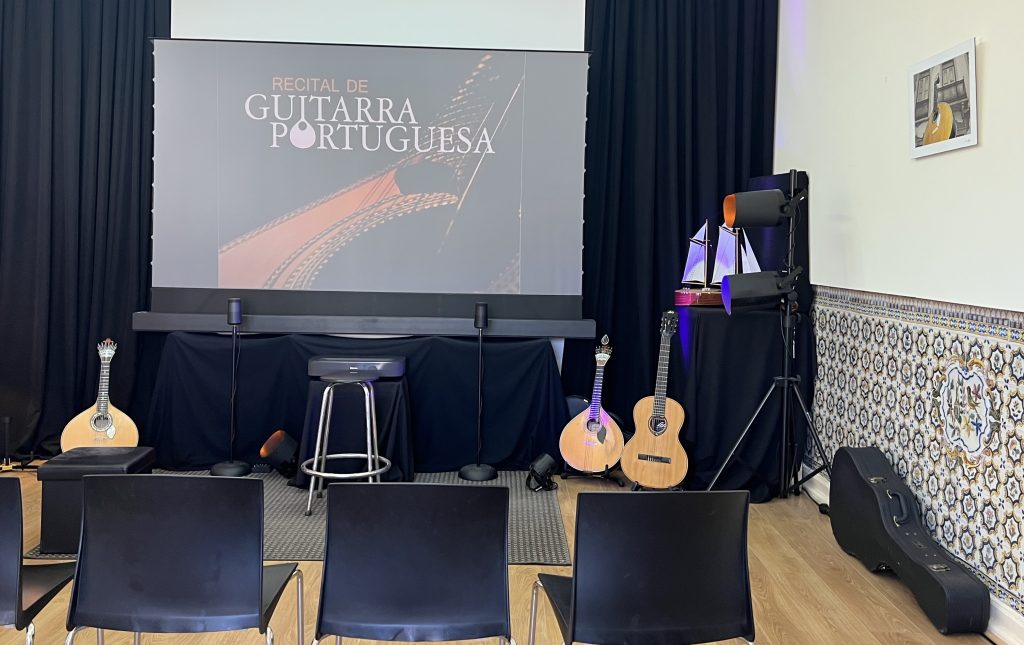
Visitors are already sitting on the chairs in Faro’s old chapel of the pregnant virgin when João Cuña enters the room with his guitar (Well, with one of his guitars… he has 40 in total.). The musician closes the doors to his Recital de Guitarra Portuguesa, and dims the lights saying: “Please turn off the sound of your phones. No photos, no videos, in general.”
The recital, located in the building of the tourist office of Faro, is not just like any other Fado place. The shows are created from the bottom of João Cuña’s heart, which you will feel during the shows. When he plays the guitar, all eyes in the room are on him. Only his own are shut. The rhythms and melodies seem to be found within himself, flowing through his blood. His words and his guitar sounds will guide you through a unique emotional journey. The room is small, allowing an intimate atmosphere with around five to ten people sitting in two rows of chairs.
“Here in this small room you capture many things. You start to understand that it’s a lot of psychology. It’s not only music, it’s psychology. (…) All cultures can understand, but still it depends on the individual if one enjoys it. (…) I feel a lot if you are enjoying or not. And sometimes I react. Yes it’s the ego. Somehow I want you to be with me. I’m giving everything so at least people should listen.”1
João Cuña
João Cuña has friends from all around the world
He describes his show as a mix of music, cultural knowledge and emotion. Some jokes and surprises bring the laughs out of the visitors. And laughing is something very important in music, he thinks. After each song, he talks with the audience, telling them anecdotes as for example that in Coimbra Fado, people traditionally don’t clap but instead show their appreciation through clearing their throats. João explains this usually before he plays a Coimbra Fado. The outcome is what one would expect: no clapping among the audience. Something else, that no one in the room expects, is the moment when he gives his guitar to the visitors. His shows have been experienced by over 40.000 people, his guitars travelled through 80.000 hands.
“That’s unique. No guitar player gives his guitar to someone else. But I thought, why not? The people don’t expect it, it’s always a good surprise.”
João Cuña
The visitors come from different places in the world, but here, they are united for a little while of their lives.
“I had a guy from Finland who came 10 times. I told him, why, you know everything, the jokes. He says, ‘I want to feel the emotion, I want to feel the emotion again’”
João Cuña
When João plays the guitar, he plays with the guitar. Moving through the room and moving his instrument is “part of the performance”, as he puts it, and also a way to convey emotions.
“If I move with the guitar, listeners will see and also hear the guitar moving. It’s the way I play, the way I feel the music.”
João Cuña
Where is the fado, when there is no voice?
João remembers a Spanish guy who came to his show who disrespectfully threw in the room that ‘Music without voice is no music!‘. He thinks that for him as a guitar player it is more difficult to touch the people emotionally, yet it is possible. “That’s the reason I play.” And with this way of playing, he even made the Spanish guy admit that instrumental music indeed is music.
The Portuguese guitar has existed before the fado. Thanks to its use in Lisbon Fado and Coimbra Fado it survived over the years. The instrument has become so popular that musicians use it even outside the fado genre. As there are two styles of fado, there are also two types of Portuguese guitars. Both models have 6 double strings, other than a classic guitar which only comes with 6 single strings. The Lisbon tuning is B A E B A D when listed from the highest-pitched course to the lowest.
“The three lowest-pitched courses (D, A, B in low-to-high notation) are tuned with one string an octave apart from the other in the pair, while the three highest-pitched courses (E, A, B in low-to-high notation) are tuned in unison, meaning both strings in the pair are the same note and the same octave.”
João Cuña
As the expert explains, the practice of playing the pair of strings creates a full, rich sound with a “chorus effect” due to the micro differences in tension and tuning.
“These guitars are high-tension instruments with a wide dynamic range, which enhances artistic expression. This, in conjunction with the pairs of strings being played together, allows for beautiful, soulful vibrato making the guitar almost ‘cry’ and provides a vast range of volume intensities while playing.”
João Cuña
The characteristic sound of the Portuguese guitar is determined by higher tonalities than other string instruments. This makes it a solist instrument, suitable for playing melodies.
“Of course you can play it to accompany singers, but it’s the classical guitar that plays the rhythms. It has more lower notes. The Portuguese guitar on the other hand is the solist instrument, playing the answer for the singer, the introductions, the solos. Its sound is very important and characteristic for the fado. It’s like the Spanish guitar in the flamenco, the bandonion in the tango.”
João Cuña
Also, the way of playing the Portuguese guitar is special: only two fingers are active.
“The index finger plays in both directions, and the tumb plays only down strokes. All the songs being played on the Portuguese guitar are played with only two fingers in the right hand. It’s a funny thing.”
João Cuña
João Cuña describes differences between fado guitars
The sound of every guitar is determined by its shape and – of course by the tuning of the strings. Only for the classical guitar, there exist over 100 tuning systems. Portuguese guitars have another tuning which can be adjusted according to the preferences of the musician. Coimbra fado guitars are equipped with thicker strings that are tuned one tone below to be more suitable for the male voice. In Coimbra fado, only Coimbra guitars are accepted. A Lisbon guitar might have some problems after many years when you tune it lower than usual. For Lisbon fado, both guitars work equally well.
“I played many years also Lisbon Fado with Coimbra guitars tuned one tone above, so they had Lisbon guitar sounds.”
João Cuña
Apart from the Portuguese guitar, João has also a collection of classical acoustic guitars. He shows me his magical one that can record and repeat his playings. That makes it suitable for composing: João invents the rhythm and lets the acoustic guitar do its magic. Thus, he is able to play the melody on the Portuguese guitar simultanously.
The musician treats his guitars like family
As he appreciates each of them, the musician baptized them: The Portuguese guitar he currently plays on in the recital is named after his daughter ‘Rita’. But there is more to it. His “beautiful babe” is named after his wife ‘Tânia’. Then there is Mammy ‘Nanda’, which is the diminutive of his mother’s name Fernanda. And the guitar grandmammy is ‘Graciosa’, because the name of the luthier was Grácio and also because it means ‘graceful’.
The Recital da Guitarra Portuguesa is João Cuña’s own room for Fado that he opened in 2012, guaranteeing a stable work and income. Before, he played in many different places, also in the capital Lisbon where he is originally from. Nowadays, he continues to perform on stage with Pedro Mendes and Francis Matas, just as he has since 1994, when he founded the world music trio AMAR GUITARRA.
Combining passions: the marine biology and the music
Already as a young boy, at the age of 12, João Cuña started learning to play the guitar. Later he has also developed a passion for the ocean and the environment, which he intensely explored with his studies in marine biology at the Universidad de Algarve. Throughout many years, he has followed these two passions, working both as a marine biologist and a musician. When he was 37, he decided to fully focus on the music. “And then I began starving”, he jokes with a wink, referring to the difficulties of financial surviving in the cultural industry. Today he is 55.
When Covid came he had to close the recital. After a few days he thought that this would be the perfect moment to put an idea into action that he has always thought of but never really had “the time and muse to do it”. He created a proposal which was recognized and financially supported by the Portuguese government. S. A. V. E. Ria Formosa is the title of his immersive live music and video experience.
“It’s my life musical project. I thought I have to do it before I die.” João presents 8 original compositions in 3 parts. Throughout the narrative in the video he combines ecological with personal inspirations. S. A. V. E. is a unique experience, which melts live performance with cinematic recordings of landscape and music. João Cuña would perform live the melodic response to the rhythms played in the video. Usually, in the live performance he wears black. And in the film – wandering along the beaches of the nature reserve at Ria Formosa with his guitar – he wears white. Like Yin and Yang, the Portuguese guitar and the acoustic guitar complement each other to form a harmonious whole.
- Quotes from my interview with João Cuña on September 23rd 2025 in Faro ↩︎

Leave a Reply