
Chapter 1: Tourism beyond the beach waves
What does it take to be Europe’s Leading Tourist Destination? It may be stunning landscapes, endless beaches with Atlantic waves or cultural and historical richness – Portugal has it all. In 2025 the country has been voted Europe’s top destination. On top of that the World Travel Awards 2025 honor Lisbon as Europe’s Leading City Break Destination and the magical Porto receives the title of Europe’s Leading City Destination.1 What’s the secret behind this success? To be one as a culture, it is important to have something to be proud of. Something that makes everyone smile when they hear the word – without any doubt, in Portugal, this thing is the unique FADO.
Does Fado unite all touristic places across Portugal?
Not every tourist knows about it before they go there, though during their stay in Lisbon it will almost be impossible to not get to know the melancholic, sometimes dramatic Fado sounds.
It is normal that there are tourists visiting a foreign country without any expectation or knowledge about its culture. At the same time there are travellers who inform themselves beforehand about the places they go, thus setting some kind of expectation or objectives for their stay.
Tourists searching Fado, Fado searching tourists
People travelling to Algarve in the South of Portugal usually don’t go there with the intention to experience Fado, but rather to enjoy beaches and waves. However, there are places in the region that may give you a glimpse of the Fado universe. As I started my travels in Faro at Algarve, I experienced my first Fado night outside the capital Lisbon. And still, I could feel the city’s magic illuminating the restaurant.
Every night, O Castelo presents excellent music to their guests. From Mondays to Thursdays the Fado nights transform the restaurant into a hall for soulful traditional music. I go there on a Monday, assuming that there won’t be a lot of people. Well… When I ask for a place for me without having made a reservation before, the waiter looks sceptically at me. “Do you want dinner?” he asks. I said, “I would be fine with a drink”. I thought that would make it easier to get a table. He retorts that “fado is only possible with dinner”. Luckily he seems to like me, as he looks for a place to get me seated. Leading me to a table on the terrace, he notes that we will find one inside as soon as someone leaves.
Fado restaurants are full, even on Mondays
I started to like my view from outside. I saw the musicians coming to stage, starting to tune their guitars. One of them with a Portuguese, the other with an acoustic guitar. The speaker outside transferred the music from inside to the terrace. While I was looking, the man comes again to my table. “Hello, follow me please”, he says, grabbing my wine glass in an elegant way. I follow him.
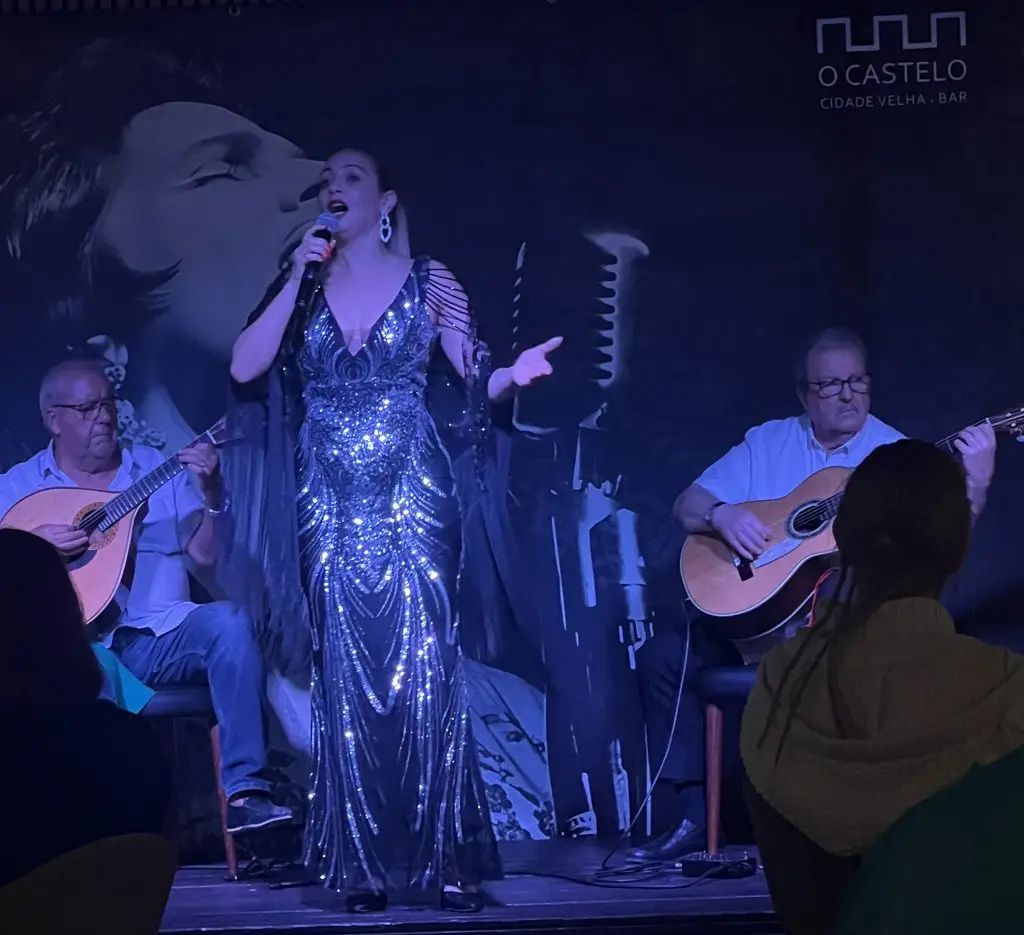
From a table in the middle of the room I will watch this fado night – and I have a pretty good view to the artists’ table. The female fadista is clearly recognizable by her festive dress. I feel somehow an emotional distance toward her, which dissolves as soon as she starts talking on stage: Helena Candeias opens the night and welcomes all guests in different languages. From Portuguese to Spanish, English and French. With her black glittering dress and the cloth around her shoulders she is a great appearance. And she seems to get even greater when she opens her voice to singing.
Fado makes souls dance
She animates us to sing with her, in the “international language” that everyone knows and understands. It is the lyrics lalala.
She comes down and walks elegantly through the rows. I look at her very consciously until she reaches my table. She stays a moment, looks into my eyes while she is singing. Alternatingly she animates everyone to either clap or sing lalala – with success: the guests in the O Castelo are happily interacting with her. After a few fado classics, she leaves the stage. Later Helena goes through the tables to talk with the remaining guests. The restaurant has slowly gotten empty.
Lisbon: The center of Fado in Portugal
Fado is very closely bond to Portugal, especially to its capital Lisbon. At that Fado night in Faro, the artists carried with them a kind of a longing towards Lisbon. The deep connection exists as it has been played there since its beginnings. Also, many songs refer with their lyrics to places in and around the Portuguese capital city. All the people in the restaurant knew that they were far from Lisbon, which adds even more emotion, more saudade to the Fado night.
Nevertheless, to fully experience the Fado universe in Portugal, one needs to go to Lisbon. And so, I did.
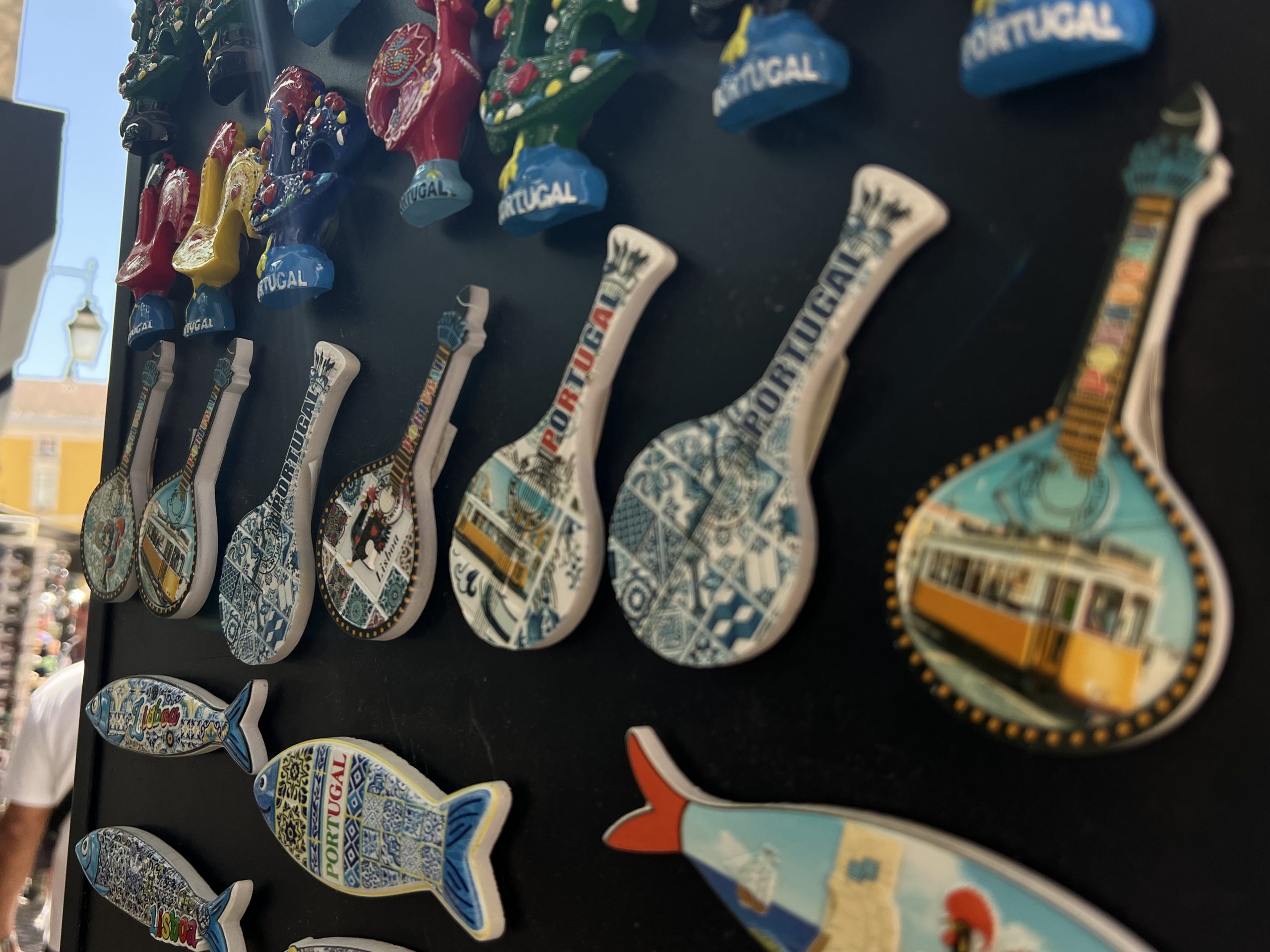
Walking through the oldtown of Lisbon, the bairro of Alfama, one will see and hear Fado in every corner. During the day, you will already see the tables announcing “the most authentic Fado night” everywhere. At night, it will feel different. Every now and then you see a guitarist in front of a restaurant, Fado singers disguised as normal humans. In Alfama, almost every restaurant plays fado. You don’t have to look for it.
Fado in Portugal as a national symbol
Being associated with a specific music genre is very often turned into a key instrument in promoting that place as a tourist destination: apart from Fado’s Lisbon we have cities like the Tango’s Buenos Aires, Samba’s Rio de Janeiro, Folk-music’s Dublin. Characteristic sounds define those places – and thereby create their very own “soundscape”.2 Even when we know that fado is unconditionally linked to Lisbon, you will need to look for it to find good fado. At the same time, Fado will be looking for you.
With all the offers, some very touristically and others more authentic, it is almost a challenge to find oneself the best place for a magic Fado night. You won’t find fado houses all over the city, but you will find them all over Fado hotspots Alfama and Bairro Alto. When I walk through the circled alleys of Alfama, I can hear fado sung from different directions. Sometimes, it makes me stop for a moment and think about where the sounds come from.
Fado as a living cultural heritage in Portugal
The value of the Portuguese music genre (which is much more than just music) can be felt in the streets, in the Fado houses, between a singer and a listener. To officially recognize this emotionally and cultural significant value the UNESCO International Commitee incorporated Fado in the 2011 Representative list of the Intangible Cultural Heritage of Humanity. This decision has been reasoned with the following three criteria.3
1: Fado strengthens the feeling of belonging and identity within the community of Lisbon.
2: (Fado’s inclusion in) the Representative List could contribute to further interaction with other musical genres, (…) encouraging intercultural dialogue.
3: Safeguarding measures reflect the combined efforts and commitment of the bearers, local communities, the Fado Museum, (and) the Ministry of Culture, as well as other local and national authorities, and aim at long-term safeguarding through educational programmes, research, publications, performances, seminars and workshops.
Appearing on the list of Intangible Cultural Heritage defines Fado as a cultural phenomenon that is of value to all humanity, and that responsibility for its management goes beyond its nation of origin. The Fado museum has launched a protection plan. It includes the involvement of civil society, fostering education, promoting research, energizing traditional venues and taking actions to promote Fado at an international level.
- Tourism of Portugal (2025, October 23). Portugal voted Europe’s Best Destination in 2025 at the World Travel Awards. Turismo de Portugal. https://www.turismodeportugal.pt/en/Noticias/Pages/portugal-melhor-destino-europa-2025-wta.aspx ↩︎
- Zarrilli, L. (2022). LISBON’S FADO SOUNDSCAPE: BETWEEN IDENTITY AND TOURISM. GeoJournal of Tourism and Geosites, 41(2), 517–522. https://doi.org/10.30892/gtg.41224-858 ↩︎
- Henriques, C. H. N. (2016). Lisbon Fado as Heritage of Humanity: Interconnections with Tourism. In C. Henriques, M. C. Moreira & P. A. B. César (Eds.), Tourism and History – World Heritage: Case Studies of Ibero-American Space (pp. 383–406). CICS-NOVA. ↩︎