Chapter 2: Sara Pereira about honouring a living cultural heritage
“I would like for the Portuguese to be more aware of the past role of African culture in their own culture”, says the Portuguese music scientist Rui Vieira Nery. His research on Fado’s origins is widely used as a reference for explaining the history of fado. Also, the exhibition in the Fado museum is taking Nery’s writings as a fundamental source of information. He links his theories about the development of Portuguese culture very closely to the nation’s colonial history.
Thus, Portugal has always been forced to interact with other cultures, especially African ones. Through the connections between the colonies and African slavery in Brazil, popular dances with African roots were later brought to Portugal.
“Afro-Brazilian dances were developed throughout the 18th century in Brazil and then were carried to Portugal, they are not ‘pure’ African music; they are already the result of a combination between African rhythms and expression with European forms and harmonies, so they are already a negotiation, and when Portuguese composers take that and try to compose in that vein, of course, there’s new negotiations.”
Rui Vieira Nery, 20191
It is due to its Afro-Brazilian roots that fado was not only sung but also danced to all the way until the end of the 19th century. Throughout the last centuries, Fado has lost its choreographic character and rather focuses on the depth of lyrics, emotions and the singing.
Museums are not just about the dead
Considering these complex und multilayered history of the Fado, it was necessary to gather all knowledge on this cultural phenomenon and make it visible for the public.
“Lisbon City Council with the major Jean Soares in 1998 decided to open a Fado Museum to preserve, to safeguard all this heritage that was distributed. It was in the hands of the families, the artists; it was not gathered in one place and preserved and studied.”2
Sara Pereira
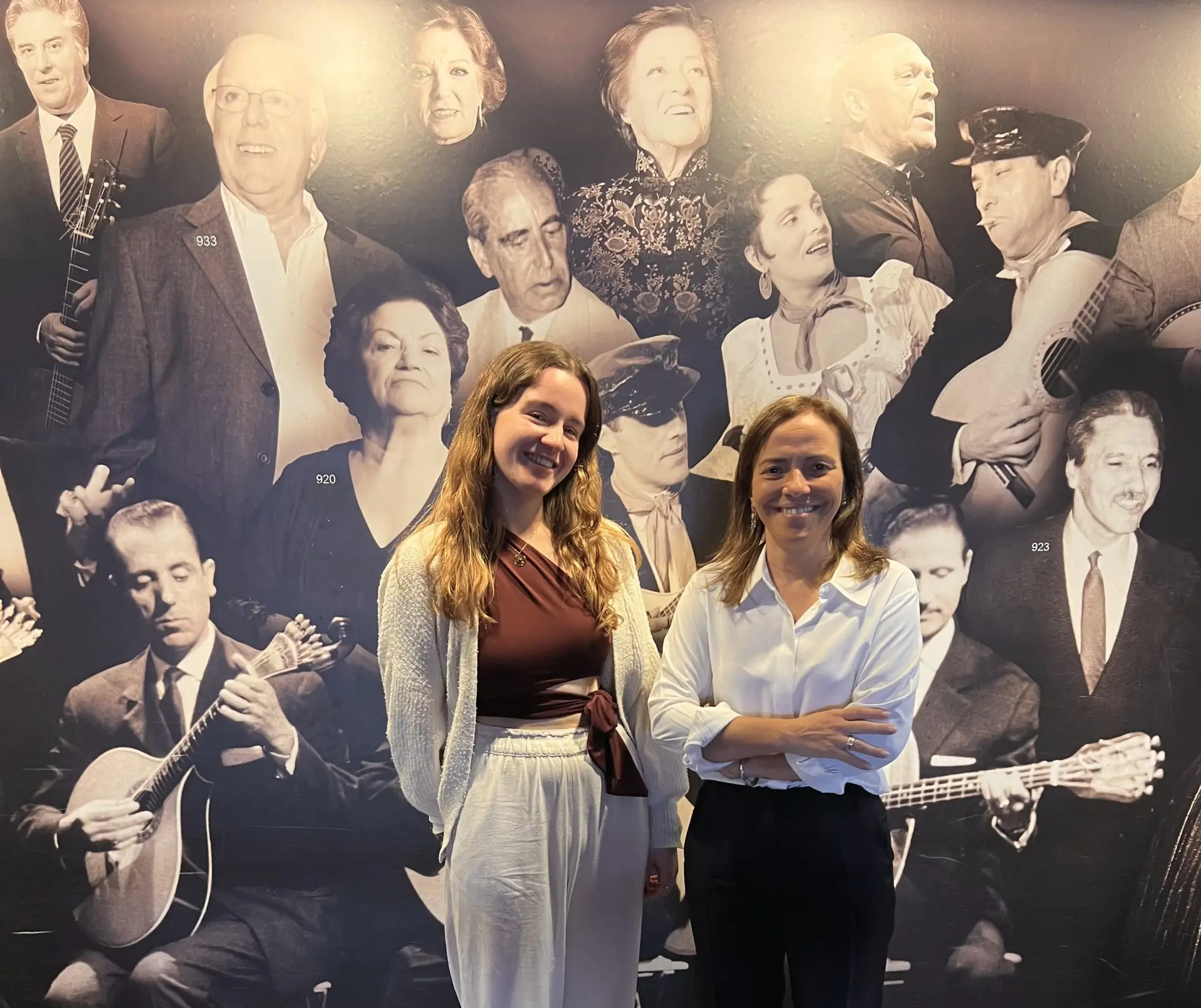
Sara Pereira, the director of the Fado Museum has been part of it since its founding. “Unfortunately, this wasn’t my idea”, she laughs when I ask her about the museum’s beginnings. Building up a museum from zero comes with a lot of challenges.
“The biggest challenge at the beginning was to deal with some suspicion of the artistic community because they were thinking that the museum was synonym of dead patrimony. We had to conquer their trust. And I think we did it. ”
Sara Pereira
To gain the artists’ trust and their support, Sara Pereira and her small team had to build a connection with them. Therefore, for one year, they went to all Fado houses across Lisbon spreading the plan of the Lisbon city council to open a Fado Museum. Through that, they “started to know people and to go deeper and deeper in this field”.
The Fado museum preserves a living Cultural Heritage
After some years of existence, the Fado museum’s team started to build a plan for taking part in the nomination of fado as a UNESCO cultural heritage.
“We presented to UNESCO in 2010 and then UNESCO deliberated in 2011. What we presented in 2010 were all the measures that the museum was developing since 2005. All the programs, documentaries with the national television. All the inventory of the museum, all the workshops of our school, guitar lessons, all the work with the community. We had to have declarations of the community, attesting their participation in this program and their willingness to achieve this goal.”
Sara Pereira
The UNESCO nomination was a long process with – a happy ending, which has actually been the beginning of something even bigger. Today, all humanity carries a responsibility to preserve Fado on a national and international level. The Fado Museum is the leading operator in this preservation.
“We have to develop all the safeguarding measures proposed. We have to guarantee that we are promoting the transmission of this tradition to younger generations; that we are keeping the community, artistic community working together with us.”
Sara Pereira
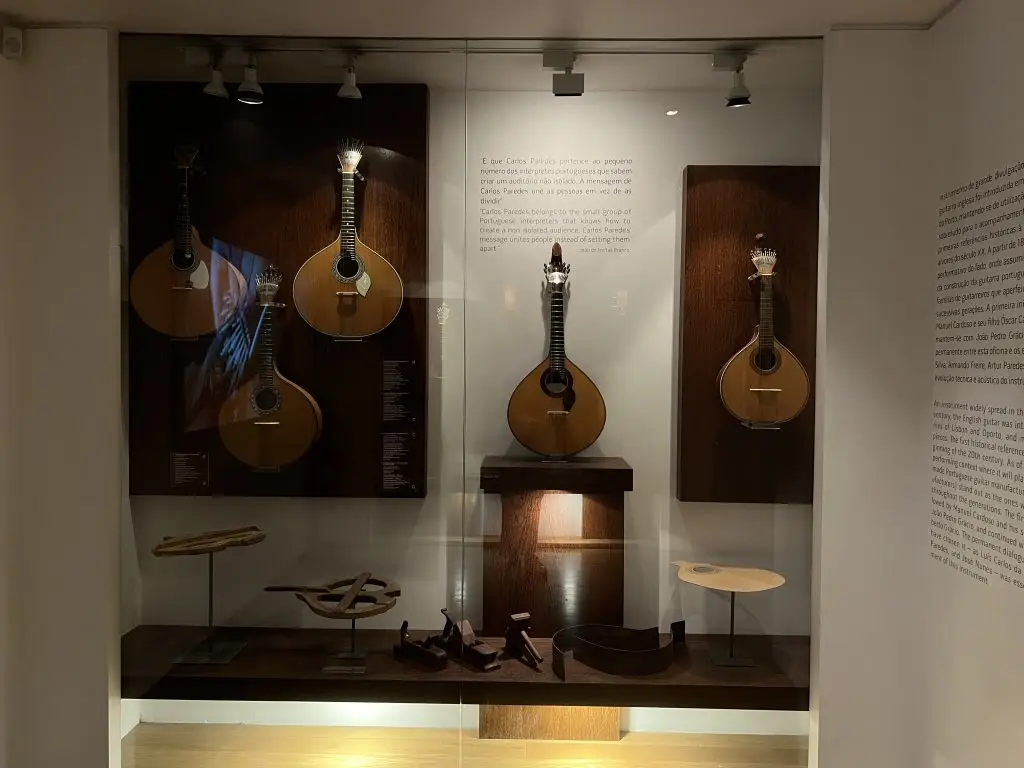
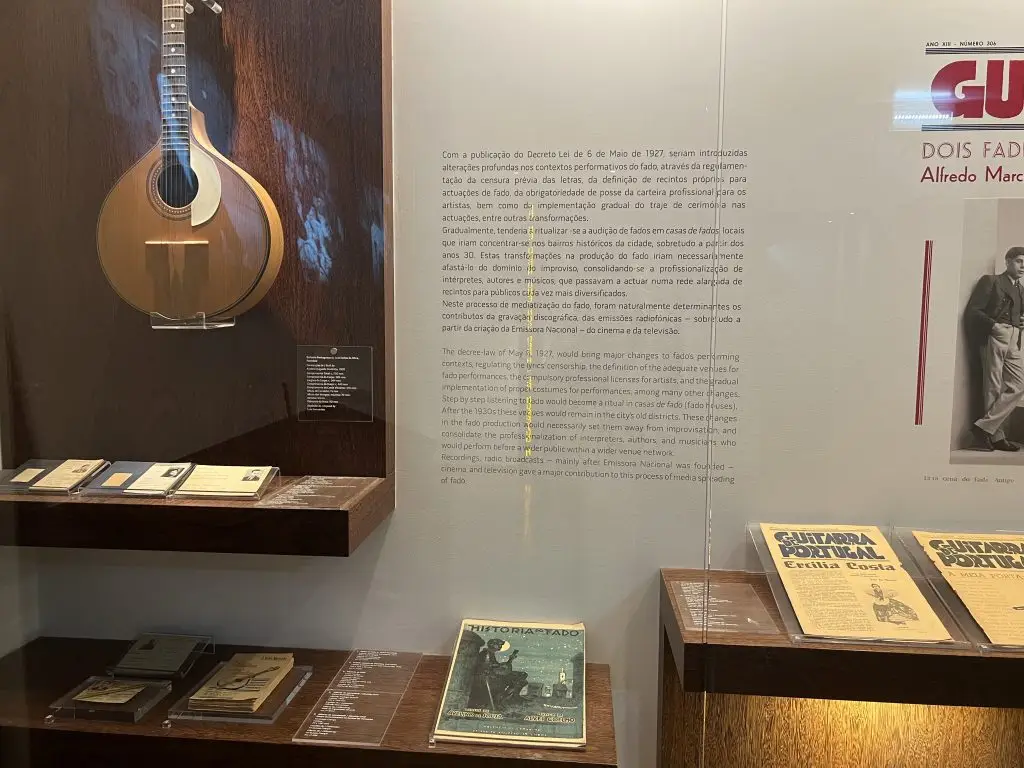
Fado is not just music. It’s a mutli-layered cultural phenomenon that’s fading lines between disciplinaries of arts. It unites elements of theatre, dance, poetry and philosophy.
“One of the ideas in the safeguarding plan was precisely to explore this ability of Fado to dialogue with multiple arts and domains: with visual arts, with the cinema, with the theater, with graphic, everything. It’s much more complex than we could suppose.“
Sara Pereira
Putting together the diversity of fado
Putting this complexity into exhibitions is what the Fado Museum is continously working on for the alternating temporary exhibitions.
Question & Answer
How do you curate an exhibition, Sara Pereira?
“I’m bringing together all the information available about that subject and publishing the catalogue as exhaustive as we could at that time. So, our idea was to start building knowledge about Fado, about this patrimony and about its importance throughout our history. And to also put it in relation with all the different artistical domains. Sometimes we also have celebrations of anniversarys. In partnership with the cultural government, we made an exhibition for the 100 years of work by Carlos Paredes.”
To explain everything to the visitors, there is are well-educated experts at the museum. They give guided tours through the exhibition and are available for any questions the visitors might have.
“The mediation team has the role of making that bridge between the contents of the exhibition and the public. Because it’s very difficult for one exhibition to reach all kinds of public. We have young people, we have older people, we have people who know deeply everything about Amália. And we have another visitor who knows nothing.” (S. Pereira)
Question & Answer
As the museum’s director, how do you find the balance between the people passionate about Fado and the tourists that don’t have any background knowledge?
“It’s a big challenge for all of us, for everyone who works in a museum and specifically in this one. Because for instance Amália, well… every Portuguese knows Amália and for us it’s a bit obvious. And then we invite curators, who know a lot about one subject. And they can write a lot and are excited to explain and to transmit everything. And that can also be a challenge because our visitors – they are not willing to read a lot.”
The planning of the exhibitions takes much time. Therefore, Sara Pereira and her team have to work with one or two years of anticipation. This is also important in terms of collaborating with other cultural institutions that plan their schedule years ahead. For instance, when it comes to organizing Fado concerts, the museum works together with the big venue Centro Cultural de Belém, as Sara Pereira explains. “All that program has to be defined one year in advance.”
Question & Answer
Sara Pereira, is it right that with the exhibitions you give voice to artists of the past and with the concerts to artists of the present?
“Yes. And we have even curated exhibitions with the participation of artists, of living artists. (…) I think this work of giving voice to them is one of the main objectives of the museum. To work together with the community, helping them.”
The museum enriches the heritage of Fado
In 2025, the Fado museum started organizing and recording videos under the theme Gesto do Fado (“Fado Gesture”) – a project presented by the association Access Lab. The museum already collaborated with Access Lab before, as they sometimes included a translation to Portuguese gesture language in the concerts. The new project should bring fado even closer to the deaf community.
“It’s a beautiful project. And for all of us it was also a learning process because – I also had that misperception that deaf people can’t listen to music. It’s totally wrong. They can feel it, and they deeply appreciate it. So, all the work in process until we reach the final videos is wonderful. All the elements, they come here, they choose the lyrics first, they work on the choreography.”
Sara Pereira
In the first phase of the project, they recorded videos with well-known fadistas, like Ricardo Ribeiro and Camané. Right next to the singers there are artists presenting the same lyrics in gesture language. Sara Pereira points out the great and empowering impact of this project. Together with the fadista, “at the same stage there is a deaf interpreter with the exact same importance – it’s very beautiful to give them that empowerment.”
Fado gains value, and so the museum gets bigger
The perception and experience of fado is evolving and so is the Fado museum. The current rooms have gotten too small to present all information and artworks that deserve to be seen by the public.
In 2026, there will be construction works to make the exhibition space bigger: The offices of the museum’s staff, the museum shop and services will be relocated to another building. The new museum will honor the UNESCO world heritage of Fado to an even greater extent.
“We want to incorporate more information about Amália, more information about Carlos do Carmo, more objects, more collections. More works of art, if possible.”
Sara Pereira
A new permanent exhibition will be created – and this shows once again that everything is changing. In all the past centuries Fado has travelled across continents and has undergone cultural and social influences. Let’s see it this way: With time, with all the changes that happened in the past and those about to happen in the future, this living cultural heritage gets richer and richer. Day by day. Song by song.
- Hoyt, S. (2019). Rui Vieira Nery interviewed by Satch Hoyt, Lisbon, 2019. In Afro-Sonic Mapping. Retrieved from https://afrosonicmapping.com/rui-vieira-nery-interview/ ↩︎
- Quotes from my Interview with Sara Pereira on 23rd October 2025 in Lisbon ↩︎